

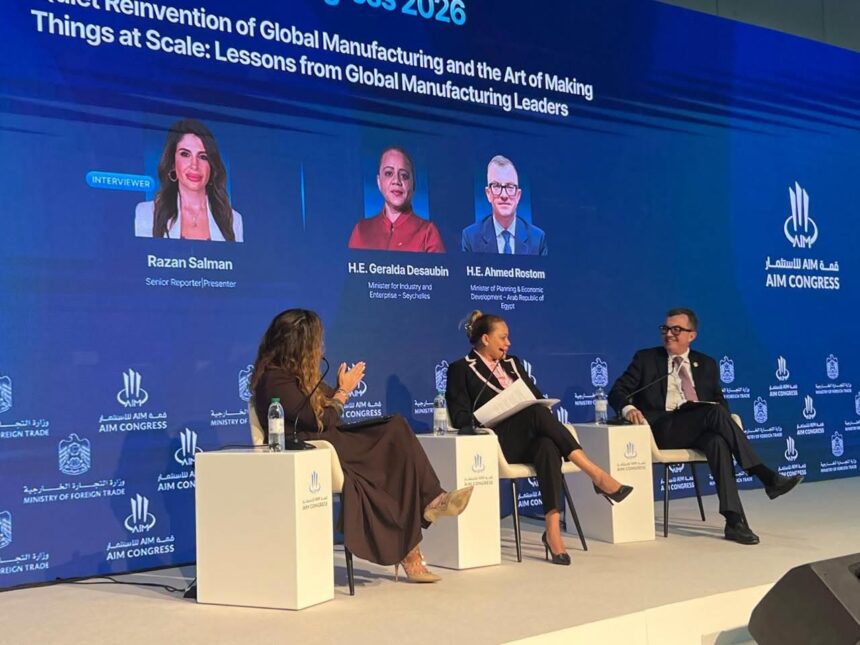
Ahmed Rostom, Minister of Planning and Economic Development, said Egypt has begun intensive work, in cooperation with the Organisation for Economic Co-operation and Development (OECD), to develop its national artificial intelligence (AI) strategy.
The strategy aims to establish a comprehensive five-year vision for expanding the responsible use of emerging technologies, raising public awareness, and unifying government standards and regulations to ensure the efficient and secure exchange of data.
Rostom made the remarks during his participation in a session on the quiet reinvention of global manufacturing and the art of production at scale, held as part of the 15th edition of the AIM Congress in Dubai. He outlined Egypt’s vision for integrating advanced technology into productive sectors and its direct impact on the national economy.
During the session, Rostom also revealed that Egypt’s manufacturing sector has continued to record positive growth rates for more than 19 consecutive periods. He noted that the sector contributed around 1.1% to the overall economic growth rate of 5.1% recorded during FY 2025/2026.
He added that the textiles, automotive and value-added services sectors offer promising investment opportunities to strengthen Egypt’s domestic manufacturing base and attract foreign investment.
The Minister of Planning and Economic Development also stressed the need to establish regulatory frameworks that ensure transparency and accountability while mitigating cybersecurity risks resulting from autonomous interactions between algorithms.
He stressed that integrating AI into production must go hand in hand with reskilling the workforce, noting that the objective is not to replace humans with machines, but rather to empower people to supervise and control them.
Rostom also called for increased investment in science and technology programmes at universities to ensure that such knowledge reaches less-privileged groups. He warned that neglecting the human element could turn the “digital divide” into a structural crisis in future employment opportunities.


