Agricultural officials and plant health experts from across the Middle East and North Africa are meeting in Cairo to strengthen regional cooperation against transboundary pests and diseases, as climate change, water scarcity and geopolitical disruptions increase risks to food production and trade.
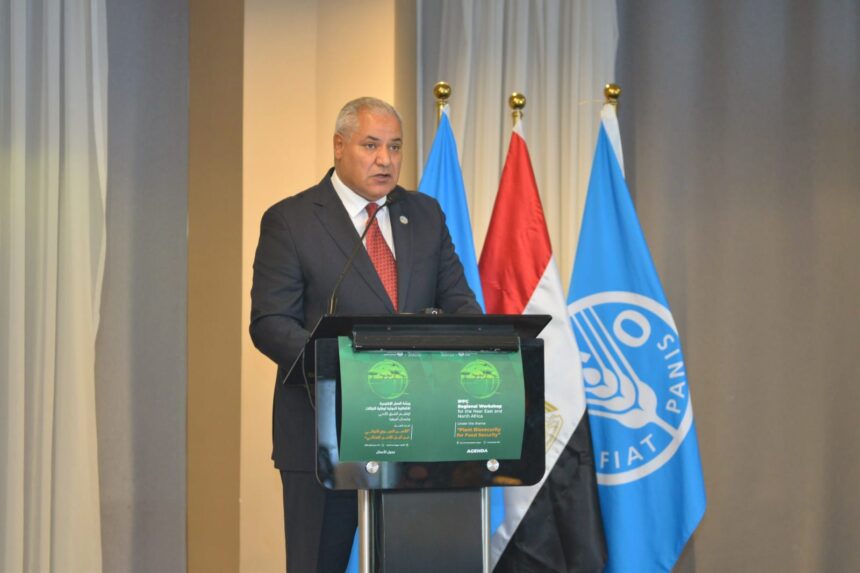
The four-day regional workshop of the International Plant Protection Convention (IPPC), held under the theme “Plant Biosecurity for Food Security,” brings together the Food and Agriculture Organization (FAO), the IPPC Secretariat, the Near East Plant Protection Organization (NEPPO) and agricultural authorities from across the region.
In his address, Egyptian Minister of Agriculture and Land Reclamation Alaa Farouk said plant health represents the first line of defence for food security, particularly as climate change and expanding international trade increase the risks posed by transboundary pests.
Farouk outlined four priorities for regional action: harmonising positions on International Standards for Phytosanitary Measures (ISPMs), accelerating digital transformation to facilitate safe agricultural trade, promoting environmentally friendly pest-control and integrated pest-management solutions, and strengthening institutional capacity and phytosanitary assessment systems.
He also highlighted the Central Administration of Plant Quarantine (CAPQ) as a cornerstone of Egypt’s agricultural export system, stressing the importance of modern quality and phytosanitary standards to protect crops and expand access to international markets.
FAO Assistant Director-General and Regional Representative for the Near East and North Africa AbdulHakim Elwaer told Daily News Egypt that plant diseases and pests are among the major threats to agricultural productivity, with between 20% and 40% of agricultural production lost to pests and diseases.
“Our region can no longer afford to treat every transboundary pest as an isolated crisis or temporary emergency,” Elwaer said, calling for a shift from responding after damage occurs to prevention and preparedness.
He affirmed the need for sustained cooperation among Arab and regional countries, saying the Cairo workshop provides a platform for FAO, IPPC, NEPPO and national authorities to exchange expertise and coordinate responses to plant health threats.
Elwaer also pointed to climate change, drought and water scarcity as mounting pressures on agricultural production, while geopolitical tensions are increasing the cost of producing and transporting food.
“Every agricultural product must be protected from pests and diseases,” he said, highlighting the importance of plant protection for countries seeking to safeguard food supplies while expanding agricultural exports.
He noted that Egypt’s focus on agricultural exports to European markets makes effective plant protection particularly important given strict food safety and phytosanitary requirements imposed by importing markets.
Stronger quarantine systems can help protect agricultural resources and ensure exports meet international standards while supporting farmers and producing communities, he added.
Elwaer said disruptions to global supply chains had compounded existing food-security challenges, pointing to the COVID-19 pandemic, the Russia-Ukraine war and instability along major maritime routes.
The Black Sea conflict has affected a major food-supply corridor for Arab countries that depend heavily on imports, while higher shipping and insurance costs have added pressure to food markets, he said.
He also pointed to instability around the Red Sea and Bab el-Mandeb and its impact on fertiliser and other agricultural inputs.
Elwaer said the latest FAO food price index showed the combined food basket rising by 2.2% from the previous month, with commodities including wheat affected by geopolitical volatility and maritime transport disruptions.
Such shocks could feed into local markets over the following three to six months unless countries use strategic reserves and other measures to cushion their impact, he warned.
Also, Mubarak Hamdan, Sudan’s representative at the workshop told DNE that Sudan was actively participating in discussions aimed at combating transboundary pests and reviewing draft international phytosanitary standards.
He described the workshop as an important opportunity for countries to exchange scientific expertise and strengthen cooperation under international and regional plant-protection frameworks.
Hamdan highlighted the technical and financial assistance provided by regional and international organisations to member states, noting that Sudan had benefited from such support and related projects.
He called for closer coordination among Arab countries and neighbouring states to improve the region’s ability to prevent and control pest outbreaks.
In turn, Mohamed El-Habib Ben Jamâa, Executive Secretary of NEPPO, said the workshop was focused on updating the organisation’s strategy and identifying emerging challenges that will require new policies and approaches.
Speaking to DNE, Ben Jamâa stressed the importance of developing a forward-looking regional strategy to address future plant-health risks and strengthen countries’ capacity to respond collectively.
Amjad El-Kahky, an FAO agricultural officer speaking on behalf of the IPPC Secretariat and FAO headquarters in Rome, highlighted the role of digital tools such as the ePhyto system in facilitating secure and efficient agricultural trade while strengthening phytosanitary controls.
The Cairo workshop is scheduled to continue through Sept. 10, bringing together regional experts to discuss plant biosecurity, agricultural trade, pest management and measures to protect food production from emerging threats.