

Sudan’s state leadership is attempting to rewrite the country’s political future while fighting to secure its most critical economic and logistical arteries.
In a dual offensive intended to consolidate control, Sovereign Council Head Abdel Fattah al-Burhan announced the launch of a comprehensive national dialogue that explicitly bars the rival Rapid Support Forces (RSF) from returning to power, just as the armed forces mobilise to reclaim strategic border towns and reopen vital commercial trade routes linking the country’s west to the capital.
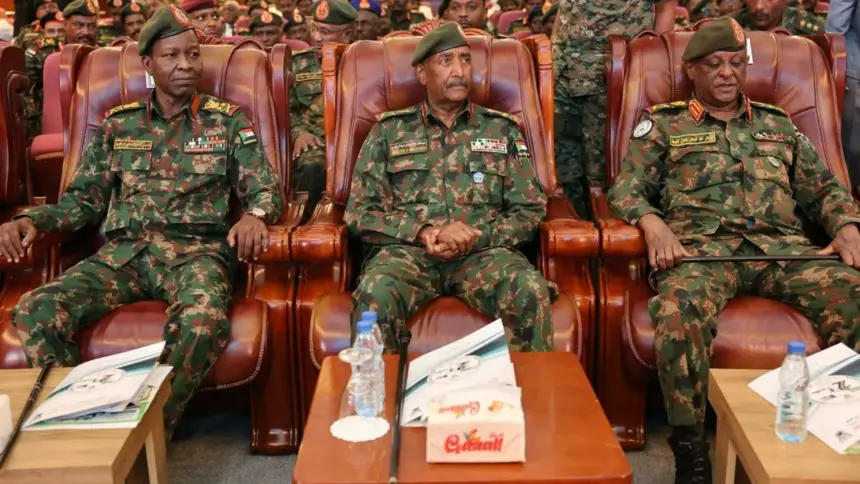
Speaking on the 72nd anniversary of the Sudanese Armed Forces, Burhan outlined a political transition plan driven by an independent national mechanism. The initiative marks a concerted effort by the Sovereign Council to establish a civilian governance framework on its own terms, while definitively shutting the door on its paramilitary rivals following more than a year of devastating conflict.
“We will not accept a peace that returns the leaders of the Rapid Support Forces to power,” Burhan stated, characterising the rival commanders as criminals and murderers. He stressed that any path to peace must begin with a cessation of hostilities, the laying down of weapons, and the restoration of state security and services.
A Calculated Political Opening
The proposed dialogue, according to Burhan, is an independent initiative brought forward by a national group of Sudanese citizens. He stated that the government will not manage the process, dictate its agenda, or determine its outcomes. Instead, the state’s role will be limited to providing logistical, political, and security support.
To encourage participation, the Sovereign Council head offered sweeping legal guarantees. Participants will be granted “temporary procedural immunity” from existing criminal proceedings to facilitate their involvement, though Burhan clarified this does not constitute a permanent amnesty or a final dismissal of legal accountability. However, participants will receive permanent immunity for any opinions or proposals expressed during the dialogue sessions, shielding them from future criminal, civil, or administrative retaliation.
The ultimate objective, Burhan noted, is to reach a national consensus that leads to stability and the completion of state governance institutions, specifically citing the formation of a legislative council as a constitutional necessity.
The Battle for Economic Arteries
As the state sets its political parameters, intense fighting is redefining the map of control over Sudan’s primary trade corridors. The city of El Obeid, the capital of North Kordofan State, has returned to the forefront of the conflict, reflecting an escalating battle over the country’s commercial geography.
El Obeid serves as the indispensable logistical and commercial bridge connecting western and central Sudan. On Friday morning, the RSF—bolstered by reinforcements from neighbouring West Kordofan—launched a major assault on advanced army defences south of the city, sparking fierce clashes in the areas of Um Arda, Jebel Al-Hashaba, and Al-Ban Jadid.
The Sudanese Armed Forces successfully repelled the advance, according to military statements, containing the RSF’s push just a day after thwarting another attack on the Al-Ayara area to the southwest. The successful defence of El Obeid follows a broader military expansion in North Kordofan, with the army seizing control of the Kajmar and Al-Mazroub areas after defeating an RSF assault on Jabrat al-Sheikh on Thursday.
The tactical victories in North Kordofan have yielded immediate economic dividends. Recognising the shift in momentum, the Khartoum State Security Committee cancelled emergency orders that had previously restricted the movement of goods. Authorities announced the reopening of the crucial export road linking Khartoum, El Obeid, and Bara to commercial traffic, a critical lifeline for merchants and civilians alike.
However, the human cost surrounding these logistical hubs remains severe. El Obeid currently hosts more than 1.2 million displaced people who have fled conflict zones across Darfur and Kordofan. These populations face mounting risks as fighting encroaches; on Wednesday, a drone attack attributed to the RSF struck the city, resulting in civilian casualties, according to the Sudan Doctors Network.
Securing the Borderlands
Simultaneously, the military is shifting its focus to the country’s southeastern periphery to secure lucrative border territories. In the Blue Nile region, the armed forces are massing outside the strategic city of Kurmuk, preparing to launch an offensive to wrest control from the RSF.
The buildup comes roughly 48 hours after the RSF declared it had seized Kurmuk, a city of immense strategic value due to its proximity to the Ethiopian border. The RSF and its allied militias initially advanced into the area in March, prompting the Sudanese army to launch a gradual, methodical counter-offensive. In recent months, the military has successfully recaptured the surrounding areas of Magja, Sharkam, Al-Baraka, Khor Hassan, and Al-Kaili, setting the stage for the imminent battle over Kurmuk itself.
The dual fronts—from the commercial crossroads of El Obeid to the borderlands of Kurmuk—highlight a strategy focused not just on territorial gains, but on securing the economic infrastructure required to govern, even as Burhan pitches a new political reality for a fractured nation.


