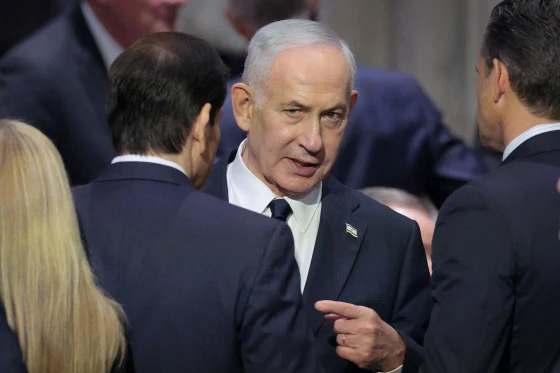
Mere hours before Israeli Prime Minister Benjamin Netanyahu’s meeting with US President Donald Trump in Washington, former Israeli Defence Minister Yoav Gallant delivered a sharp and startling interpretation of the direct reason behind the failure of the war on Iran to achieve its objectives. He stated: “The greatest error was in the choice of the strategic objective… Israel ought to have gone to war with a single aim—the elimination of the nuclear programme and the fissile materials. Yet Netanyahu presented Trump with an illusory plan for the destruction and overthrow of the regime.”
The gravity of this statement—or, more accurately, this confession—lies not merely in its attribution of failure to Netanyahu, but in the fact that it fundamentally alters the entire perception of the military campaign. Moreover, it was uttered by the highest military authority at the time of the Gaza war. It also widens the already unprecedented rift between Trump and Netanyahu.
The agenda of the meeting is laden with unresolved and highly contentious files: the confrontation with Tehran, which Netanyahu continues to regard as sufficient to secure his hold on power despite opposition from Israel’s military leadership; the future of negotiations with Lebanon; and, finally, American promises to allow Saudi Arabia to develop a peaceful nuclear programme—an issue that further complicates an already ambiguous regional landscape.
Yet the security file and regional arrangements clearly dominate the agenda of the talks between Trump and Netanyahu. The American administration seeks to recalibrate the regional rhythm and consolidate a measure of stability that safeguards its interests and freedom of navigation, while Netanyahu endeavours to integrate Tel Aviv into this new architecture and to prevent any understandings that might constrain Israel’s future freedom of military action in the region.
To date, the Islamabad negotiations constitute a fundamental point of divergence between the two traditional allies. A prevailing anger within political and security circles in Tel Aviv reflects a genuine sense of direct marginalisation. Although this exclusion was dictated by the complex diplomatic nature of dealings with Tehran—which required intermediary and mutually acceptable parties to reach initial understandings—Tel Aviv perceives its isolation from the negotiating table as the beginning of its exclusion from any future political and security arrangements in the region that would not fully serve its priorities.
It appears, however, that Trump has decided to proceed with punishing Netanyahu for having dragged the United States into the war—a charge later confirmed by Gallant’s admissions. This was manifested in the decision to sell F 35 aircraft to Turkey, a move that would erode Israel’s qualitative aerial superiority in the region. Nor was that all: an agreement was signed concerning a civilian nuclear programme with Saudi Arabia. Originally, such a programme was intended to serve as one of Washington’s principal incentives to draw Riyadh into a normalisation agreement with Israel.
An impression prevails in Israeli circles that the Trump administration is growing impatient with Netanyahu’s attempts to impose his military agenda and escalate the cost of American entanglement in the region. Trump, who presents himself as a deal maker who ends conflicts rather than exhausting American power, is now handling regional tracks according to Washington’s direct strategic calculations. This has produced a state of political estrangement between the two allies.

Nevertheless, the security partnership between Washington and Tel Aviv remains a fundamental pillar that cannot be entirely disregarded. Israeli pressure is currently concentrated on the Trump administration to ensure that the final arrangements proposed—whether in Islamabad or elsewhere—do not result in a weakening of deterrent capacity or the granting of unreciprocated concessions to Tehran and its regional allies.
Meanwhile, as the war with Iran enters its fifth month with no prospect of resolution, and as the midterm congressional elections approach, pressure from the anti open ended war current within the administration and among the American public is intensifying.
Steve Bannon, the veteran adviser and one of the president’s closest associates, launched a fierce attack on Netanyahu, declaring: “Netanyahu has dragged us into a dreadful conflict filled with lies. People can see with their own eyes what is happening.”
This caustic criticism reflects the widening fissure within the American conservative alliance. Time is running short for the Trump administration ahead of the midterm elections, and there is growing fear of the disastrous consequences this war may have on Republican prospects.
The foregoing is by no means Netanyahu’s final crisis. He stands approximately three months away from elections that will determine his political fate. According to a poll conducted by the newspaper Maariv, the Likud party would win only 20 seats. The recent rise in the polls of former Chief of Staff Gadi Eisenkot and his party—who clearly outpaces Likud and Netanyahu—represents the gravest threat to Netanyahu’s survival in power. Washington is fully aware of this development and regards Eisenkot as a more balanced military and political figure, better equipped to align with the American vision of de escalation and regional security arrangements.
Consequently, Netanyahu’s traditional escape route remains the push to expand the confrontation with Iran. He is gambling that drawing the United States into new strikes or confrontations with Iran may once again scramble the cards and compel Trump to return to square one—thereby offering Netanyahu a domestic lifeline to boost his popularity and postpone the reckoning of political collapse.
In reality, however, the picture is entirely different. Washington has already bypassed its Israeli ally at critical junctures, most notably the recent negotiating track with Tehran under Pakistani auspices. The exclusion of Tel Aviv from the table of these understandings has demonstrated that the American administration places its own interests and regional understandings above Israeli preferences, thereby breaking the old rules of the relationship and formally announcing the end of the era of absolute harmony.
Indeed, it may be said that the phase of absolute concordance and unconditional alliance between the two sides has ended. The present situation confirms that Trump’s pragmatic interests are now colliding directly with Netanyahu’s existential choices, rendering any return to the previous concord highly improbable under current circumstances.
There is little doubt that the Trump–Netanyahu meeting will reflect a sharp intersection between the American president’s desire to close the confrontation file according to his vision of the “grand bargain,” and Netanyahu’s efforts to circumvent the path of marginalisation so that the new security architecture of the Middle East is not shaped far from the Israeli table.
The prevailing expectation is that the meeting will yield no tangible breakthroughs capable of narrowing the gaps between them; rather, it may well turn into a disciplinary session for the Israeli prime minister, who has come to Washington as a supplicant, searching for an exit that might yet rescue a political career on the brink of catastrophe.
Professor Hatem Sadek, Helwan University