

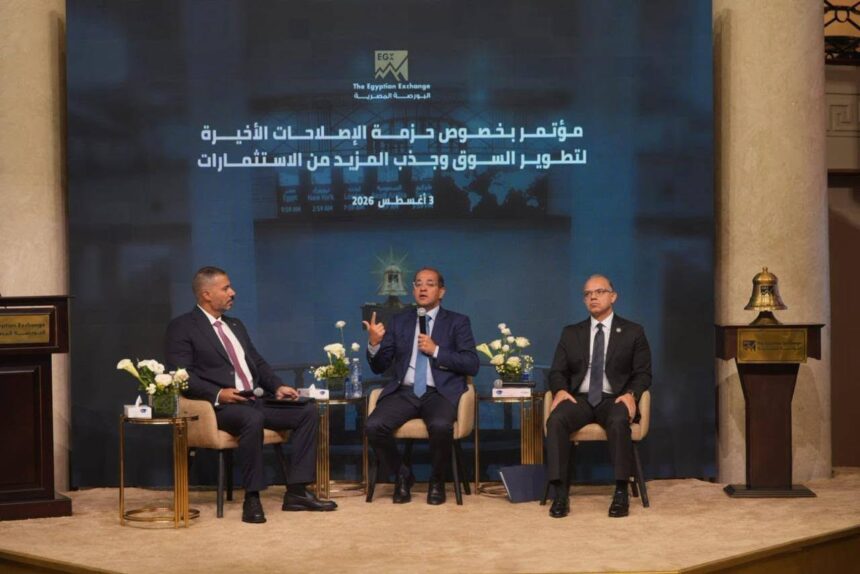
Minister of Finance Ahmed Kouchouk said the government’s new tax facilitation package will benefit all taxpayers, stressing that the measures were developed through extensive consultations with market participants, the private sector, and tax specialists based on a partnership built on trust.
Speaking at an investor conference organised by the Egyptian Exchange (EGX), Kouchouk said the government is committed to providing strong support for the capital market, attracting large and influential companies to list on the exchange, and helping businesses expand through easier access to financing.
He announced that companies listing on the Egyptian Exchange will receive an investment incentive equivalent to a 15% deduction from the tax due, as declared in their tax returns, for three years, in a move aimed at encouraging more major companies to go public.
Kouchouk also said the government has replaced the capital gains tax with a stamp duty to reduce tax burdens and encourage investment and trading on the Egyptian Exchange. He noted that the stamp duty for non-resident investors has been reduced to 0.5 per mille from 1.25 per mille, ensuring equal treatment for resident and non-resident investors.
He added that the government is encouraged by the recent increase in the volume and value of daily trading on the Egyptian Exchange, noting that market makers have also been exempted from stamp duty on the purchase and sale of listed securities to support market-making activities and enhance market liquidity.
Kouchouk said the government views the capital market as a key pillar of economic growth and investment financing, with efforts focused on simplifying tax procedures, reducing business costs, increasing market liquidity, and attracting more local and foreign investors. He added that reforms are also aimed at strengthening the Egyptian Exchange’s role in mobilising savings and financing economic development.
The minister stressed that the private sector remains the main engine of economic growth, reaffirming the government’s commitment to preserving macroeconomic stability while expanding the private sector’s contribution to investment and economic activity.
He revealed that the government is preparing a new package of facilitation measures designed to further enhance the competitiveness of the Egyptian economy and improve the business environment.
Kouchouk also reaffirmed the government’s commitment to continuing its economic reform programme and strengthening Egypt’s attractiveness as an investment destination by advancing structural reforms that support the investment climate and boost industrial and services production and exports.
The Ministry of Finance, he said, manages the state’s public finances from the broader perspective of supporting economic growth, adding that “revenues will come as investment increases and the private sector expands.”
Kouchouk said Egypt’s economic indicators remain reassuring as a result of the reforms implemented over the past year, faster decision-making, and greater consistency in government policies. He noted that the private sector is now leading economic growth, with private investment accounting for 60% of total implemented investments. He also highlighted strong performance in the industrial, tourism, communications, and information technology sectors, while foreign direct investment exceeded $13bn between July 2025 and March 2026.


