

Egypt launched its 2026-2027 water year on Saturday after implementing a wide-ranging programme to modernise water management, including major projects for agricultural drainage water reuse, infrastructure rehabilitation, digital transformation, and protection against floods and coastal erosion, the Ministry of Water Resources and Irrigation said.
The ministry said it had intensified preparations for the summer peak-demand season to ensure adequate water supplies for agriculture, drinking water and other sectors through close monitoring of Nile inflows, water releases, and the operational readiness of canals, drains, pumping stations and hydraulic structures.
According to the ministry, these measures helped resolve water distribution challenges at several locations, including pumping stations in Wadi El-Naqra in Kom Ombo, Aswan, as well as along the Suez, Port Said and El-Nasr canals.
The ministry said it is implementing its second-generation Water 2.0 programme, which is built around 10 strategic pillars, including water treatment and reuse, smart water management, digital transformation, infrastructure rehabilitation, climate adaptation, governance and institutional development.
As part of its water reuse strategy, construction of the agricultural drainage water conveyance system serving the New Delta wastewater treatment plant has reached 79% completion. The project includes 13 pumping stations and a 174-km conveyance network designed to support the reclamation of around 362,000 feddans.
Meanwhile, two water conveyance routes linking the Bahr El-Baqar wastewater treatment plant with reclamation areas in northern and central Sinai are about 89% complete. The 105-km system includes 18 pumping stations and is expected to provide irrigation water for approximately 456,000 feddans.
The ministry said it is expanding the use of satellite imagery, drones, artificial intelligence and machine learning to detect encroachments on waterways, monitor canal maintenance, track shoreline retreat, assess urban expansion and evaluate lake water quality.
It is also developing a digital twin of the Ismailia Canal that will enable officials to monitor operational conditions in real time and simulate different management scenarios before implementation. The system will be integrated with a telemetry network providing live data and will include tools to monitor aquatic weeds, water distribution and the performance of hydraulic control structures.
As part of its digital transformation programme, the ministry has completed an electronic licensing system for groundwater well drilling and developed comprehensive digital databases covering canals, drains, hydraulic structures, equipment and state-owned irrigation land. It has also digitised procedures for collecting land-use fees and other government revenues.
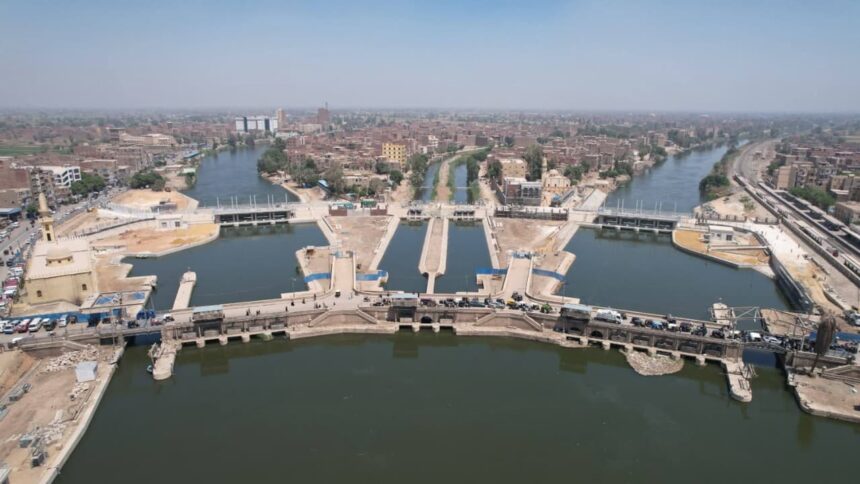
On infrastructure, the ministry said it had completed and commissioned the new Dairut Barrages while continuing to modernise gate operating systems at several barrages and navigation locks.
Work is also under way to increase the discharge capacity of the Toshka spillway and channel to strengthen the operational resilience of the Aswan High Dam system.
The ministry said it had assessed 55,998 water structures nationwide, contracted the replacement of 508 structures and continued procurement procedures for hundreds more requiring rehabilitation or replacement.
During the previous water year, the ministry cleared around 33,000 km of irrigation canals and 22,000 km of agricultural drains, while replacing subsurface drainage networks serving approximately 67,000 feddans.
Work also continued on the Siwa Oasis irrigation and drainage improvement project, including the closure of highly saline shallow wells, the drilling of deep groundwater wells, and the construction of pumping stations and irrigation networks aimed at restoring the oasis’s environmental balance.
The ministry said it had implemented or continued flood protection projects across the Red Sea, North Sinai, South Sinai, Matrouh, Cairo, Giza, Beni Suef, Minya, Assiut, Qena, Luxor, and Aswan governorates.
Ahead of the rainy season, it is clearing 117 flood channels with a combined length of 318 km, while emergency response centres and the ministry’s flood forecasting centre continue operating around the clock.
Coastal protection projects are also progressing in Alexandria, Damietta, Matrouh and Kafr El-Sheikh, including works to protect roads and infrastructure, restore sandy beaches and safeguard low-lying coastal areas against erosion and rising sea levels.
Under a national Nile River regulation programme, authorities removed 838 illegal structures and 45 cases of unlawful land filling covering around 36,000 square metres. The programme also includes the production of digital topographic and bathymetric maps of the Nile and the survey of state-owned riverbank land across 16 governorates.
In workforce development, the ministry organised 400 training programmes for around 9,500 participants, in addition to 31 programmes attended by 688 trainees from Egypt and 25 African, Arab and Asian countries.
It is also preparing a new generation of engineers to lead the Water 2.0 programme and is working with Italian partners to establish five Egyptian-Italian water technology schools to better align technical education with labour market needs in the water sector.
Internationally, the ministry said it continued implementing water projects and capacity-building programmes across Africa, while participating in global water and climate forums and hosting the eighth Cairo Water Week in October 2025.
Looking ahead, the ministry said priorities for the 2026-2027 water year include improving water distribution efficiency, accelerating digital transformation, strengthening climate resilience and ensuring sustainable water supplies amid growing demand, limited water resources and continued population growth.


