

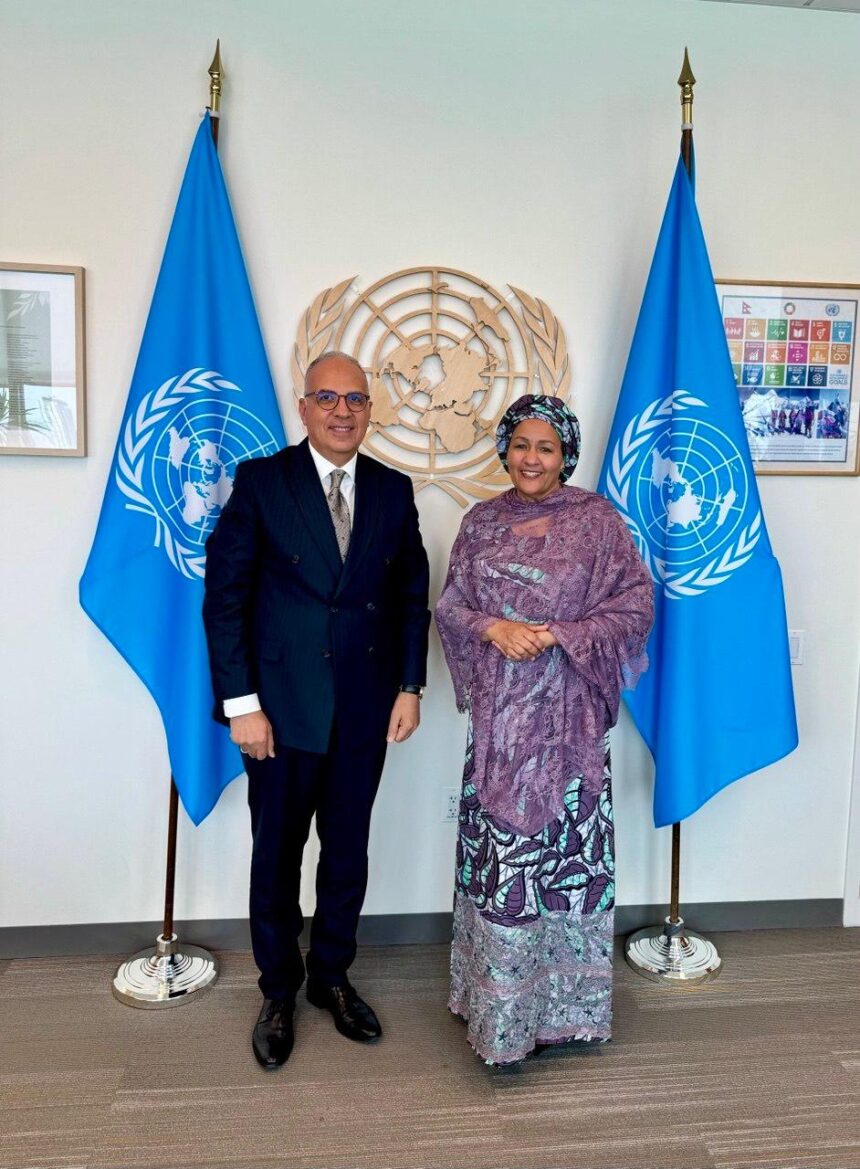
Egyptian Minister of Water Resources and Irrigation Hani Sewilam held a series of high-level meetings on the sidelines of the UN High-level Political Forum on Sustainable Development to advance preparations for the 2026 UN Water Conference and promote stronger global water governance.
Sewilam met UN Deputy Secretary-General Amina Mohammed, accompanied by Egypt’s Permanent Representative to the United Nations, Ambassador Ihab Awad, to discuss preparations for the conference and the future of water governance within the UN system.
The minister thanked the United Nations for its role in organizing the conference and praised Mohammed’s efforts to keep water high on the global agenda.
As co-chair of the conference’s third interactive dialogue, “Water for the Planet,” alongside Japan, Sewilam outlined the outcomes of extensive consultations with UN member states, agencies and stakeholders. He said the current phase is focused on developing flagship initiatives that are large-scale, implementable and financially viable, supported by clear resource mobilization mechanisms to ensure lasting impact.
He stressed that these initiatives should constitute the conference’s long-term implementation legacy, with the United Nations playing a central role in monitoring their execution after the event.
The meeting also explored the future of global water governance, with both sides agreeing on the need to strengthen the UN system’s role in addressing the growing interlinkages between water, sustainable development, climate action, food security, energy and regional stability.
Sewilam also called for greater coherence between the 2023, 2026 and 2028 UN Water Conferences, as well as other international water-related processes, to maintain political momentum and ensure continuity in global water action.
The discussions highlighted renewable energy-powered desalination for food production, alongside wastewater treatment and water reuse, as essential pillars of future water security strategies. Sewilam also underscored the importance of promoting innovation, reducing technology costs and linking proposed initiatives to sustainable financing mechanisms capable of turning them into practical, scalable projects.
In a separate meeting, Sewilam met German officials, whose country co-chairs the conference’s fifth interactive dialogue, “Water in Multilateral Processes,” to discuss closer coordination between the conference’s thematic dialogues.
He praised Germany’s leadership of the dialogue and highlighted the close Egyptian-German cooperation since preparations for the 2026 conference began in 2023.
Sewilam presented Egypt’s proposal to develop a roadmap for integrating water issues into the three Rio Conventions on climate change, biodiversity and desertification, describing it as one of the flagship initiatives emerging from the “Water for the Planet” dialogue. He said the proposal complements the objectives of Germany’s dialogue and called for closer cooperation in advancing the initiative.
The two sides also discussed options for strengthening global water governance beyond the 2026 conference, including preparations for the 2028 UN Water Conference, the possibility of holding regular global water conferences and mechanisms to sustain political momentum after 2026.
Sewilam also reviewed preparations for the ninth Cairo Water Week, scheduled for October, which will bring together representatives from Africa, the Arab region and the Mediterranean. He said the event would help build regional and international momentum ahead of the conference’s preparatory meeting, where dialogue co-chairs are expected to present their near-final recommendations.
Later, Sewilam participated in a ministerial preparatory meeting for the 2026 UN Water Conference hosted by the United Arab Emirates and Senegal.
Speaking in his capacity as co-chair of the “Water for the Planet” dialogue, he updated participants on the progress of preparations and efforts to develop practical outcomes that strengthen international cooperation on water.
He praised the UAE and Senegal for leading the preparatory process and commended the close coordination among the host countries, dialogue co-chairs, the conference secretariat and other stakeholders. Sewilam also welcomed the launch of a platform for flagship initiatives, describing it as an important step towards translating policy discussions into concrete, implementable actions that deliver lasting global impact.


