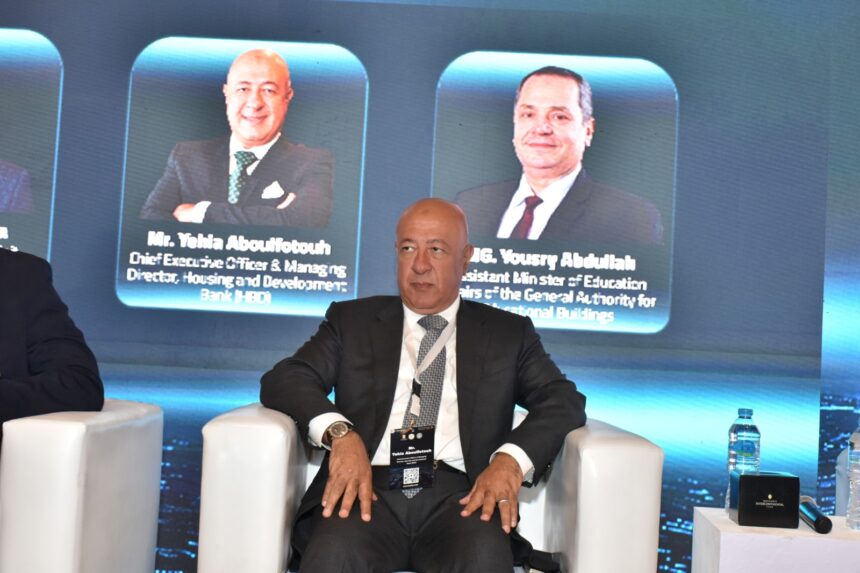
Yahia Aboul Fotouh, Chief Executive Officer of Housing and Development Bank (HDB), said the banking sector views investment in education as a cornerstone of sustainable development and human capital formation, stressing that financing education is a long-term investment that supports economic growth.
Speaking at the opening session of the fifth Annual Education Investment Summit, held under the theme “Creating an Enabling Investment Environment for the Education Sector: The State’s Role in Developing Infrastructure and Attracting Strategic Partnerships,” Aboul Fotouh highlighted the banking sector’s role in advancing Egypt’s education ecosystem.
He noted that government spending on education has exceeded 2.5% of GDP, compared with UNESCO’s recommended range of 4% to 6%, underscoring the need for continued investment to enhance educational outcomes and strengthen the country’s human capital.
Aboul Fotouh said investment in education delivers tangible economic returns, pointing to remittances from Egyptians working abroad, which are approaching $40bn, as one of the country’s most important sources of foreign currency.
He explained that these remittances are a direct result of investing in qualified professionals, including engineers, doctors, technicians, and other skilled workers, generating substantial income for the national economy with relatively low operating costs compared with many other sectors.
According to Aboul Fotouh, the banking sector supports investment in education through three main pillars.
The first is financing educational institutions by providing funding for the establishment and expansion of schools, universities, and technical and vocational education and training (TVET) institutions.
The second is direct and indirect investment through partnerships with private-sector investors to establish educational institutions. He praised the government’s strategy of linking newly established universities with leading international academic institutions to facilitate knowledge transfer and improve the quality of higher education.
The third pillar is corporate social responsibility, through which banks support underprivileged students and help finance applied and research universities, including Zewail City of Science, Technology and Innovation and Nile University, expanding access to high-quality education.
Aboul Fotouh stressed that investment in education has become increasingly important amid the rapid adoption of artificial intelligence and digital transformation, noting that banks require professionals equipped with future-ready skills. This, he said, reinforces the banking sector’s commitment to supporting education through financing, strategic investment, and corporate social responsibility initiatives.
The fifth Annual Education Investment Summit opened on Tuesday, organised by Cassy Media for the fifth consecutive year under the joint patronage of the Ministries of Finance, Investment and Foreign Trade, and Planning, Economic Development and International Cooperation, alongside the Egyptian Exchange (EGX), the General Authority for Educational Buildings, and the General Authority for Investment and Free Zones (GAFI).
The summit is supported by several leading economic and educational institutions, including e-finance, e& Egypt, and True Finance Lease as strategic sponsors, in addition to Abu Dhabi Islamic Bank Egypt, Badr University in Cairo, GIZ, the Industrial Development Bank, Classera, Tahoun Law Firm, and Khemet AI.