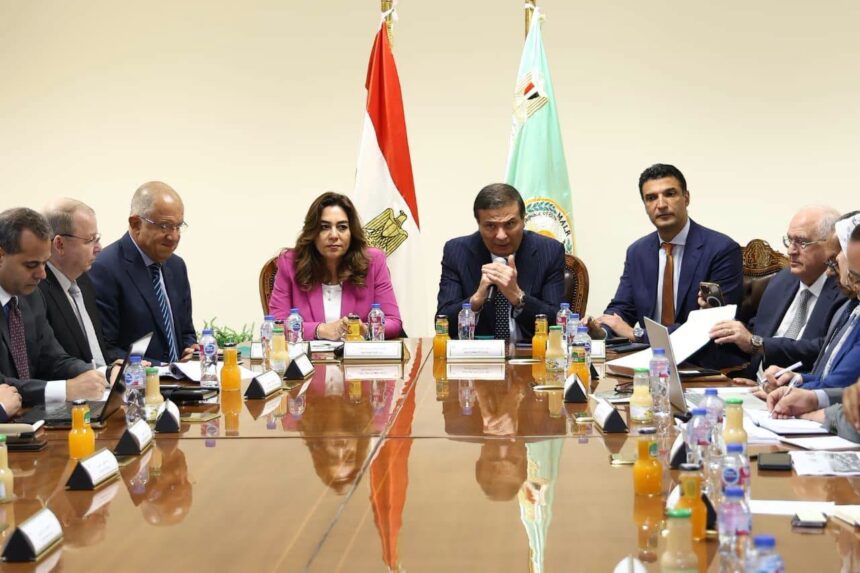
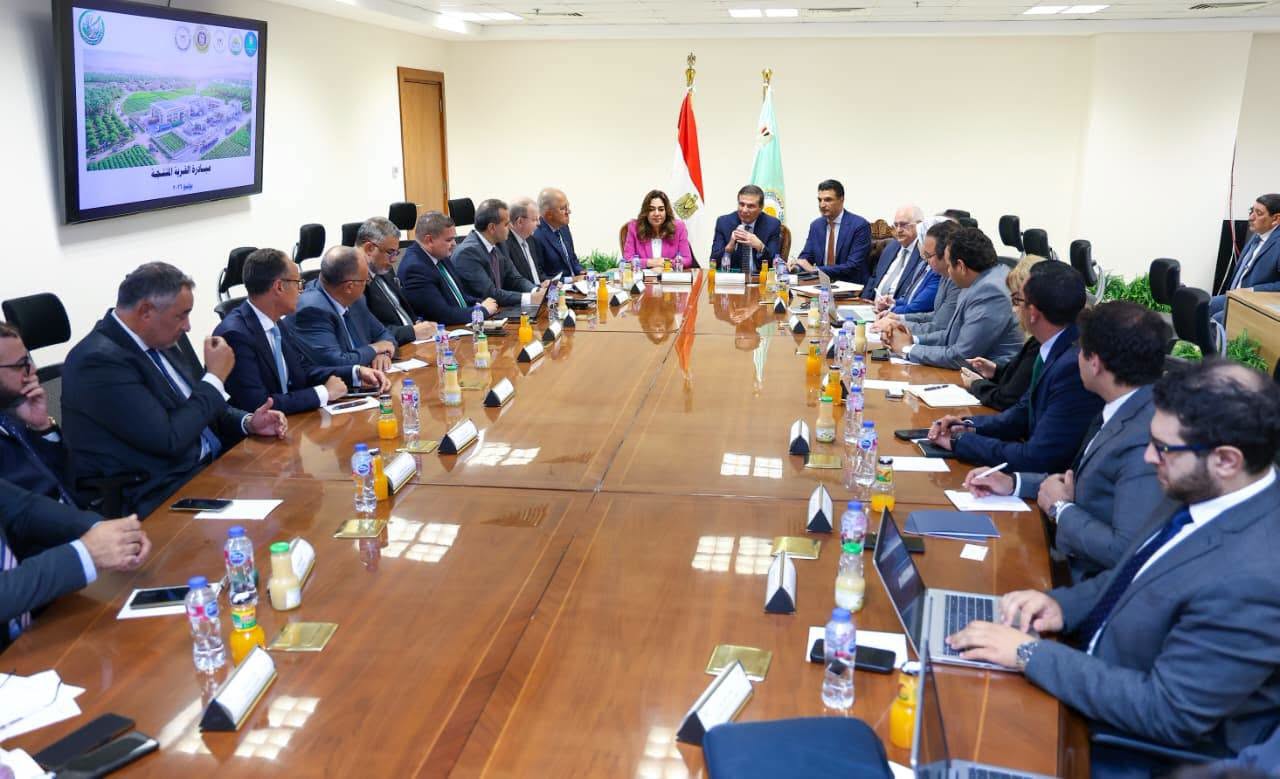
Minister of Agriculture and Land Reclamation Alaa Farouk, Minister of Local Development and Environment Manal Awad, and Minister of Industry Khaled Hashem held a meeting to review progress on the implementation of the Productive Village initiative, aimed at transforming rural communities into productive economic hubs.
The meeting forms part of efforts to implement the political leadership’s directives to economically empower rural Egypt and promote sustainable development. Participants reviewed the findings of surveys and field visits conducted by inter-ministerial teams to assess the productive potential of targeted villages and develop a clear roadmap for converting them into centres of economic activity. Discussions also covered mechanisms for establishing small-scale enterprises tailored to the characteristics and comparative advantages of each village.
The meeting was attended by Mohamed El-Sewedy, Chairperson of the Federation of Egyptian Industries, representatives from the Ministries of Planning and Economic Development, Social Solidarity, and Local Development and Environment, along with senior officials from the relevant ministries and representatives of various industrial chambers.
The ministers and officials reviewed technical reports from field visits to villages across several governorates, assessing their comparative advantages and suitability for the proposed projects. Participants agreed on the selection and classification of villages of varying sizes that possess the infrastructure, human resources and natural assets needed to accommodate small and medium-sized production units integrated into local supply chains.
The proposed projects are expected to create sustainable employment opportunities for rural residents, particularly young people and women who are the primary breadwinners, with a focus on villages included in the presidential Decent Life initiative.
Participants stressed the importance of close coordination among all stakeholders to ensure the initiative’s success. Efforts will combine infrastructure development, streamlined licensing procedures, technical support and training for farmers and artisans, environmental compliance, and the application of green and circular economy standards, alongside social protection measures and access to affordable financing through economic empowerment programmes.
Farouk said the Productive Village initiative represents a key pillar in improving living standards in rural Egypt while strengthening food security and supporting sustainable agricultural development.
He added that the ministry has coordinated with the Food and Agriculture Organization of the United Nations (FAO) to enhance cooperation, provide technical assistance, build the capacities of smallholder farmers and transfer international expertise to support the adoption of best agricultural and environmental practices in the targeted villages.
Farouk said the ministry is also working with partner ministries and the Federation of Egyptian Industries to develop productive infrastructure and strengthen agricultural value chains across governorates, particularly through expanding milk collection centres and agricultural and food processing facilities. He stressed the importance of integrating targeted villages into the formal economy and creating reliable marketing channels for rural products to provide greater stability for small producers.
He added that the financial sustainability of small economic enterprises in the villages depends largely on strategic partnerships with Egypt’s national banks. These partnerships are intended to provide highly concessional loans and flexible financing packages for small and micro-enterprises while expanding financial inclusion programmes aimed at empowering young people and rural women and overcoming financing barriers, helping transform the villages into productive centres that contribute to the national economy.
For her part, Awad said the implementation strategy should prioritise converting unused government-owned buildings and vacant state-owned land in fully serviced Decent Life villages into industrial units specialising in textile and food industries.
She noted that these villages benefit from abundant agricultural raw materials, an available workforce, existing economic activities and competitive advantages that can support sustainable job creation and improve household incomes.
Awad added that governorates will make these properties and sites available to the private sector in cooperation with the Federation of Egyptian Industries and the Ministry of Industry, with private operators responsible for managing and operating the facilities in accordance with the relevant legal procedures. A clear implementation timetable will also be established to ensure swift execution and resolve any obstacles.
She said the ministry has completed an inventory of all unused facilities and available land in the targeted governorates and Decent Life villages where infrastructure works have already been completed. Ten local village units across Lower and Upper Egypt have been selected for immediate implementation, while additional sites in other villages will be included in subsequent phases.
Hashem said the diversity of the identified land plots will support a wide range of industrial projects, including standalone factories and small industrial complexes, all of which will fall under the jurisdiction of the Industrial Development Authority.
He noted that most of the identified sites are already serviced or located close to essential utilities, while some include existing buildings that can be repurposed for industrial use. This, he said, will enable beneficiary investors to begin operations and production within a relatively short timeframe.
Hashem added that the Ministry of Industry’s recent decision to reorganise licensing procedures for establishing, managing and operating industrial activities outside designated industrial zones but within urban boundaries will facilitate licensing for these projects and help integrate productive activities in villages into the formal economy.
He also said the initiative would reduce waste in food industries by enabling agricultural produce to be processed closer to where it is grown rather than transporting it to industrial facilities in other governorates.
At the conclusion of the meeting, the ministers and officials agreed to continue the work of the joint task force comprising representatives from all relevant entities. The task force will consolidate field data, survey findings and technical outputs into a unified final report outlining the implementation plan, timetable and expected investment returns before submitting it to the Prime Minister and the political leadership for approval ahead of the launch of the implementation phase in the selected villages.