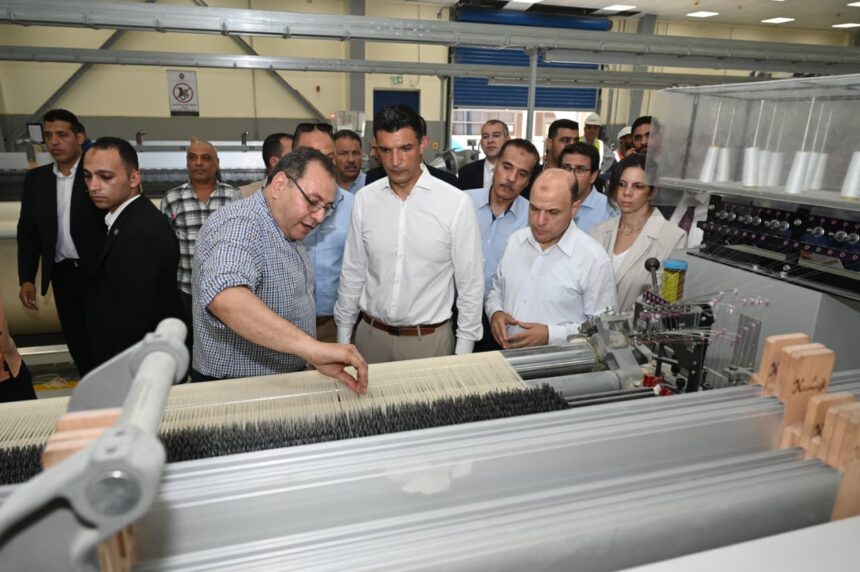
Egypt’s Minister of Industry, Khaled Hashem, began a field tour of El Mahalla El Kubra—one of the country’s largest industrial hubs—with a visit to the Misr Spinning and Weaving Company complex, reaffirming the government’s commitment to modernising the textile sector, strengthening domestic manufacturing, and increasing industrial competitiveness.
The visit forms part of a series of inspection tours of major industrial facilities across Egypt aimed at monitoring production, supporting manufacturers, removing obstacles to investment, and accelerating industrial development.
The Misr Spinning and Weaving Company spans 2.5 million square metres and is undergoing a comprehensive modernisation programme with investments totalling EGP 27bn. The company has a capital base of EGP 13.8bn and annual production capacity of 10,312 tonnes of yarn, wool products, threads and medical cotton, alongside 1.9 million garments, blankets, textile products and medical gauze bandages, in addition to 8.3 million metres of fabric.
Local content currently stands at 65%, while annual exports amount to approximately EGP 1.37bn. The company also provides around 14,000 direct and indirect job opportunities.
During the visit, Hashem toured Spinning Mill 1, built on an area of 62,000 square metres and regarded as the world’s largest spinning mill. The facility operates 182,784 spindles with a daily production capacity of 30 tonnes of fine and coarse yarn.
The minister also inspected Spinning Mill 4, which covers 24,000 square metres, operates 73,000 spindles, and produces 13 tonnes of yarn per day, in addition to visiting the company’s two preparation plants.
The tour continued with a visit to the weaving factory, which occupies more than 40,000 square metres and houses 597 weaving machines, with a daily production capacity of 136,000 metres of fabric and 32 tonnes of wool products.
Hashem also inspected the dyeing factory, built on an area of 36,500 square metres, where 105 machines are currently being installed. The facility is expected to begin operations within three months and, once fully operational, will produce 40 tonnes of wool products and 135,000 metres of fabric daily using advanced dyeing technologies.
Company officials briefed the minister on the progress of the modernisation programme, including upgrades to production lines, initiatives to improve water-use efficiency, measures to comply with international environmental standards, and plans to increase local value addition while expanding partnerships with private sector companies.
Hashem said Misr Spinning and Weaving represents far more than one of Egypt’s largest industrial enterprises, describing it as the cornerstone of the country’s textile industry and a symbol of Egypt’s industrial heritage since its establishment in 1927.
“The company is a key pillar of the comprehensive modernisation programme currently transforming Egypt’s textile sector,” he said.
He added that the company’s integrated production model—covering spinning, weaving, dyeing, finishing and garment manufacturing within a single industrial complex—strengthens domestic supply chains, reduces reliance on imported production inputs, increases the added value of Egypt’s long-staple cotton, and enhances the competitiveness of Egyptian textile products in domestic and international markets.
For his part, Gharbia Governor Alaa Abdel Maaty said the company is undergoing an unprecedented modernisation programme as part of Egypt’s national textile industry development strategy, reinforcing the country’s ambition to become a regional hub for textile and garment manufacturing.
He added that the governorate remains committed to supporting major industrial enterprises by removing investment obstacles, facilitating expansion plans, and providing a business environment that promotes production, investment, and sustainable industrial growth.