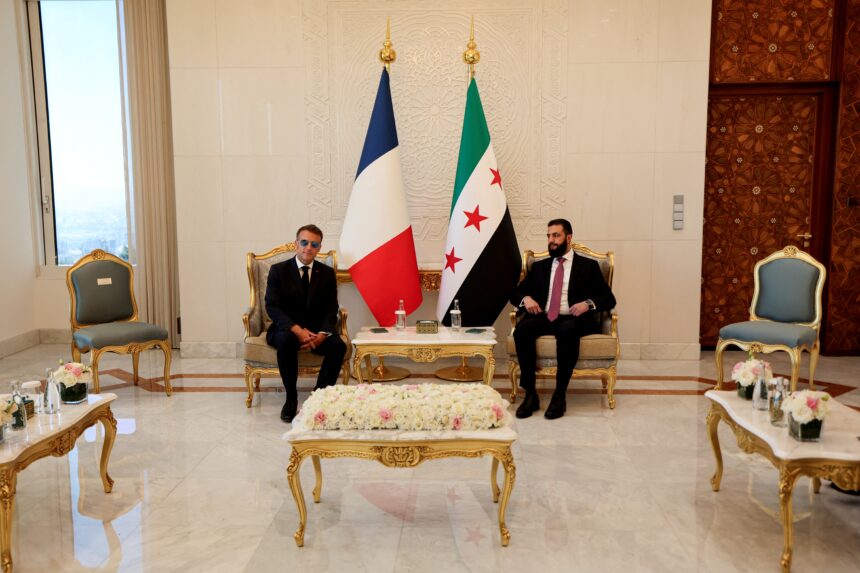
French President Emmanuel Macron and Syrian President Ahmed Al-Sharaa on Tuesday announced a strategic economic partnership to support Syria’s reconstruction, as twin explosions in Damascus briefly overshadowed Macron’s historic visit but failed to disrupt a programme focused on investment and rebuilding.
Speaking at a joint press conference in the Syrian capital, Al-Sharaa said Syria was opening its economy to foreign investors and introducing a new legal and financial framework to encourage investment.
“Those who invest in Syria early will benefit early,” he said, adding that the government was reforming the banking sector and preparing industrial cities to receive international investors. He identified ports, energy, healthcare and water infrastructure as priority areas for cooperation with France.
Macron said France and the European Union would stand by Syria throughout its reconstruction and help create the conditions for the voluntary return of refugees. He announced the establishment of joint economic committees to oversee bilateral cooperation, saying French companies were well placed to contribute to rebuilding the country.
“We want to continue working on restructuring the banking sector,” Macron said, adding that France was supporting Syria’s central bank as part of broader economic reforms.
The visit resulted in a series of commercial agreements. According to the French presidency, shipping and logistics group CMA CGM signed a partnership agreement with Syria that includes air cargo operations at Damascus International Airport. The company had already signed a contract in May to operate two inland dry ports.
The Élysée Palace also announced that France and Syria had begun the process of returning €51m in assets confiscated from Rifaat Al-Assad, the uncle of former Syrian president Bashar Al-Assad.
Meanwhile, TotalEnergies Chief Executive Patrick Pouyanné said the company would hold talks with Syrian officials on an offshore oil exploration contract in the eastern Mediterranean. The French energy group signed a memorandum of understanding with the Syrian Petroleum Company in May and has recently highlighted Syria’s potential role as an alternative transit route for Iraqi oil exports, reducing dependence on the Strait of Hormuz.
Accompanied by senior executives from TotalEnergies and CMA CGM, Macron became the first French president to visit Syria in nearly 18 years, marking a significant shift in bilateral relations following the fall of Bashar Al-Assad’s government in December 2024.
The visit was briefly overshadowed by two explosions near the Four Seasons Hotel, where Macron had spent the night. Syrian authorities said improvised explosive devices detonated near the French president’s security perimeter, injuring 18 people, including four police officers.
The Interior Ministry said security forces had detected the devices and were attempting to defuse them when they exploded. Preliminary investigations indicated that one device had been concealed inside a parked vehicle and the other inside a rubbish container.
Interior Ministry spokesperson Nour Al-Din Al-Baba said the attack was intended to undermine Syrian-French relations rather than target strategic state institutions. He added that investigators had identified promising leads and expected those responsible to be arrested soon.
The Élysée said Macron was unaware of the explosions and proceeded with his scheduled meeting with Al-Sharaa without interruption. The two leaders later oversaw the signing of several agreements, including a comprehensive cooperation framework, a strategic partnership covering maritime and air transport and logistics, and a declaration of intent on the recovery of assets linked to Rifaat Al-Assad.
The attack prompted swift regional condemnation. Saudi Arabia denounced what it described as a terrorist attack aimed at undermining Syria’s security and stability, while Qatar reaffirmed its rejection of terrorism in all forms and expressed full solidarity with Damascus.
Jordan also condemned the bombings and reiterated its support for Syria’s efforts to preserve security and stability. Egypt likewise denounced the attacks as acts of terrorism, reaffirming its rejection of all forms of violence and expressing solidarity with the Syrian government and people.
Despite the security incident, Macron’s visit proceeded as planned, underscoring France’s renewed engagement with post-Assad Syria and the new Syrian leadership’s determination to attract international investment while addressing persistent security challenges.