

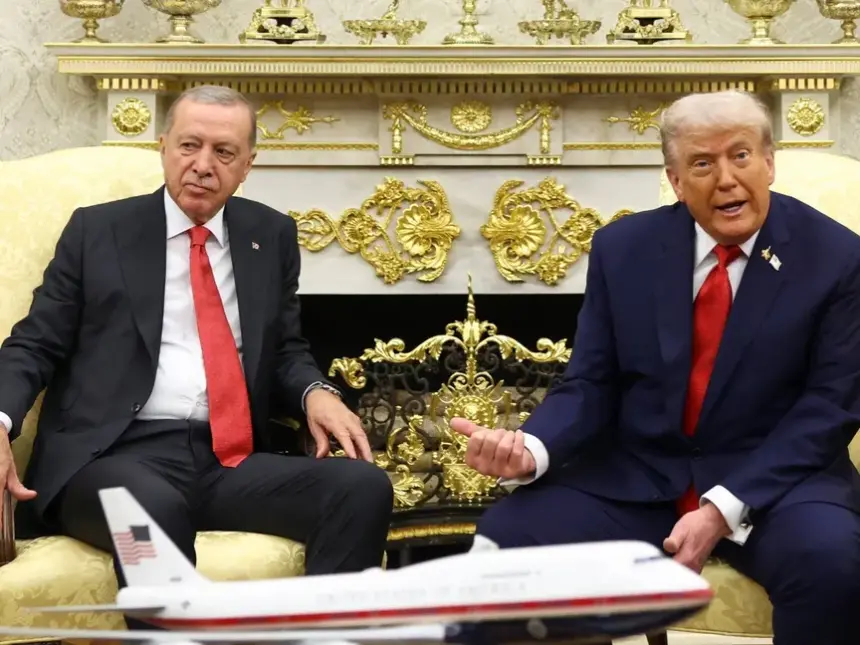
US President Donald Trump indicated he may announce significant defence agreements—potentially reviving a stalled F-35 fighter jet sale and supplying F-110 aircraft engines—during his upcoming visit to Ankara for the NATO summit, signalling a renewed rapprochement in US-Turkish relations.
Trump is scheduled to attend the July 7-8 summit following a personal invitation from Turkish President Recep Tayyip Erdogan. The trip will make Trump the first US president to visit Türkiye since Barack Obama in 2015, and the two leaders are expected to hold a bilateral meeting on the sidelines of the summit.
“I wouldn’t have gone for most people, but he called me and said: Please, the summit is in Türkiye, you must be there, and the United States must participate,” Trump stated last week. “So I will go out of respect for President Erdogan.”
According to the Associated Press, Erdogan’s personal diplomatic intervention helped avert potential disruption to the alliance that would have resulted from Trump’s absence. The Republican president’s attendance comes at a highly sensitive time, as he has repeatedly alarmed allies by threatening to withdraw US forces from Europe and diminish Washington’s role within NATO.
Trump, who has frequently praised Erdogan as a “top-tier leader,” has consistently criticised NATO members for insufficient defence spending, viewing the alliance’s pledge last year to increase military expenditure as a personal victory. Recently, he has also clashed with several member states over their lack of support for the ongoing US war against Iran.
F-35 fighter jets and F-110 engines
Trump has signalled that his visit to Ankara could yield a major breakthrough regarding F-110 aircraft engines and potentially reopen the frozen F-35 fighter jet dossier.
Türkiye was controversially expelled from the F-35 programme in 2019 following its acquisition of the Russian S-400 air defence system. The United States had expressed severe concerns that operating the Russian equipment could allow Moscow to gather sensitive intelligence regarding the advanced capabilities of the American stealth fighter.
However, during a recent meeting with NATO Secretary General Mark Rutte in Washington, US Vice President J.D. Vance confirmed that Washington is currently exploring avenues to sell the fighters to Türkiye while ensuring compliance with US laws. This effort faces formidable opposition within Congress, notably from Senate Foreign Relations Committee Chairman Jim Risch, who adamantly opposes any deal as long as Ankara retains the S-400 system.
Trump hints at a ‘gift’ for Türkiye
During that same meeting with Rutte in Washington, Trump was asked directly whether he would bring a “gift bag” to Erdogan containing F-110 engines or F-35 fighter jets.
“I think so… maybe I will do something that will make him very happy,” Trump replied. The US president had previously alluded in September to the possibility of resuming F-35 sales to Ankara.
$700 million engine deal
Türkiye is concurrently seeking to acquire F-110 engines to power its domestically manufactured KAAN fighter jets. Last week, the US State Department notified senior Congressional members of its intention to bypass their objections to proceed with an engine sale valued at over $700 million, according to informed officials.
Democratic Representative Gregory Meeks strongly criticised the decision, stating that the department failed to provide any written justification for bypassing Congress and did not clarify the deal’s implications for US-Turkish relations or Ankara’s continued possession of the Russian S-400 system.
The anticipated defence agreements coincide with a broader series of indicators pointing to rapidly improving bilateral ties. Earlier this year, the US Department of Justice dropped a major case against Türkiye’s state-owned Halkbank, which had been accused of assisting Iran in circumventing US sanctions.
Furthermore, Trump appointed his close friend Tom Barrack as US ambassador to Ankara, a move that researcher Ahmed Qasim Khan described as a critical factor in facilitating smoother relations between the two nations.
Diplomatically, Erdogan and Trump have maintained frequent telephone contact to coordinate on issues concerning Syria, Gaza, and the broader Middle East. Türkiye recently joined a Trump-led initiative to oversee a ceasefire in Gaza. Moreover, during a joint press conference with Israeli Prime Minister Benjamin Netanyahu last year, Trump surprised attendees by publicly praising Erdogan and urging Netanyahu to be “rational” regarding Turkish influence in Syria.
Following a bilateral meeting with Trump at last year’s NATO summit in The Hague, Erdogan highlighted the profound shift in their diplomatic engagement.
“With my friend Trump we are opening the door to a new phase in Turkish-American relations,” Erdogan said. “Telephone diplomacy between us does not take more than 24 hours; when one of us calls, the other party responds in less than a day.”

