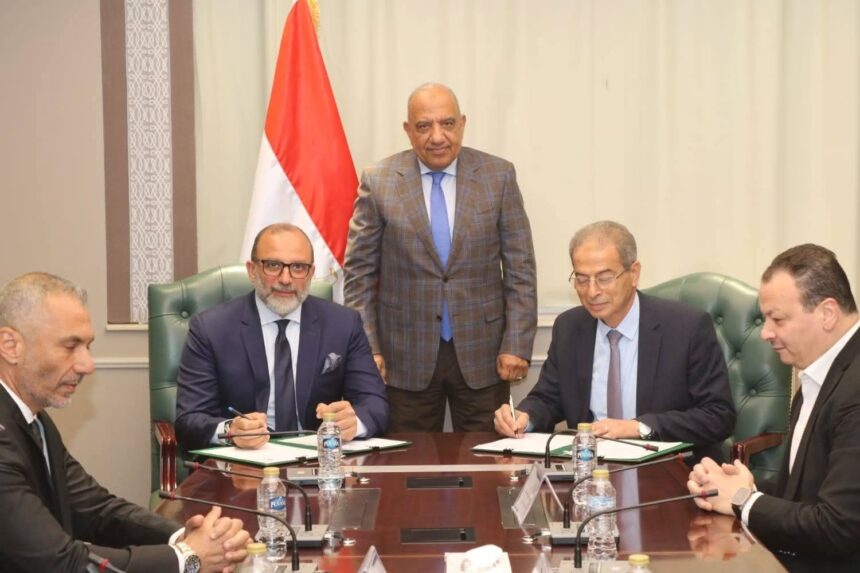
Egypt’s Minister of Electricity and Renewable Energy, Mahmoud Esmat, witnessed the signing of a cooperation protocol between the Egyptian Electricity Holding Company (EEHC) and e& to replace conventional electricity meters at the telecom operator’s sites across the country with advanced smart meters.
The protocol was signed by Gaber El-Desouky, Chairperson of the Egyptian Electricity Holding Company, and Hossam Abdel Aziz El-Maadawy, Chief Enterprise Officer at e&, during a ceremony held at the ministry’s headquarters in the New Administrative Capital.
The agreement aims to enhance the efficiency of electricity metering, improve the accuracy of consumption measurement, and expand the deployment of modern technologies in energy management.
It also reflects ongoing cooperation between the electricity sector and other industries to accelerate the rollout of smart metering systems.
Under the protocol, the newly installed smart meters will be integrated with the Egyptian Electricity Holding Company’s central systems, including the Meter Data Management (MDM) and Unified Head-End System (UHES) platforms.
The integration will ensure highly accurate and reliable data collection while enabling advanced consumption analysis, fault detection, and improved operational efficiency.
The agreement also provides for consolidated electricity billing covering all e& Egypt sites nationwide, simplifying billing procedures and strengthening financial and operational oversight.
Meter reading, billing, and collection processes will be managed through the company’s centralised digital platforms, supported by continuous technical assistance.
Speaking at the signing ceremony, Esmat said modernising Egypt’s electricity system is an ongoing process aimed at improving operational performance and enhancing the quality of services provided to consumers.
He noted that the ministry is implementing a comprehensive plan to transform the conventional electricity grid into a smart grid capable of accommodating the country’s rapidly expanding renewable energy generation capacity while ensuring more efficient power transmission.
He emphasised that adopting advanced technologies is a key pillar of the government’s digital transformation agenda, adding that expanding the use of smart meters remains one of the ministry’s top priorities to improve service quality and promote more efficient energy consumption.
Esmat described the protocol as a successful model of integration between the electricity and telecommunications sectors, stressing that it paves the way for further strategic partnerships that will contribute to developing Egypt’s energy system, improving operational efficiency, and supporting the country’s sustainable development goals.