

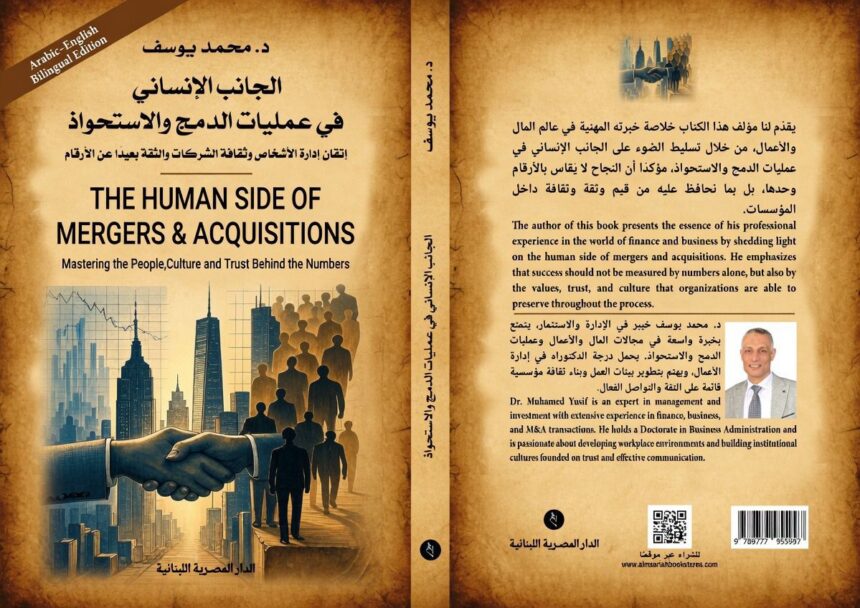
Investment and mergers and acquisitions (M&A) specialist Dr. Mohamed Youssef has launched a new practical framework titled “HumanCorp Due Diligence,” alongside a book, to address the human, cultural, and organisational factors that determine the success or failure of corporate transactions in the Arab region.
Originating from a specialised doctoral thesis, the newly introduced framework serves as a tool to evaluate the non-financial variables that are frequently overlooked during deal negotiations and completions.
The accompanying book, titled “The Human Side in Mergers and Acquisitions,” highlights the necessity of this approach by detailing the true story of an M&A deal valued at over one billion riyals. According to the text, the transaction collapsed in its final stages for reasons entirely unrelated to financial indicators or figures, despite having met all legal and financial requirements.
The framework addresses a specific need in the Arab region, where family-owned businesses constitute a significant proportion of the economy. In this environment, human relationships, family ties, and corporate culture play a central role in strategic decision-making and overall business sustainability, necessitating a more comprehensive methodology that accounts for post-execution integration.

For decades, global financial and consulting institutions have primarily relied on financial and legal due diligence as the principal standard for investment decisions. This traditional approach has left numerous human and cultural factors outside the scope of evaluation, despite their direct impact on deal outcomes.
Youssef’s book examines the most prominent non-financial elements influencing transaction success. These include the emotional attachment of owners to their companies, the effectiveness of communication between work teams, change management, the alignment of corporate cultures across different entities, and the establishment of trust among all involved parties.
The book and its accompanying framework assert that M&A success cannot be achieved through numbers alone. Instead, it requires a profound understanding of the people, corporate culture, and relationships that form the core of a business, which in turn contributes to building more sustainable companies, supporting economic development, and creating stronger, more competitive national entities.


