

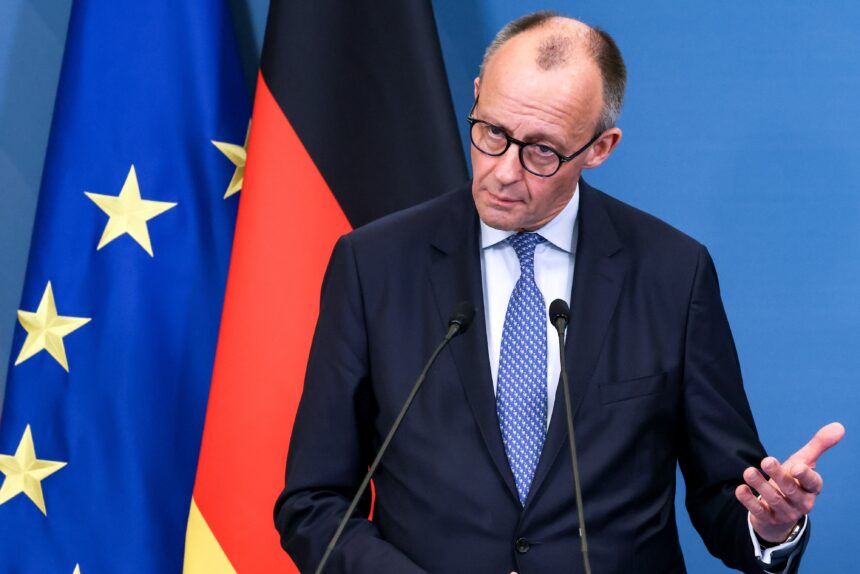
German Chancellor Friedrich Merz is confronting mounting internal party pressure and speculation of an early replacement ahead of critical September regional elections, reflecting an unprecedented state of political turmoil in a country long considered a pillar of European stability, according to Politico magazine.
Returning from his summer holiday, the German Chancellor does not appear to feel the threats surrounding his position, according to the European edition of the magazine, and may be underestimating the growing pressure within his party.
“I assume that things will have calmed down a bit by September,” Merz said last week, following escalating internal party disputes regarding his management of a cabinet reshuffle.
With critical regional elections scheduled for September, during which the far-right Alternative for Germany (AfD) party has a significant chance of reaching power in a German state for the first time, the term Kanzlertausch (changing the Chancellor) is increasingly echoing in political circles. This refers to the possibility of replacing Merz with another chancellor this coming autumn.
Although public criticism has primarily come from ministers who exited the government during the recent reshuffle, a growing number of politicians within Merz’s Christian Democratic Union (CDU) are quietly discussing a scenario that would be considered exceptional in Germany: replacing the chancellor just over a year into his tenure.
Changing political landscape
Politico noted that Germany, Europe’s largest economy, has long been considered one of the continent’s most stable democracies, lacking a political tradition of rapidly changing leaders as seen in post-World War II Italy or post-Brexit Britain.
However, expectations of strong AfD results in the upcoming elections, juxtaposed with an anticipated decline for the CDU, have begun to upend the country’s traditional political rules.
The “chancellor change” concept relies on the premise that conservatives may need to contain the fallout from the elections in eastern Germany and provide the party with renewed political momentum by replacing Merz, who has thus far failed to improve his low approval ratings.
The risks remain substantial; the AfD, which currently leads national opinion polls, is likely to exploit any fresh turmoil within the ruling coalition to strengthen its political position.
Furthermore, replacing a chancellor years before his term expires would push Germany into largely unfamiliar political territory. Post-WWII German history has seen only three instances where a new chancellor assumed power from the same political camp as his predecessor while the latter was in office. In 1963, 87-year-old Konrad Adenauer resigned to make way for Ludwig Erhard. In 1966, Erhard was succeeded by another chancellor following a coalition collapse. In 1974, Social Democratic Chancellor Willy Brandt stepped down amid an espionage scandal.
Palace rebellion
The current “chancellor change” scenario, which positions Hendrik Wüst, the Premier of North Rhine-Westphalia, as the leading candidate to succeed Merz, has gained widespread attention in German media, including Der Spiegel magazine, which dedicated its latest cover to the topic under the headline “Palace Rebellion.”
Conservative politicians, speaking to Politico on condition of anonymity, confirmed that this debate is occurring within the ruling party. They explained that growing dissatisfaction reflects declining confidence in Merz’s ability to lead the country, as well as doubts about his capacity to keep the party united should the AfD succeed in taking power in a state during the September elections.
Opinion polls indicate that the far-right AfD could win an absolute majority in the Saxony-Anhalt state elections scheduled for September 6. The party also appears strongly positioned to secure victory in Mecklenburg-Vorpommern and achieve advanced results in Berlin during elections scheduled for September 20.
Some CDU members fear that party politicians in eastern Germany might support an AfD-led local government post-election, a move that would break Merz’s long-standing pledge to never allow the far-right to participate in government.
One conservative politician described the discussions as “still in the realm of speculation,” noting that the outcome of the eastern German elections will be the “decisive factor” in determining Merz’s political future.
The politicians added that, to date, no senior party leaders have publicly declared their opposition to Merz. However, the rising dissatisfaction within the party has become evident, an unusual development for a group historically renowned for its internal discipline.
According to Politico, Merz’s future largely depends on the September regional election results, and whether they will confirm the rise of the far-right or provide conservatives an opportunity to stem their declining popularity.
Calls for calm
Conversely, calls for calm and restraint have begun to emerge from across the political spectrum, the magazine reported.
Christiane Hoffmann, former spokesperson for the former centre-left Chancellor Olaf Scholz, commented on the ongoing debate in a lengthy post on the X platform: “A Union party tearing itself apart from the inside will benefit no one in the democratic camp.”
“We need some stability, please. What we are witnessing is nothing but grumbling and chaos without a clear vision, while no one knows where things are heading. Europe is burning, so can some people show a little calm?” she added.
Politico noted that if Merz is forced from office, it would represent a massive shock to Germany’s consensus-based political system. Coming less than two years after the collapse of the previous centre-left coalition, the development could pave the way for snap elections.
The magazine quoted Kai Arzheimer, a political science professor at the University of Mainz, who stated that the fragmentation of the German party system—where centrist parties are forced to form complex coalitions to prevent extremist parties from reaching power—has led to a shift in the political landscape.
“Compared to the 1970s and 1980s, Germany has not enjoyed the same degree of political stability for quite some time. But if compared to what has become typical in many other European countries, it can be said that Germany has simply reached the stage that other countries reached long ago,” Arzheimer said.
Merz still retains the backing of prominent conservative figures. Markus Söder, Bavarian Premier and leader of the Christian Social Union (CSU), told German public broadcaster ARD: “I am absolutely convinced that Friedrich Merz will remain Chancellor,” warning that replacing him at this stage “would plunge the conservative camp into total chaos.”
Potential scenarios and outcomes
Politico suggested that the least disruptive scenario would be for Merz to resign voluntarily, allowing a successor to be elected by a majority vote in parliament.
If he refuses to step down, his opponents would have no choice but to resort to a constructive vote of no confidence, a constitutional mechanism allowing parliament to oust the current chancellor and elect a successor in the same vote.
However, resorting to this extraordinary measure could lead to the disintegration of the ruling coalition—which includes the CDU, its Bavarian ally the CSU, and the Social Democratic Party (SPD)—potentially pushing the country into a fresh political crisis.
At present, Merz’s best available political option appears to rely on German politicians’ tendency to avoid risk, in an attempt to preserve what remains of Germany’s reputation as one of Europe’s most stable democracies.
Meanwhile, opinion polls reflect the scale of the challenges facing Merz. Nationally, the AfD leads with an average of 28% support, compared to 21% for Merz’s conservative alliance, according to an average of polls compiled by Politico.
Based on the latest “Deutschlandtrend” survey, conducted by a specialised institute commissioned by ARD, only 13% of Germans are satisfied with Merz’s performance, marking the lowest approval rating for a German chancellor since the poll’s inception nearly 30 years ago.
The record decline in Merz’s popularity is attributed to voter dissatisfaction with his efforts to revive the struggling German economy, alongside scepticism regarding comprehensive pension and healthcare reforms, which are expected to be difficult to implement and impose financial burdens on citizens.

