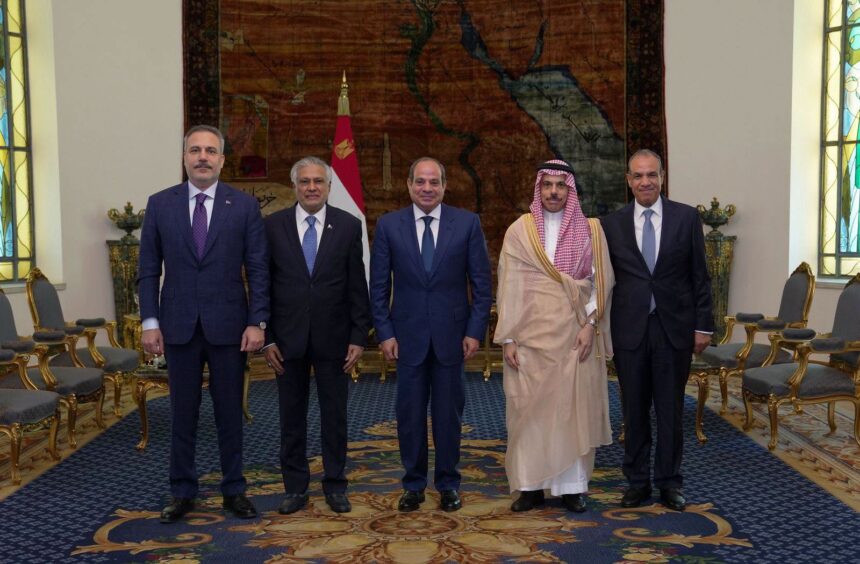
Egyptian President Abdel Fattah Al-Sisi called for transforming the consultative mechanism bringing together Egypt, Saudi Arabia, Türkiye, and Pakistan into a more institutionalised framework capable of contributing to regional stability and addressing Middle East crises.
According to a statement from the Egyptian presidency, Al-Sisi met Pakistani Deputy Prime Minister and Foreign Minister Mohammad Ishaq Dar, Saudi Foreign Minister Prince Faisal bin Farhan Al Saud, and Turkish Foreign Minister Hakan Fidan in Cairo during the fourth meeting of the four countries’ foreign ministers.
Al-Sisi said recent regional developments had highlighted the importance of the four countries as key pillars of regional security and stability, stressing the need to further develop the mechanism into an effective institutional platform capable of generating sustainable solutions to regional challenges.
The Egyptian president praised the level of coordination among the four countries and reaffirmed Cairo’s commitment to continuing cooperation with Saudi Arabia, Türkiye, and Pakistan, as well as with other Arab and regional partners.
The talks also addressed developments in US-Iran relations. Al-Sisi welcomed the recently signed Islamabad Memorandum of Understanding (MoU) between Washington and Tehran, describing it as an important step towards reducing regional tensions.
He also praised Pakistan’s role in helping bridge differences between the two sides and facilitating progress towards the agreement.
Al-Sisi stressed the importance of maintaining joint efforts to support the implementation of the memorandum and continue negotiations between the United States and Iran with the aim of reaching a comprehensive and sustainable final agreement.
He said any final deal should address the security concerns of Gulf Cooperation Council states and other Arab countries, while ensuring respect for sovereignty and territorial integrity, adherence to good-neighbourly relations, freedom of navigation, and the peaceful settlement of disputes.
The Egyptian president also reiterated the need for a just and comprehensive solution to the Palestinian issue, describing it as a prerequisite for lasting stability in the Middle East.
The foreign ministers of Saudi Arabia, Türkiye, and Pakistan expressed appreciation for the meeting and voiced support for strengthening coordination among the four countries through a more effective institutional framework for addressing regional and international issues.
In a joint statement issued following their separate meeting, the foreign ministers of Egypt, Pakistan, Saudi Arabia, and Türkiye said their talks provided an opportunity for a comprehensive exchange of views on regional and international developments and reaffirmed the importance of continued consultation and coordination in support of peace, security, stability, and prosperity in the Middle East and the broader region.
The ministers welcomed the signing of the Islamabad Memorandum of Understanding between the United States and Iran on 18 June 2026, describing it as a constructive step towards de-escalation and ending a conflict that posed significant risks to regional security and stability, as well as to energy markets, international maritime routes, global supply chains, and international trade.
They commended the efforts of regional and international actors that contributed to facilitating the agreement and stressed the importance of faithfully implementing the commitments undertaken by the parties concerned. The ministers praised Pakistan’s role in securing the agreement, as well as Qatar’s support in helping bring the negotiations to a successful conclusion. They also highlighted Pakistan’s continued coordination with the four countries throughout the process.
Building on this momentum, the ministers emphasised the importance of achieving a swift and successful conclusion to the next phase of negotiations aimed at reaching a lasting, verifiable, and mutually acceptable settlement of the remaining issues.
They stressed that such efforts should take into account the concerns of countries in the region, particularly regarding the security and stability of the Gulf Arab states and the Levant, with a view to strengthening collective security and promoting long-term regional stability.
Reaffirming the centrality of the Palestinian cause to achieving peace, security, and stability in the Middle East, the ministers said the issue remains at the heart of efforts to secure a just, comprehensive, and lasting peace and constitutes a fundamental pillar of a stable and secure regional order.
They devoted particular attention to the humanitarian and political situation in the Gaza Strip, the West Bank, and occupied East Jerusalem.
The ministers reiterated their support for the legitimate rights of the Palestinian people, including their right to self-determination and the establishment of an independent Palestinian state on the basis of the 4 June 1967 borders, with East Jerusalem as its capital, as an indispensable foundation for achieving a just, comprehensive, and lasting peace in accordance with relevant United Nations Security Council resolutions.