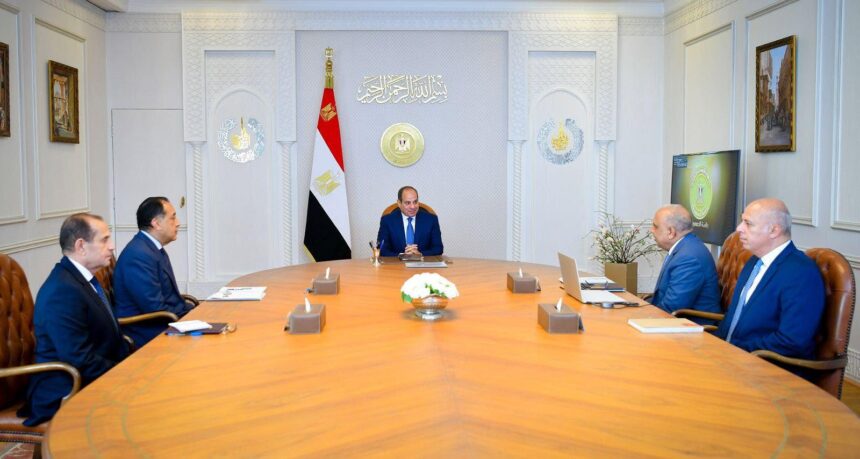
Egyptian President Abdel Fattah Al-Sisi reviewed progress on 105 projects aimed at strengthening the national electricity grid as part of the state’s efforts to improve power stability, enhance energy efficiency, and expand the use of renewable energy sources.
According to a statement issued by the presidency, Al-Sisi met with Prime Minister Mostafa Madbouly and Minister of Electricity and Renewable Energy Mahmoud Esmat to discuss the implementation of the second phase of electricity grid reinforcement projects, as well as plans to connect additional solar and wind energy projects to the national grid by 2027.
During the meeting, Al-Sisi stressed the importance of improving the quality and reliability of electricity supply, enhancing the efficiency of conventional fuel consumption, and maintaining the stability of the national grid, while ensuring adherence to project implementation schedules.
The discussions also reviewed plans to expand solar power generation and battery energy storage systems as part of Egypt’s strategy to increase the share of renewable energy in the national energy mix to 45% within the next two years.
Esmat noted that the first phase of the Obelisk Solar Project, with a generation capacity of 500 megawatts (MW), along with an associated battery storage facility with a capacity of 200 megawatt-hours (MWh), had already been connected to the national grid earlier this year. He added that the second phase, also with a capacity of 500 MW, is expected to enter operation in the coming weeks.
The meeting further reviewed progress on the Energy Valley project, which the presidency described as one of the world’s largest integrated clean energy developments. The project includes 1.7 gigawatts (GW) of solar power generation capacity in Minya Governorate, supported by battery storage systems with a combined capacity of 4 gigawatt-hours (GWh) distributed across Minya, Qena, and Alexandria.
Al-Sisi called for continuous monitoring of renewable energy projects throughout both the implementation and operational phases. He also stressed the importance of strengthening cooperation with local and international private-sector partners and expanding the deployment of energy storage technologies to maximise the benefits of renewable energy generation and support grid stability.
The president further emphasised that localising industries related to renewable energy technologies represents a key pillar of Egypt’s efforts to strengthen energy security, reduce dependence on imports, and accelerate the country’s transition towards a greener and more sustainable energy future.
The projects form part of Egypt’s broader strategy to modernise its electricity infrastructure, meet growing energy demand, and position the country as a regional hub for renewable energy production and transmission.