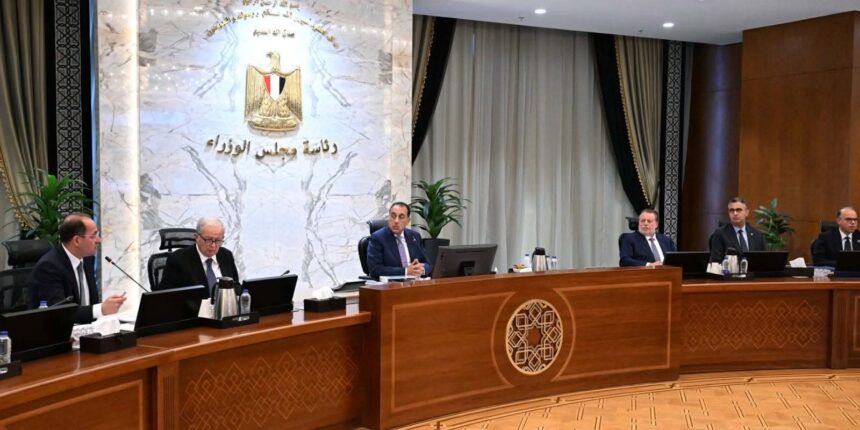
Egypt’s Prime Minister Mostafa Madbouly chaired a meeting of the Economic Ministerial Group in the New Administrative Capital to review key economic priorities, including progress under Egypt’s reform programme with the International Monetary Fund (IMF), inflation developments, investment reforms, and updates to the State Ownership Policy Document.
The meeting was attended by senior government officials, including Deputy Prime Minister for Economic Affairs Hussein Eissa, Central Bank Governor Hassan Abdalla, Finance Minister Ahmed Kouchouk, Investment and Foreign Trade Minister Mohamed Farid, Planning and Economic Development Minister Ahmed Rostom, Industry Minister Khaled Hashem, and other officials.
IMF Reform Programme Remains on Track
The group reviewed the latest developments in Egypt’s economic reform programme implemented in cooperation with the IMF, with officials confirming that all quantitative performance criteria for March 2026 had been successfully achieved.
Key targets met included primary surplus objectives, tax revenue goals, the transfer of privatisation proceeds to the state budget, the preservation of spending on social protection and healthcare programmes, and the completion of several state asset sale transactions. These included the recently signed agreement for the Gebel El-Zeit project with Alcazar Energy.
Finance Minister Ahmed Kouchouk also presented a package of structural and legislative reforms currently being finalised as part of the government’s broader economic reform agenda.
Digital Investment Platform Advances
Investment and Foreign Trade Minister Mohamed Farid reviewed progress on the Economic Entities Platform, a flagship initiative designed to modernise Egypt’s investment services ecosystem through digital transformation.
The platform will serve as an integrated digital gateway connecting government entities and providing investors with a seamless experience throughout the investment lifecycle, from company establishment to exit procedures.
Farid said the first phase will integrate services offered by the General Authority for Investment and Free Zones (GAFI) and the Commercial Registry, while allowing additional government entities to be incorporated without requiring modifications to the platform’s underlying architecture.
He also highlighted several digital transformation projects currently under development, including a financial statements aggregation platform, an investor complaints and grievance management system, a free zones platform, a digital export development fund portal, and a renewable energy project registration platform.
Inflation Continues to Moderate
Planning and Economic Development Minister Ahmed Rostom presented an update on inflation and commodity prices, noting that annual inflation declined to 13.0% in May 2026, reflecting a continued easing of inflationary pressures and a slower pace of price increases.
Monthly inflation also moderated, recording 1.2% in April and 1.4% in May after reaching 3.3% in March, indicating a gradual return to more stable price dynamics despite ongoing pressures stemming from production costs and global economic conditions.
The report also pointed to relative stability in the prices of several strategic commodities between 24 May and 7 June, including red meat, edible oils and selected agricultural products, while egg and fish prices declined during the period.
Updated State Ownership Policy Approved
The meeting reviewed the revised State Ownership Policy Document, which has undergone extensive consultations through more than ten meetings chaired by the Prime Minister and involving relevant ministries and stakeholders.
According to officials, the updated document incorporates lessons learned from the initial phase of implementation and draws on international best practices to establish a clearer framework for the state’s role in economic activity.
Unlike the original version, which focused largely on identifying sectors from which the state would withdraw, the revised policy adopts a broader approach centred on defining the state’s economic role, strengthening governance of state-owned assets, improving asset utilisation and maximising economic returns.
The updated framework also seeks to reinforce competitive neutrality, ensure a level playing field for all market participants and expand the private sector’s role as a key engine of growth and sustainable development.
The Economic Ministerial Group formally approved the revised document following the incorporation of feedback from relevant national entities. Officials said the government would take the necessary steps to officially launch the updated policy before the end of June.
External Sector Indicators Improve
The meeting also reviewed a report prepared by the Central Bank of Egypt’s Economic Research Sector on preliminary balance of payments indicators for the period from July 2025 to March 2026.
The report highlighted continued strength in several external sector indicators. Tourism revenues increased by 14.9% year-on-year to approximately $14.4bn, compared with $12.5bn during the corresponding period of the previous fiscal year. European markets accounted for around 69.2% of total tourist arrivals, with Russia remaining the largest source market, followed by Germany.
Remittances from Egyptians working abroad rose by 32% to approximately $34.9bn, up from $26.4bn during the same period a year earlier, reflecting stronger inflows from expatriates across multiple markets.
Officials said the latest indicators underscore ongoing improvements in Egypt’s external accounts amid continued reform efforts and measures aimed at strengthening investment, expanding private sector participation and maintaining macroeconomic stability.