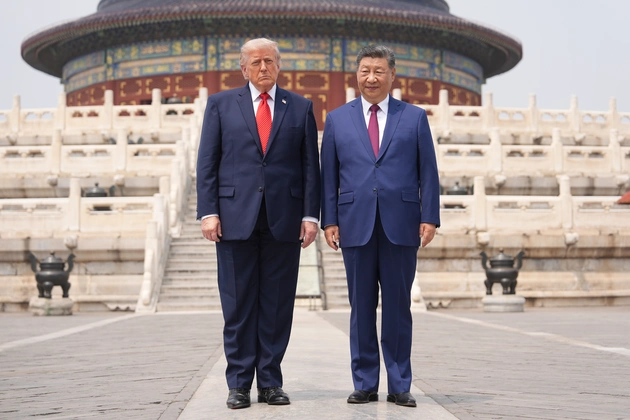
US President Donald Trump announced he has suspended a proposed $14bn arms sale to Taiwan, describing the package as a “very strong bargaining chip” in his negotiations with Chinese President Xi Jinping, whilst warning that Taipei will face a “harsh response” if it pursues independence.
Speaking in a Fox News interview broadcast on Friday following his visit to Beijing, Trump stated that the arms deal remains under review. “I have not approved it yet, and we will see what happens. I am keeping it on hold for now, and the matter depends on China,” he said, adding that the proposed sale is “a very good bargaining chip for us, frankly.. it is a large amount of weapons.”
The US president described the status of Taiwan as the “most important file for the Chinese president” and noted that the issue dominated their summit discussions. Emphasising that Beijing “does not want to see Taiwan independent,” Trump predicted that China would take “very strong steps” should Taipei move in that direction.
“They will face a harsh response, and bad things will happen,” Trump said. He highlighted the geographic disparity as a “difficult problem,” noting that Taiwan is situated approximately 59 miles from China, whereas the United States is about 9,500 miles away.
Trump also accused Taiwan of “stealing” the American microchip industry, asserting that previous US administrations allowed semiconductor manufacturing companies to leave the country. “If we had imposed tariffs of 100% or 200% on chips coming into the United States, we would not have lost this industry,” he stated, adding that the sector is “returning now” to the US. He subsequently called on both Beijing and Taipei to de-escalate tensions, stating: “It would be smart for Taiwan to calm down a little, and it would also be smart for China to calm down a little.. both sides should calm down.”
Prior to his interview, a Chinese government spokeswoman stated that “the Taiwan issue is the most important issue in relations between China and the United States,” warning that improper handling could lead to “clashes and even conflicts” between the two nations. The status of Taiwan, located 80 kilometres off the Chinese coast, has historically strained bilateral relations; Beijing refuses to rule out the use of force to take control of the island, whilst Washington is bound by law to provide Taipei with the means for its defence.
Trade Agreements and AI Supremacy
Reflecting on his meetings in Beijing, Trump said “the relationship was the most important thing” he took away from the summit. “It is all about the relationship. I have a very good relationship with President Xi, and with China,” he noted.
He characterised trade relations between the two countries as “very strong,” announcing that China has committed to increasing its purchases of US soybeans and acquiring commercial aircraft from Boeing. Trump specified that Xi pledged to purchase 200 large Boeing aircraft, including 777 and 737 models. He added that this figure could rise to 750 aircraft if “Boeing and General Electric engines perform well.”
Beyond trade, artificial intelligence was a central focus of the bilateral talks. Trump asserted that the United States “excels by a large margin” over China in the sector. He disclosed that the two leaders discussed the possibility of establishing “controls” to regulate the development of AI.
Describing artificial intelligence as “mostly a wonderful thing,” Trump stated he has granted AI companies the right to construct their own power stations to secure necessary energy requirements, a move he claims has bolstered the US lead over China. “Very rich companies led by many geniuses” have already begun building these power plants, he said.
Trump noted that the global competition in artificial intelligence is “primarily concentrated” between the US and China. “Who will win the artificial intelligence race? We will win it,” he declared. He added that Xi was “surprised” by the extent of American progress, explaining that Beijing initially believed it held a “massive lead,” but that the US had “caught up, and is now clearly ahead of it.”
Putin to Seek Briefings in Beijing
Following Trump’s departure, Russian President Vladimir Putin is scheduled to visit China on Wednesday and Thursday. Kremlin spokesman Dmitry Peskov highlighted the significance of communication between the world’s two largest economies, stating on Friday that Russia expects to receive direct information from China regarding its talks with the United States during Putin’s visit.
The Kremlin announced in a statement that Putin’s visit, taking place at Xi’s invitation, coincides with the 25th anniversary of the signing of the Good Neighbourliness, Friendship and Cooperation Treaty, which it described as “fundamental to relations between the two states.” The 2001 agreement, signed by Putin and former Chinese President Jiang Zemin, established a long-term strategic partnership and structured economic cooperation across multiple sectors, according to Bloomberg.
Putin and Xi are expected to discuss bilateral relations and exchange views on prominent international and regional issues. Bloomberg reported that following the talks, the two sides are scheduled to sign a joint statement alongside a number of bilateral governmental agreements and other documents. Putin will also hold discussions with Chinese Premier Li Qiang regarding trade and economic cooperation.
The South China Morning Post reported previously, citing unnamed sources, that the visit is unlikely to feature formal ceremonies such as a military parade.
The trip marks Putin’s first foreign visit of the year, underscoring the close alignment between Beijing and Moscow. The two nations view one another as essential partners in a broader effort to challenge the US-led global order. Last month, Xi praised the stability of relations with Moscow and pledged to enhance bilateral coordination during a meeting with the Russian foreign minister. In early May, Putin stated that the two countries had “agreed in principle” on a high level of serious cooperation in the oil and gas sectors, adding that he intends to discuss nuclear energy with Xi during the upcoming summit.