

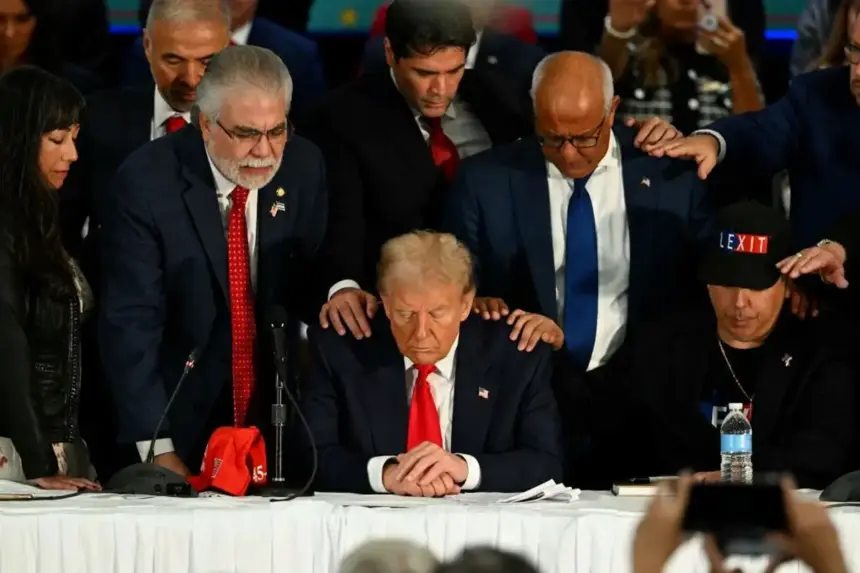
On May 1, 2025, during a White House event marking the National Day of Prayer, US President Donald Trump announced the creation of the White House Religious Liberty Commission, a body he said was designed to “protect the religious and spiritual values of American society.” Yet the event quickly became one of the most controversial political moments in recent American history after Trump declared before a religious and political audience: “Maybe we should forget about that for a while,” referring to the principle of separation between church and state. The statement, widely reported by major American outlets such as the Associated Press and Politico, was interpreted as an unprecedented signal from a US president regarding one of the foundational constitutional principles of the American republic.
The controversy did not end with Trump’s remark. It intensified because of the figures appointed to the new commission, individuals who clearly reflect the growing influence of the Christian conservative movement within circles surrounding the administration. Among the most prominent names is Texas Lieutenant Governor Dan Patrick, known for his deeply conservative positions, who openly described the separation of church and state as “a historical myth,” arguing that the United States was founded as a nation rooted in Christian values and that this reality had been deliberately distorted over the decades.
The commission also includes influential religious and media personalities tied to the American evangelical movement, one of Trump’s most loyal and politically powerful electoral bases. According to reports published by TIME magazine and the Associated Press, many members of the commission believe the United States is experiencing a period of “moral and cultural decay,” and that restoring religion to the center of public life is essential to saving traditional American identity.
What makes this development particularly alarming is that these are no longer merely theological debates taking place inside churches or among conservative intellectual circles. They have become part of an emerging discourse voiced by individuals operating close to the center of political power in Washington itself. For this reason, major American newspapers and political analysts have increasingly treated the commission not as a symbolic advisory panel, but as a reflection of a deeper ideological transformation underway in the United States.
Associated Press reports explicitly noted that opposition to the “strict separation” between church and state has become central to discussions surrounding the commission. Politico framed Trump’s remarks as a direct attempt to redefine the relationship between religion and political authority in America, while TIME warned that the commission could eventually become a platform for imposing a conservative religious vision on public policy, education, culture, and American law.
The danger of this commission does not simply lie in the presence of conservative religious figures. Religious conservatives have always existed in American politics. What is new—and potentially historic—is the migration of this ideology into a semi-official position within the White House itself, at a moment when the United States is already experiencing profound polarization over identity, culture, and national values. For the first time in decades, there appears to be a current within the American political establishment that no longer views the separation of religion and state as a constitutional safeguard, but rather as an obstacle to the restoration of “true American identity.”

This is where the issue becomes especially serious. The principle of church-state separation in the United States was never merely an abstract philosophical concept; it functioned as the essential safeguard preventing America from evolving into a religious state dominated by a single doctrinal worldview. It preserved equilibrium within a nation composed of countless denominations, religions, and cultural identities. Once political authority itself begins questioning that foundation, concerns no longer revolve solely around religion, but around the future of civil liberties, minority rights, and the nature of American democracy itself.
Many American academics and constitutional scholars fear that the Religious Liberty Commission could eventually become a pressure mechanism for reshaping educational, cultural, and legal policies in the United States, particularly concerning abortion, LGBTQ rights, school curricula, and the role of religion in public institutions. In other words, the debate is no longer simply about protecting religious worship; it is about integrating a conservative theological vision into the heart of American policymaking and cultural authority.
To fully understand what is happening, one must examine the broader American context. The United States has spent years trapped in unprecedented cultural and political polarization involving identity, immigration, gender, education, and even the meaning of “American values” themselves. Within this environment, many conservatives believe the country has fundamentally changed in ways that threaten its traditional identity, and that modern liberalism has evolved beyond a political ideology into a cultural project that marginalizes religion and reshapes society itself.
What Trump is doing, therefore, is not merely an electoral maneuver. It is an attempt to consolidate religious conservatives behind a message asserting that the American state should no longer apologize for its Christian roots, and that religion should once again occupy a central place in public life. The Religious Liberty Commission thus emerges not simply as an advisory institution, but as a political and ideological symbol.
Yet the implications extend far beyond the United States. When the world’s most powerful nation begins redefining the relationship between religion and politics, the message resonates globally. For decades, America promoted itself as the leading defender of liberal democracy, secular governance, and institutional neutrality toward religion, using this image as a cornerstone of its political and cultural influence, especially in the Middle East. Today, however, Washington itself appears to be reopening debate over these very principles.
This transformation could have profound consequences for the Middle East. Many conservative and religious movements across the region will likely interpret developments in America as evidence that the West itself is retreating from the secular model it long presented as the ultimate form of modern governance. Some governments may even use this American shift to justify expanding the role of religion in politics and public culture, arguing that such developments are now occurring inside the United States itself.
Even more significantly, what is happening in America does not appear isolated from broader global trends. Europe is witnessing the rise of Christian nationalist movements, Russia increasingly portrays itself as the defender of “traditional Christian values,” and India continues to experience the ascent of Hindu nationalism. The world, it seems, may be entering a new historical phase in which religious and civilizational identities return to the center of international politics after decades dominated by liberal globalization.
For this reason, many American analysts no longer view Trump’s Religious Liberty Commission as a temporary political controversy, but rather as an indicator of a deeper civilizational transformation unfolding within the West itself; one that may ultimately redefine the relationship between religion and political power not only in America, but across the global order in the years ahead.
Dr. Marwa El-Shinawy – Academic and Writer

