

Amid shifting global supply chains and evolving partnerships across the Middle East and North Africa, Egypt stands at a pivotal geopolitical crossroads. With its unmatched geographic positioning and the vital artery of the Suez Canal, the country holds the ingredients to become a formidable hub linking Africa, the Mediterranean, and Europe. Yet as China and Russia pursue state led investment models, the question remains: how does the American private sector approach fit into Egypt’s future?
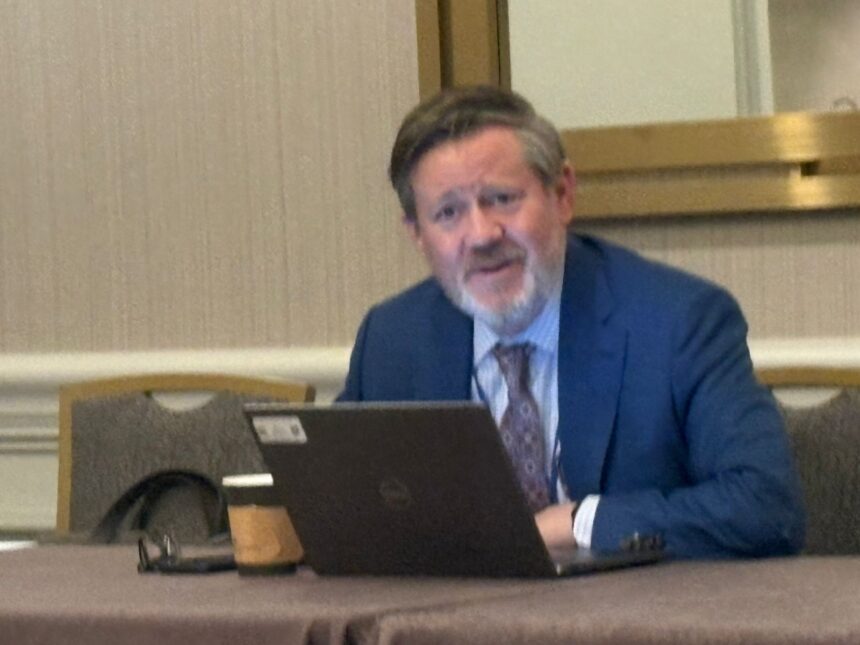
Daily News Egypt sat down with Steve Lutes, Vice President of the US Chamber of Commerce for Middle East Affairs, to explore the realities of US-Egypt economic ties and the challenges of turning Egypt’s potential into execution.
How do you assess Egypt’s performance in attracting investment? What is needed to improve?
Every government faces the challenge of becoming an attractive destination. Egypt already enjoys advantages that are difficult to replicate, most notably its geographic location. The key question is how to fully leverage that position.
Egypt also benefits from trade agreements with African markets. While I am not an economist, many experts anticipate strong growth across Africa in the coming years, which presents a significant opportunity. We often speak about Egypt as a gateway to Africa, but the priority now is to translate that concept into practical reality. This requires expanding dialogue frameworks beyond bilateral engagement to more multilateral cooperation.
What role can the US Chamber play in promoting economic support for Egypt?
The Chamber maintains ongoing engagement with US policymakers to highlight Egypt’s strategic economic importance, its role in regional stability, and its value as a trade and investment partner, particularly amid rising geopolitical tensions.
Through the US-Egypt Business Council, we consistently advocate for strengthening economic resilience, ensuring market stability, and supporting private sector-led growth. During periods of crisis, we also communicate the impact of economic shocks on supply chains, investor confidence, and reform trajectories. This helps foster a more stable political and economic environment conducive to financing and sustainable investment.
There’s a perception that Egypt’s private sector lacks equal opportunity. How do you see it?
There is always room for improvement; no system is perfect. From what I hear, there is clear government intent to expand privatisation and strengthen the private sector’s role. Naturally, businesses would like to see this process move faster.
Recent government changes suggest a greater willingness to accelerate reforms. This is creating more opportunities for private sector participation across a range of industries, whether through domestic firms or partnerships with international companies, including American ones.
With China, Türkiye, Germany, and Russia active in Egypt, where does the US stand?
It is important to recognise that different countries operate under different economic models. China and, to a large extent, Russia rely on state-led investment approaches. The United States operates very differently.
The US government does not direct companies where to invest. Decisions are made by private firms based on market conditions. If the investment environment is attractive, companies will come. If not, they will look elsewhere.
Can Egypt truly become a regional hub?
Absolutely. Egypt has the potential to serve not only as a gateway to Africa, but also to the Mediterranean and Europe. The Suez Canal remains a critical artery for global trade, whether for goods, energy, or even digital connectivity through submarine cables.
However, the real challenge is not promotion; it is execution.
What do you mean by execution?
Attracting American investment requires a more tailored approach than in state-led systems. In countries like China, agreements are often concluded at the government level, with companies following.
In the United States, each company must be engaged individually. Some are looking to expand into Africa, others have capital ready to deploy, while others require detailed feasibility studies. This makes the process more complex and demands targeted engagement and customised analysis.
Does this make US investment more difficult to secure?
It does make it more demanding, but also more sustainable. American companies tend to take a long-term view. They invest in local hiring, integrate into the market, and build enduring business operations.
What can we expect from the second Egyptian-American Economic Forum?
The objective is to frame the relationship strategically, rather than as a one-off event. There is a real opportunity to reinforce Egypt’s role as a gateway to Africa, including by involving African stakeholders and presenting concrete, investment-ready projects.
How can interest be converted into real investment?
American firms require precise, actionable information, not general messaging. When opportunities are clearly defined and well-structured, it becomes much easier to convert interest into investment.
Sector-focused discussions and direct engagement are essential to this process.
Why has Egypt-US cooperation in Africa been limited?
The Chamber continues to view Egypt as a key platform for US companies seeking to expand into Africa, particularly in sectors such as logistics, construction, energy, agriculture, and services.
However, progress depends on clearer project pipelines, the use of innovative financing tools such as blended finance, and stronger coordination between governments and development institutions.
What guarantees do US investors seek in tech and infrastructure?
Investors prioritise regulatory stability, transparency, effective dispute resolution mechanisms, and the availability of foreign currency. They also look for clear frameworks for public-private partnerships and predictable licensing timelines.
In the technology sector, data governance, intellectual property protection, and cybersecurity are especially critical.
Beyond energy, which sectors are most attractive?
Key growth areas include logistics, ICT, fintech, healthcare, pharmaceuticals, and export-oriented manufacturing.
What is the Chamber’s vision for the future of the Egypt-US economic partnership?
The relationship is evolving into a more strategic partnership built on resilience, innovation, and shared responsibility. Key areas of focus include energy security, regional stability, supply chain diversification, and human capital development.


