

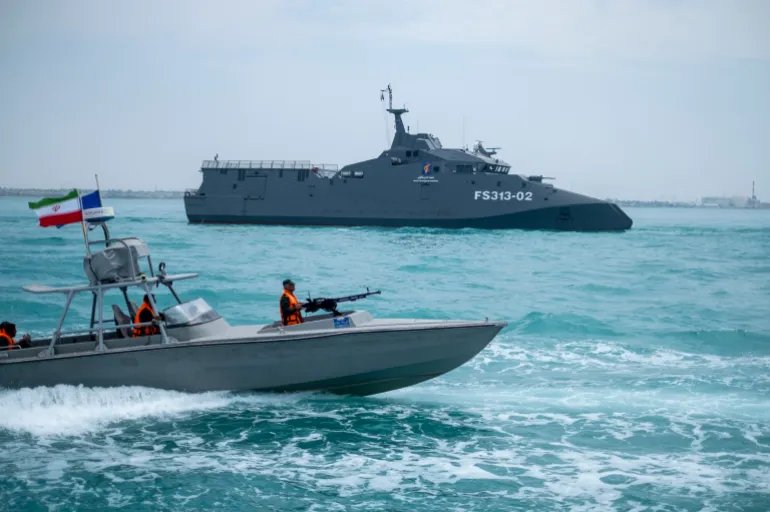
Iran has escalated its warnings over maritime movement in the Gulf and the Strait of Hormuz, cautioning vessels against approaching the strategic waterway as tensions persist with the United States and Israel and uncertainty deepens over a fragile ceasefire and the prospects for renewed conflict.
The Islamic Revolutionary Guard Corps said in a statement that all ships had been warned not to move in the Gulf and the Sea of Oman, adding that approaching the Strait of Hormuz would be treated as “cooperation with the enemy” and could result in vessels being targeted if they fail to comply.
An Iranian official also indicated that Tehran would prioritise vessels paying transit fees through the strait, signalling a tightening of control over one of the world’s most critical energy chokepoints, through which roughly one-third of global seaborne oil passes.
Politically, Iranian officials struck a dual tone of defiance and conditional openness. President Masoud Pezeshkian said the United States has no justification to deny Iran its nuclear rights, stressing that Tehran does not seek to expand the war and is acting in what it describes as legitimate self-defence.
Parliament Speaker Mohammad Bagher Ghalibaf said some progress had been made in talks with Washington but insisted on guarantees against future attacks, adding that Iran supports a step-by-step reciprocal approach.
US President Donald Trump said a US delegation would travel to Islamabad for talks on Iran, presenting what he described as a “fair deal” while warning that rejection could trigger widespread destruction of Iranian infrastructure, including power plants and bridges.
US officials said Vice President JD Vance would lead the delegation, while Pakistani authorities have stepped up security in Islamabad ahead of a possible new round of negotiations. However, uncertainty remains over whether the talks will proceed.
On the military front, Iran’s aerospace commander said the country is rapidly replenishing missile and drone launch systems at a faster pace than before the war, signalling sustained military readiness.
Israeli media reported that Israel and the United States are preparing for the possibility of a collapse in the ceasefire, with Iranian energy infrastructure cited as a potential target should hostilities resume, amid limited optimism among mediators.
Turkish Foreign Minister Hakan Fidan said both Iran and the United States appear willing to continue negotiations, though significant differences remain, calling for an extension of the ceasefire set to expire this week.


