Western airlines are redeploying aircraft to Asia and North America to capture market share from Middle Eastern competitors as the war in Iran disrupts regional flight paths and grounds regional fleets.
While the loss of capacity at Middle Eastern hubs has reduced overall long-haul flight volume, carriers including Deutsche Lufthansa, British Airways, and Air France-KLM have quickly moved to fill the void. These airlines redirected aircraft to destinations including India, Thailand, and Singapore last month to attract passengers seeking alternative routes.
Analysis by Bloomberg of Flightradar24 data across 21 major airlines shows that United Airlines and Delta Air Lines increased their long-haul wide-body capacity by 11% and 12%, respectively. However, these US increases largely reflect strategic plans enacted prior to the regional disruption.
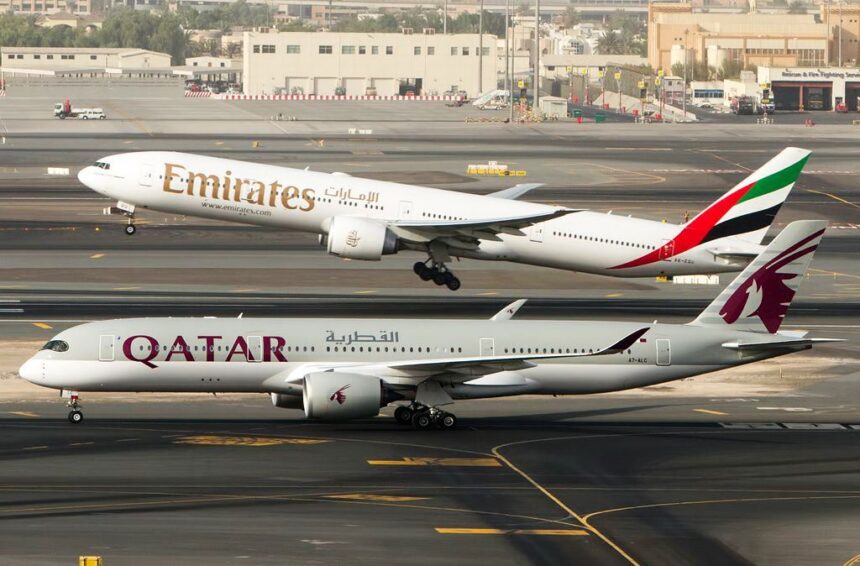
Qatar Airways emerged as the largest decliner in market share during the month following the outbreak of hostilities, according to the Bloomberg data, while Turkish Airlines recorded gains due to its geographical position.
“Gulf airlines will not abandon their ambitions to be global hubs,” said Rob Walker, an aviation analyst at consultancy ICF. “Europeans must simply try to capitalise while the opportunity is available.”
The shift comes as Lufthansa CFO Till Streichert cited “significant potential” for moving capacity to Asia more sustainably. Despite this, shifting operations remains complex; narrow-body aircraft used for European-Gulf routes are often unsuitable for longer Asian flights, and fuel-efficient wide-body replacements face multi-year delivery backlogs.
Rising energy costs triggered by the conflict have added further pressure. US carriers, which typically do not hedge fuel, benefited from a surge in bookings last month as passengers rushed to secure tickets before costs drove prices higher. Airfares have risen by up to 560%, threatening to disrupt the holiday season.
Financial markets have reacted sharply to the instability. Lufthansa’s share price has fallen 17% since the start of the war, while IAG—the parent company of British Airways—declined 13%, and Air France-KLM dropped 27%. Morgan Stanley and UBS recently lowered price targets for several European carriers, citing fuel expenses.
Political uncertainty persists as US President Donald Trump remained vague this week regarding the war’s timeline, while pledging to take more aggressive action against Iran.
The conflict has forced aircraft into narrow corridors over Georgia, Azerbaijan, and Central Asia to avoid closed Iranian and Iraqi airspace. European carriers face the additional challenge of avoiding Russian airspace, a restriction not shared by some Asian competitors.
“The problem for European airlines to Asia is airspace availability and competing with more competitive Asian airlines that can fly over Russia,” said Conroy Gaynor, an analyst at Bloomberg Intelligence.
The Middle Eastern hub model has seen massive growth over recent decades, with Emirates carrying 55.6m passengers in 2025—more than four times its volume from 20 years ago. Ben Smith, CEO of Air France-KLM, noted in an interview last month that while Gulf carriers possess modern infrastructure, differing competitive conditions between markets have contributed to their expansion.
Analysts warn the current window for Western gains may be brief. Richard Evans, senior consultant at Cirium, said he expects Gulf carriers to return with “very attractive prices” to regain traffic once the situation stabilises.
“European airlines may only have a short window to benefit from increased demand and higher prices,” Evans said