

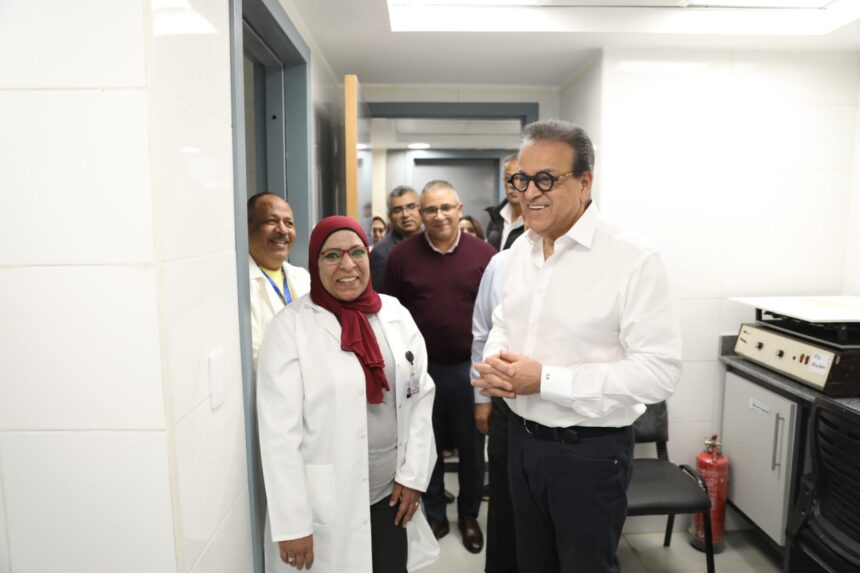
Egypt’s Health Minister Khaled Abdel Ghaffar conducted a series of field inspections of key healthcare projects and facilities in Cairo and Qalyubeya, as part of the government’s efforts to accelerate construction timelines and enhance the quality of medical services, according to official statements.
The Ministry of Health said Abdel Ghaffar began his tour with the Central Laboratories Complex project in Badr City, where he reviewed engineering designs and implementation progress at the main building, which spans 7,700 sqm across four floors within a total project area of 40,000 sqm.
The ministry noted that the first phase of the project is estimated at EGP 1.375bn, while the second phase is expected to cost EGP 2bn. Completion rates have surpassed 90%, with the project scheduled for completion by the end of April 2026 and trial operations expected to begin in July.
Abdel Ghaffar said the complex is being developed in line with international standards to deliver advanced laboratory services, commending both the architectural design and pace of execution.
The minister then visited Obour General Hospital in Obour, where construction has reached 99% completion. The hospital is being built on a total area of 16,700 sqm at an estimated cost of EGP 520m.
According to the ministry, the facility will include 189 beds—comprising 122 inpatient beds, 47 intensive care beds, 20 incubators and 20 dialysis beds—in addition to five operating theatres. It is expected to serve around one million residents in the surrounding areas.
During the visit, Abdel Ghaffar reviewed the hospital’s structural layout and operational plan, including outpatient clinics, inpatient wards, intensive care units, maternity services, operating theatres, laboratories, dialysis, endoscopy, emergency and radiology departments. He also directed the expansion of green spaces to improve the environment for both patients and medical staff.
In an unannounced stop, the minister visited the Third District Medical Centre in Badr City, where he inspected the laboratory and pharmacy and reviewed staffing schedules.
The ministry said he ordered an increase in staffing across various medical specialties and called for a reassessment of pharmacist allocations, in coordination with the therapeutic medicine sector and nearby hospitals, to address shortages and accelerate service delivery.
Abdel Ghaffar also engaged directly with patients in waiting areas, listening to their feedback and instructing facility management to respond promptly to their needs and remove any obstacles to care.
Separately, the minister inspected the Nasr City Health Insurance Hospital to follow up on ongoing development and upgrade works as part of broader efforts to modernise healthcare infrastructure.
The ministry said the hospital has a total capacity of 464 beds, including 398 inpatient beds and 66 intensive care beds, in addition to 11 emergency reception beds, 11 operating rooms, 18 incubators and 31 dialysis machines.
During the tour, Abdel Ghaffar visited several key departments, including the bacteriology and haematology laboratories, blood bank and CT scan unit. He reviewed the availability of medical equipment and trained technical staff, stressing the importance of equipping facilities with modern technologies.
The ministry added that the first phase of the hospital’s upgrade project has been completed and is now operational, covering central laboratories, pharmacies, the blood bank and a new 11-bed intensive care unit. Renovation work on the central sterilisation department and laundry unit has also been finalised, with both expected to enter service within three months.
The minister was accompanied during the visits by Peter Wajih, Assistant Minister for Therapeutic Medicine; Sherif Mostafa, Assistant Minister for National Projects; and Mohamed Abdel Hakim, Head of the Central Administration for Therapeutic Medicine, along with other senior officials.


