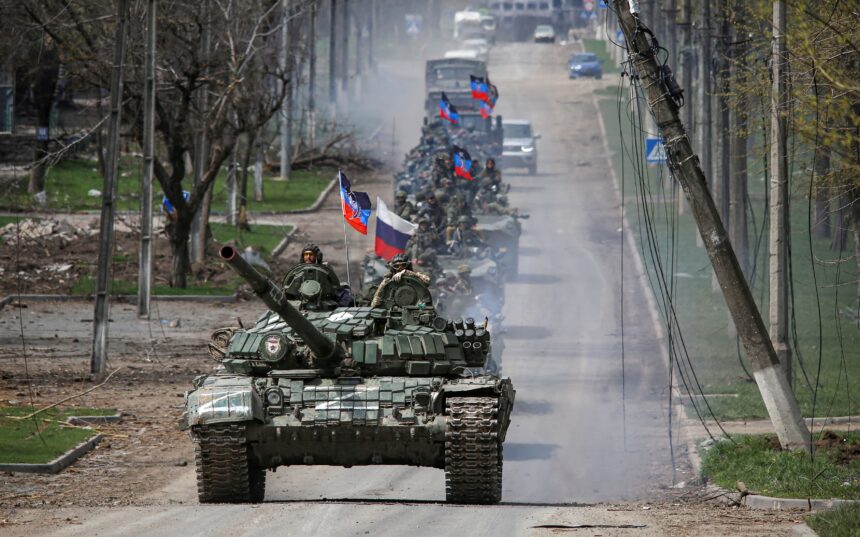
The Russian Defence Ministry said on Wednesday its forces have seized full control of the Luhansk region in eastern Ukraine, as Kyiv continues a campaign of drone strikes against Russian energy infrastructure.
Russia has long held more than 99% of Luhansk, one of four Ukrainian regions Moscow said it annexed in 2022. The move was rejected by Kyiv and most Western nations as an illegal seizure of Ukrainian territory.
The ministry stated that Russian forces also took control of the village of Verkhnia Pysarivka in the Kharkiv region and the village of Boykov in the Zaporizhzhia region of southeastern Ukraine. These battlefield reports could not be independently verified.
The reports come as the Ukrainian military increases strikes on Russian energy targets, amid rising crude prices and the easing of certain sanctions. Ukrainian forces said they carried out 10 major attacks this month on energy infrastructure, some of which reached deep into Russian territory.
President Volodymyr Zelenskyy told CNN on Saturday that Ukraine’s long-range drones have become more effective. “We responded to the strike that targeted our energy infrastructure. And we responded with a strong strike, which reduced the capabilities of Ust-Luga,” Zelenskyy said. He added that 40% of the capacity of the Ust-Luga terminal on the Baltic coast remained after the strikes.
A Russian oil refinery in Yaroslavl, northeast of Moscow, was also targeted early Saturday morning. While the military reported a direct hit followed by a fire, Yaroslavl Governor Mikhail Yevrayev said more than 30 drones were neutralised, though he noted damage to several residential buildings and a “commercial facility.”
Further attacks were reported at the Primorsk port last week and a Rosneft-operated refinery in Saratov. The Ukrainian security service stated that long-range drones damaged oil loading platforms and storage tanks containing petroleum products at Ust-Luga on Friday.
In response to the domestic market impact of these strikes and “unscheduled maintenance” at refineries, the Russian government is considering re-imposing a ban on gasoline exports starting April 1, according to state news agency TASS. Deputy Prime Minister Alexander Novak is reportedly discussing the measure with industry ministries and oil companies.
On the diplomatic front, the Kremlin on Tuesday gave a cool reception to a proposal by Zelenskyy to suspend attacks on energy facilities during Easter. Kremlin spokesperson Dmitry Peskov expressed scepticism, stating that Moscow preferred a comprehensive peace agreement over a limited truce.
“We have not seen any clear initiative regarding an Easter truce in the comments from Zelenskyy that we have seen,” Peskov told reporters.
Zelenskyy had stated on Monday that Kyiv was ready to halt strikes if Russia stopped attacking Ukrainian power grids. He noted that several allies had sent “signals” regarding the possibility of reducing long-range attacks on the Russian oil sector amid rising global energy prices.
The Ukrainian president also criticized the easing of U.S. sanctions, specifically a Treasury Department suspension of sanctions on Russian oil already at sea. Analysts suggest oil revenues, which account for at least a third of Russia’s budget, may have doubled over the past month.
Zelenskyy further stated that Russian intelligence is assisting Iran in targeting locations using satellite imagery, saying that the lifting of sanctions on Moscow allows for the transfer of critical information regarding attacks on allied bases in the region.