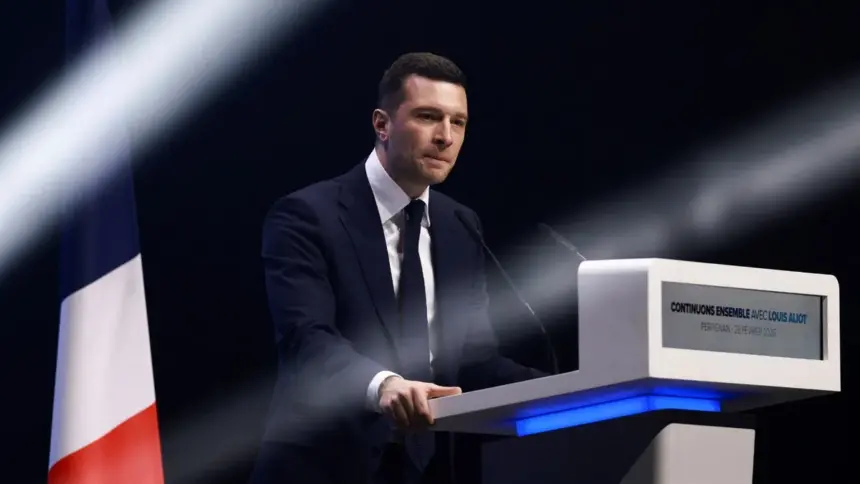
On the night the results came in, Jordan Bardella stood before a crowd of supporters in Paris and borrowed a line from the past. Invoking the ghost of François Mitterrand’s legendary 1981 campaign slogan, the president of the Rassemblement National cast himself as a “quiet force” — steady, inevitable, patient. “Our successes,” he told the room, “are not an endpoint. They are merely a beginning.”
It was a carefully choreographed performance of controlled ambition. The municipal elections had not delivered the sweeping urban conquest that some within the party had dreamed of. Yet by framing restraint as a strategy and partial victories as momentum, Bardella was already looking past the town halls — straight towards the Élysée Palace.
The local elections have, for now, confirmed a paradox that defines French politics in the run-up to the 2027 presidential contest: the Rassemblement National is simultaneously the most powerful political force in the country and the party least able to translate that raw power into governing authority. According to Politico, the anti-immigration movement led by Marine Le Pen is considered the frontrunner for the presidency — yet it remains hobbled by a structural weakness that has haunted it through two successive elections.
A Patchwork of Triumphs and Shortfalls
The evening produced what party strategists, in their more candid moments, were willing to call a “mixed picture.” The RN’s most striking triumph came on the Côte d’Azur, where an allied candidate captured the city of Nice — France’s fifth-largest city — in a result that will feature prominently in the party’s promotional literature for months to come.
In the south, the party waged muscular campaigns in Marseille, Toulon, and Nîmes. In all three cities, it performed strongly — and in all three, it finished second. In Marseille, France’s second city, the RN secured approximately 40% of the vote, a striking figure in a diverse, cosmopolitan port city that has long resisted the party’s advances. In Toulon and Nîmes, the margins were closer still, the kind of near-misses that can be read as either proof of progress or evidence of a ceiling.
The party’s leaders chose, predictably, to emphasise the positive. Marine Le Pen praised “dozens” of regional victories and insisted the party’s strategy of building local roots was bearing fruit. The wins came in medium-sized and smaller towns — Carcassonne, Ajaccio, Menton — as well as in Perpignan, which the RN had already claimed in the first round the previous week. For a party once dismissed as a protest movement with no interest in the mechanics of governance, the accumulation of local mandates represents a genuine strategic shift.
Bardella framed the results as evidence that the RN had achieved “the greatest breakthrough in its history,” gaining “strong momentum” that pointed, in his formulation, to “the end of an old world losing its impetus.”
The Second-Round Curse Endures
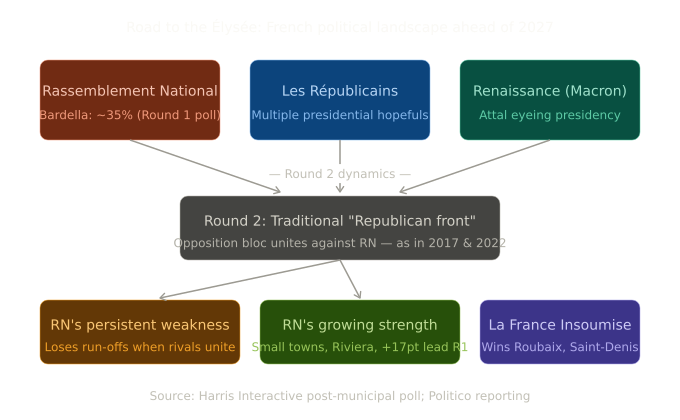
Yet history and arithmetic cast a long shadow over those celebrations. In Toulon, RN candidate Laure Lavalade began the first round with a commanding 42% of the vote — a 13-point lead over the incumbent conservative mayor, Josée Massi. It should, on paper, have been an eminently winnable race. Instead, a rival conservative candidate withdrew in favour of Massi, and the incumbent held on in the run-off. The “republican front” — the unspoken but effective tradition of mainstream parties uniting to block the RN — had worked again, as it worked against Le Pen in 2017 and again in 2022.
This is the RN’s enduring structural problem: it is the party against which all others define themselves. A post-election survey by Harris Interactive found Bardella leading the 2027 first-round polling with approximately 35% — a margin of 17 percentage points over his nearest centrist rival, former prime minister Édouard Philippe. But the second round, whereFrench presidents are actually chosen, remains a different calculation entirely. The coalition-building instincts of the mainstream are, for now, stronger than the RN’s capacity to fracture them.
Party insiders acknowledge the concern, even if the public messaging remains bullish. The inability to “break the curse” in the run-offs — as some within the party had hoped these municipal elections might finally do — is a wound that refuses to close.
How the Mainstream Is Responding
Gabriel Attal, the ambitious leader of Macron’s Renaissance party and himself a declared presidential aspirant, was sombre in his assessment of the evening. The results, he warned, reflected the rise of “the extremes” — a formulation that placed the RN alongside Jean-Luc Mélenchon’s hard-left La France Insoumise, which scored victories of its own in cities including Roubaix and Saint-Denis. “It is a warning signal,” Attal said. “More citizens want change, and they want it faster.”
For the centre-right Républicains, the picture was similarly uneven. The party consolidated its hold on several mid-sized cities — Limoges, Troyes, Brest, and Clermont-Ferrand — and retained Toulouse, where Jean-Luc Moudenc defeated a hard-left challenger. But it lost in Paris, where former culture minister Rachida Dati fell to Socialist candidate Emmanuel Grégoire, and narrowly lost in Lyon to a Green incumbent.
Party leader Bruno Retailleau, eager to carve out space between the two poles, declared the traditional right to be “the leading local political force” in France. He positioned himself explicitly as an alternative to what he described as the “social chaos” of the hard left and the “financial disruption” that, in his telling, would flow from an RN government’s economic programme. The word “populism” appeared more than once in his remarks about Bardella.
The problem for the Républicains is structural as much as rhetorical: the party has several figures with presidential ambitions — Retailleau among them — but no established mechanism for consolidating behind a single candidate. Without a unified standard-bearer, the centrist and centre-right space risks fragmenting precisely when the challenge from Bardella demands coherence.
Philippe’s Gambit and Bardella’s Long Game
Édouard Philippe, meanwhile, reinforced his own presidential credentials by securing re-election as mayor of Le Havre — a personal mandate that provides the kind of local legitimacy the Élysée race rewards. His positioning as a stable, experienced, governing alternative to Bardella is deliberate and patient, and the gap between them in the polls — wide but not impassable — gives his camp reason for measured optimism.
For its part, the RN’s leadership shows no sign of doubting the trajectory it has set. The party has spent years cultivating the image of a movement normalised by responsibility, no longer the volatile outsider of the Le Pen père era but a party of mayors, local councillors, and credible administrators. Each town hall won, each departmental seat taken, adds to the architecture of respectability the party is constructing around Bardella’s 2027 candidacy.
The question that will define the next two years in French politics — and that carries profound implications for Brussels and for NATO, given the RN’s longstanding scepticism of both institutions — is whether that architecture will be strong enough. Can Bardella convert first-round dominance into a second-round majority against a united mainstream? Or will France’s deep-seated instinct to rally against the extremes prove more durable than the grievances that feed them?
Standing before his supporters in Paris, borrowing Mitterrand’s language of quiet inevitability, Bardella was betting on the former. He did not mention Toulon.