

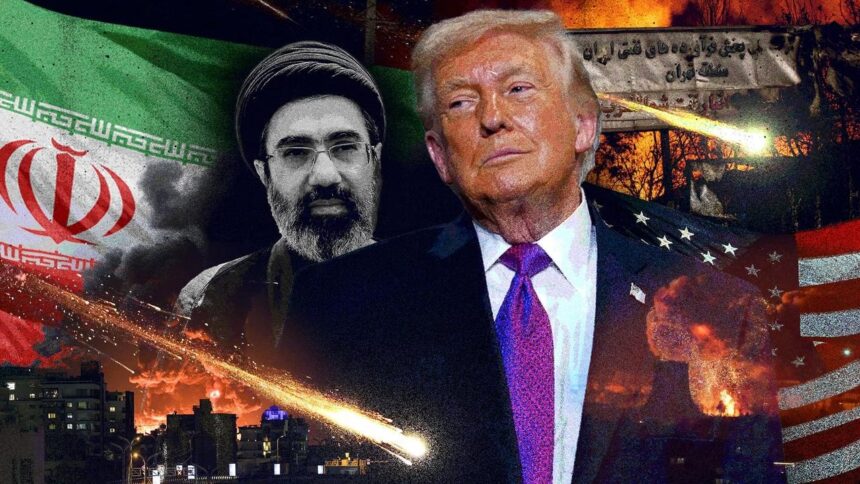
For decades, the capitals of the Middle East have been told a convenient lie: that security is a luxury product, available only in the showrooms of Washington, London, and Paris. We were taught that to be “safe,” we must drain our national treasuries to purchase $100m fighter jets and $2bn naval destroyers. We were told this was the price of admission to the “modern world.”
But as the fires of the current conflict with Iran illuminate the horizon, the mask has finally slipped. We are witnessing an “unfair war,” not merely in its kinetic escalation, but in its fundamental economic architecture.
The Arms Trap: Paying for Our Own Obsolescence
The Western vision of war is a closed loop designed to maintain strategic hegemony. They sell us “export versions” of their hardware—stripped of the most advanced electronic warfare suites and “upgraded” only enough to keep us dependent on their contractors for maintenance. We bleed our budgets on these white elephants, while the West reserves the true “edge” for themselves and their closest inner circle of allies.
This is not a defense strategy; it is a debt cycle. Every dollar spent on a Western interceptor is a dollar stolen from Egyptian schools, hospitals, and infrastructure. And for what? To be told by a foreign capital when and how we can use the very tools we bought with the sweat of our people?
The Iranian Lesson: Asymmetry as Liberation
Whatever one’s political stance on Tehran’s regional ambitions, there is a cold, technical reality we must acknowledge. Iran has proven that you can achieve a credible military deterrent for a fraction of the cost—if you have the courage to rely on national industry.
While the West continues to push the narrative of the “behemoth”—the massive, expensive, and increasingly vulnerable naval and aerial platforms—the battlefield of 2026 has been flattened.
– The Cost Ratio: We see $20,000 drones, manufactured indigenously, forcing the West to expend $2m interceptor missiles.
– The Vulnerability of Gold: In a world of cheap, mass-produced rockets and swarming FPV drones, the $15bn aircraft carrier is no longer a symbol of power; it is a target of staggering liability.
Iran’s success is not in its ideology, but in its refusal to play the West’s game. They have turned the “David vs. Goliath” dynamic into a sustainable industrial policy. They have shown that a nation can protect its skies without begging for a seat at a table that was never meant for them.

A Multipolar Alternative: The Role of China
In this shifting landscape, we must look toward a fairer model of partnership. China has emerged as the counterbalance the Global South has long needed. Beijing’s approach to military modernization is not about creating a hierarchy of “vassal states” through restrictive arms sales. Instead, they offer a vision of “intelligentization” and technological cooperation that aligns with national prosperity rather than draining it.
The Chinese model suggests a world where defense is integrated with economic development—where we build, not just buy. Their presence in the global market forces the old monopolies to face a hard truth: the era of “strategic sovereignty” through overpriced hardware is ending.
A Call for Egyptian Autonomy
Egypt stands at a crossroads. We can continue to be the world’s premier customer for the West’s military-industrial complex, or we can follow the lead of the new era. We must prioritize:
– Indigenous Mass Production: Investing in our own drone and missile programs to achieve a “low-cost, high-impact” deterrent.
– Diversified Partnerships: Strengthening ties with China and other Eastern powers to break the Western monopoly on high-tech components.
– Budgetary Realism: Refusing to sacrifice our economic future for “prestige” weapons that fail in the face of modern asymmetric warfare.
The war against Iran is a warning. It is a sign that the old gods of the Western war machine are failing. It is time we stop paying for their vision and start building our own.
Dr. Mohamed El-Seidy, pilot for EgyptAir, holder of a doctorate in Business Administration, and member of CPYP