

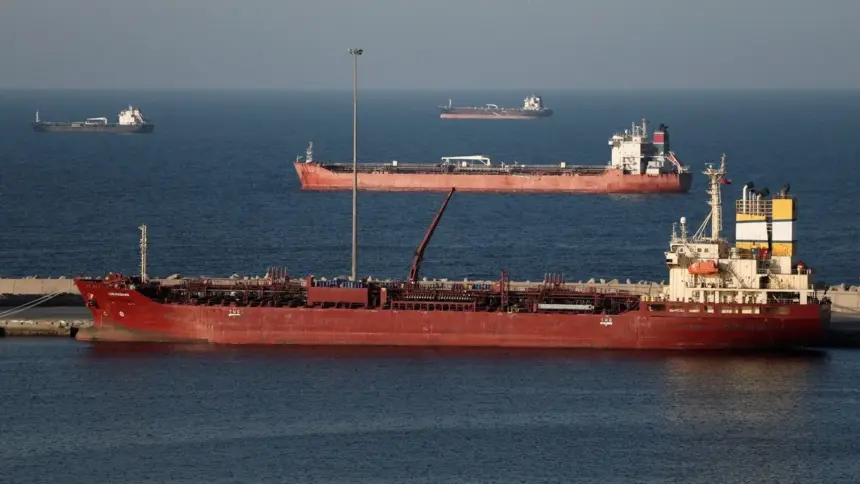
Iran is considering allowing a limited number of oil tankers to pass through the Strait of Hormuz on the condition that their cargo is priced in Chinese yuan, a senior US official told CNN.
The potential move comes as Tehran develops a new plan to regulate the flow of tankers through the waterway, the official added. Global oil trade is predominantly conducted in US dollars, with the exception of certain sanctioned exports, such as Russian oil, which is occasionally sold in roubles or yuan.
The Iranian Ambassador to India, Mohammad Fathali, said on Saturday that Tehran had already permitted some Indian vessels to transit the Strait, confirming a rare exception to a closure that has disrupted global energy supplies. Fathali did not specify the number of ships granted safe passage.
An Indian government official confirmed that two liquefied petroleum gas (LPG) tankers had crossed the Strait of Hormuz but noted that 22 Indian-flagged vessels remain west of the waterway.
“We are seeking safe passage for the remaining ships stuck in the Gulf,” the official said, noting that the stranded fleet includes four crude oil tankers, six LPG tankers, and one liquefied natural gas (LNG) carrier.
Shipping through the Strait has been almost entirely halted since the United States and Israel began launching attacks on Iran on Feb. 28. The disruption has driven global oil prices to levels not seen since 2022.
The Iranian Supreme Leader, Mujtaba Khamenei, who succeeded his father, pledged days ago to maintain the closure of the Strait of Hormuz as long as the US-Israeli war against his country continues. However, he noted that “the matter may change according to interests.”
“We believe in establishing friendly relations with neighbouring countries, and we only target US military bases, and we will continue to do so,” Mujtaba Khamenei said. “These bases must be disrupted as soon as possible because they have killed our children.”
Tehran has intensified its attacks on commercial vessels and tankers in the waters of the Arabian Gulf as the conflict has escalated. The near-total closure of the Strait affects approximately one-fifth of the world’s oil and gas supplies.
US President Donald Trump announced early Saturday that the United States had conducted air strikes targeting all military objectives on Iran’s Kharg Island. Trump indicated he might reconsider the decision to avoid targeting oil facilities and infrastructure on the island if navigation in the Strait of Hormuz faces further threats.
Iran relies heavily on Kharg Island, which processes approximately nine out of every 10 barrels of its oil exports, most of which are destined for China. Market concerns regarding the Strait, one of the world’s most critical energy arteries, have pushed oil prices to their highest levels since July 2022.
The Iranian Revolutionary Guard Corps stated on Thursday that it would keep the Strait closed in accordance with the orders of Mujtaba Khamenei, adding, “We will deal the strongest blows to the enemy.” However, the Iranian Foreign Ministry stated that many ships could still pass through the Strait if they coordinate with the Iranian Navy.
US Treasury Secretary Scott Bessent said in a television interview that the US Navy may escort ships through the Strait of Hormuz in cooperation with an international coalition once military conditions permit.
“I believe that as soon as military conditions allow, the US Navy, perhaps in cooperation with an international coalition, will escort ships through the Strait,” Bessent said.

