

The confrontation between Iran, the United States, and Israel intensified on Saturday as each side reported new military strikes, while the ripple effects of the conflict spread across the Gulf region, raising fears of a broader regional escalation.
Iranian Armed Forces spokesperson, Abolfazl Shekarchi, said preliminary information suggested the USS Abraham Lincoln (CVN-72) had sustained “significant damage,” adding that current assessments indicated the aircraft carrier was temporarily out of operational service and moving away from the combat zone.
Meanwhile, the United States Central Command (CENTCOM) said American forces had conducted a large-scale overnight strike on Iran’s Kharg Island, stating that more than 90 Iranian military targets had been successfully hit.
Iranian officials signalled that their response would intensify. A spokesperson for Iran’s defence ministry said the armed forces would expand the use of domestically developed weapons, particularly ballistic missiles and other advanced missile systems with greater destructive power, improved manoeuvrability and higher accuracy.
He added that military operations were proceeding according to a “planned programme,” warning that the pace of attacks would increase with the introduction of “new surprises” and more advanced weaponry.
The Islamic Revolutionary Guard Corps (IRGC) said it had attacked 60 strategic targets and about 500 U.S. and Israeli military sites since the conflict began, using more than 700 drones and hundreds of missiles, though it did not specify the exact types of weapons involved.
In Israel, air-raid sirens sounded across large areas of central Israel and settlements in the West Bank after missiles were launched from Iran, according to the Israeli Home Front Command.
Israeli broadcaster Channel 12 reported that missiles fired toward Tel Aviv landed in open areas without causing casualties. However, Israeli civil defence said two people were injured and four buildings damaged in the southern city of Eilat and in the Jerusalem area following the latest Iranian strikes.
The Israeli newspaper Haaretz reported that the missile that struck Eilat carried a cluster warhead, causing damage to several buildings, while other Israeli media reported missile fragments falling across about ten locations in the city.
Conflict spreads across Gulf states
The conflict’s impact has also spread to Gulf countries. The United Arab Emirates said its air-defence systems intercepted nine ballistic missiles and 33 drones launched from Iran on Saturday.
The UAE defence ministry said that since the attacks began, its air defences had intercepted 294 ballistic missiles, 15 cruise missiles and about 1,600 drones, adding that the strikes had killed six people of Emirati, Pakistani, Nepali and Bangladeshi nationalities and injured 141 others with minor to moderate wounds.
Thick black smoke was seen rising near a major energy facility in the Emirati port city of Fujairah after debris from an intercepted drone sparked a fire, local authorities said.
In Bahrain, the country’s defence force said it had intercepted and destroyed 124 missiles and 203 drones since Iranian attacks began on Feb. 28, adding that air-defence systems continue to counter what it described as ongoing assaults.
Separately, the UAE condemned a drone strike targeting its consulate in the Kurdistan Region of Iraq for the second time in a week. The attack injured two security personnel and caused damage to the building.
The IRGC warned that U.S. interests in the UAE, including ports, docks and military sites, had become “legitimate targets” following American strikes on Iranian territory, urging civilians to avoid such locations.
Shipping and energy concerns
President of the United States, Donald Trump, said Washington would continue heavy strikes along Iran’s coast and against Iranian vessels while working with several countries to keep the Strait of Hormuz open to global shipping.
He said nations including China, France, Japan, South Korea, and United Kingdom could send warships to help secure the vital waterway, adding that the United States would soon make the strait “safe.”
Trump also said a military base in Saudi Arabia had been attacked days earlier, though the aircraft stationed there sustained little damage and most had already returned to service.
Situation inside Iran
Inside Iran, First Vice President Mohammad Reza Aref said Tehran’s response would continue “until sustainable security for the country is achieved,” speaking during the funeral of Defence Minister Aziz Nasirzadeh, who was assassinated on the first day of the conflict.
Iranian authorities also reported a wave of arrests linked to alleged espionage and unrest. Police said 54 people had been detained over the past 72 hours on accusations of involvement in sabotage and riots allegedly coordinated with foreign actors.
Iran’s Mehr News Agency reported that the country’s air defences had destroyed an advanced cruise missile identified as an AGM-158 JASSM and shot down a U.S. drone over the city of Naein in Isfahan Province.
Cultural heritage damage
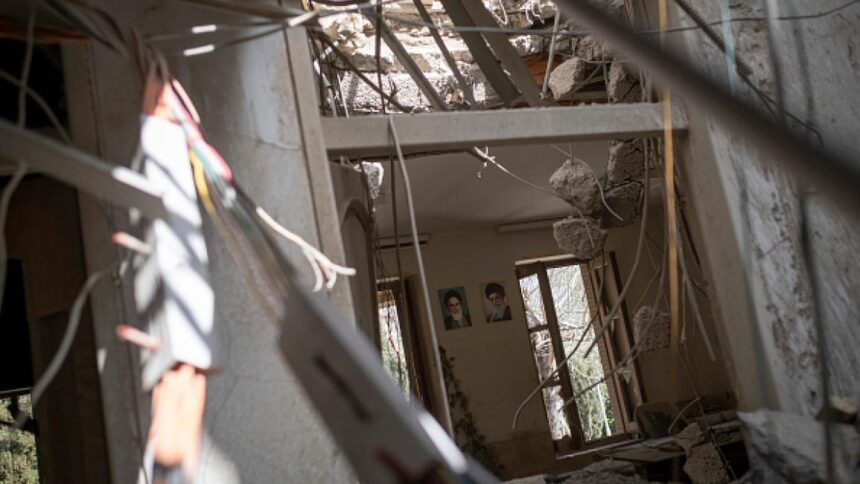
The conflict has also taken a toll on Iran’s cultural heritage. The country’s Ministry of Cultural Heritage and Tourism said at least 56 museums and historical sites had been damaged since the start of the war.
Among them is the Golestan Palace in Tehran, a UNESCO World Heritage site that once served as the residence of the Qajar dynasty between 1789 and 1925.
Officials said Tehran province recorded damage at 19 heritage sites, while the historic Naqsh-e Jahan Square in Isfahan, an architectural complex dating back to the 17th century, was also affected.
In the southern coastal province of Bushehr Province, several houses were damaged in the historic district of Siraf, a port city with buildings dating back one to two centuries.
The rapidly unfolding developments point to a widening regional confrontation, with missile and drone attacks spreading across multiple countries and growing concern over the security of energy infrastructure and shipping lanes in the Gulf.