

Escalating hostilities between Israel and Hezbollah intensified on Monday as the Lebanese government announced a ban on any security or military activity by the group, limiting its role to political engagement only.
Egypt’s Foreign Minister Badr Abdelatty said Cairo was closely monitoring what he described as a dangerous military escalation in the region and reaffirmed Egypt’s full support for Lebanon amid recent Israeli strikes. During a phone call with Lebanese Prime Minister Nawaf Salam, Abdelatty stressed the importance of shielding Lebanon from further deterioration and called for an immediate halt to Israeli military operations, according to a statement from Egypt’s Foreign Ministry.
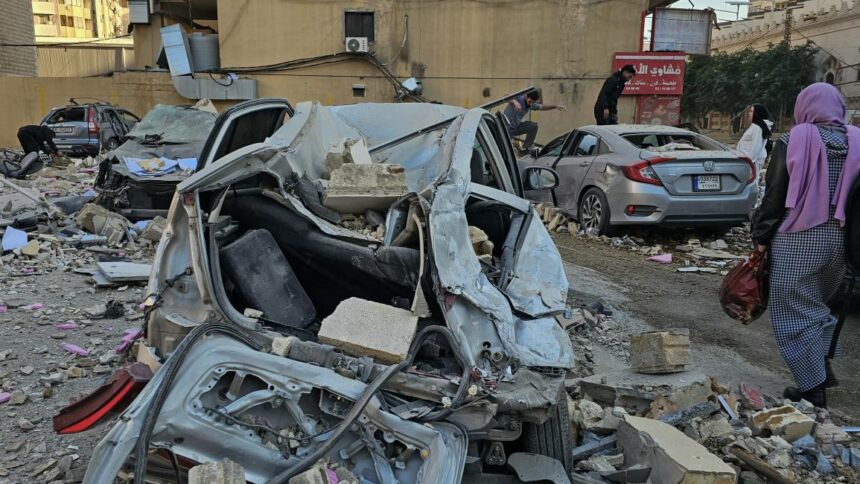
The diplomatic outreach came as Lebanon’s cabinet concluded a five-hour emergency session chaired by President Joseph Aoun. The meeting followed Hezbollah’s launch of a salvo of rockets toward Israel at dawn and Israel’s subsequent airstrikes on Beirut’s southern suburbs, southern Lebanon and the eastern Bekaa Valley.
In a statement after the session, Prime Minister Nawaf Salam said the Lebanese state categorically rejects any military or security actions launched from its territory outside the framework of its legitimate institutions. He emphasized that the authority to decide on war and peace rests exclusively with the state.
Salam announced the immediate prohibition of all Hezbollah security and military activities, the handover of its weapons to state authorities and the confinement of its role to political work within constitutional and legal frameworks.
The government instructed the Lebanese army to implement a plan to restrict weapons north of the Litani River using all necessary means. Security and military agencies were ordered to take immediate steps to prevent the launch of rockets or drones from Lebanese territory and to arrest violators.
Beirut also called on countries guaranteeing the ceasefire arrangement to secure a clear and final commitment from Israel to halt attacks across Lebanese territory. The government reaffirmed its commitment to the terms of the agreement and expressed readiness to resume negotiations with civilian participation and international sponsorship. The Foreign Ministry was directed to intensify diplomatic contacts to press for an end to Israeli operations and the implementation of relevant international resolutions.
The cabinet session opened with a minute of silence for those killed in the latest Israeli strikes. Lebanon’s Health Ministry said at least 31 people were killed and 149 wounded. Israeli airstrikes continued in several areas, including the eastern Bekaa region.
President Joseph Aoun said the rocket launches were neither in defense of Lebanon nor for the protection of its people. He questioned whether they had deterred Israel or instead exposed the country to greater danger. Those who launched the rockets, he said, bear responsibility for their actions, not the Lebanese population. He underscored the need to keep Lebanon neutral and safeguard its citizens.
Hezbollah earlier said it had targeted the Mishmar HaCarmel site south of Haifa with rockets and drones, describing the attack as its first declared response since the start of what it called U.S.-Israeli aggression against Iran. The group characterized the operation as retaliation and legitimate self-defense amid ongoing Israeli strikes.
Israel responded with airstrikes on multiple locations in Beirut’s southern suburbs and southern Lebanon. Defense Minister Israel Katz said Hezbollah would pay a heavy price and declared that its Secretary General, Naim Qassem, had become a target. He added that he and Prime Minister Benjamin Netanyahu had instructed the military to act forcefully against Hezbollah while continuing efforts to achieve what he described as the broader objective of crippling Iran’s capabilities.
Israeli Chief of Staff Eyal Zamir announced the launch of what he termed an offensive military campaign against Hezbollah, urging preparedness for days of fighting and saying Israeli forces had shifted from defensive to offensive operations.
The latest escalation comes amid rising regional tensions and mounting fears of a broader conflict that could further destabilize Lebanon and the wider Middle East, as diplomatic efforts intensify to prevent a wider war.


