

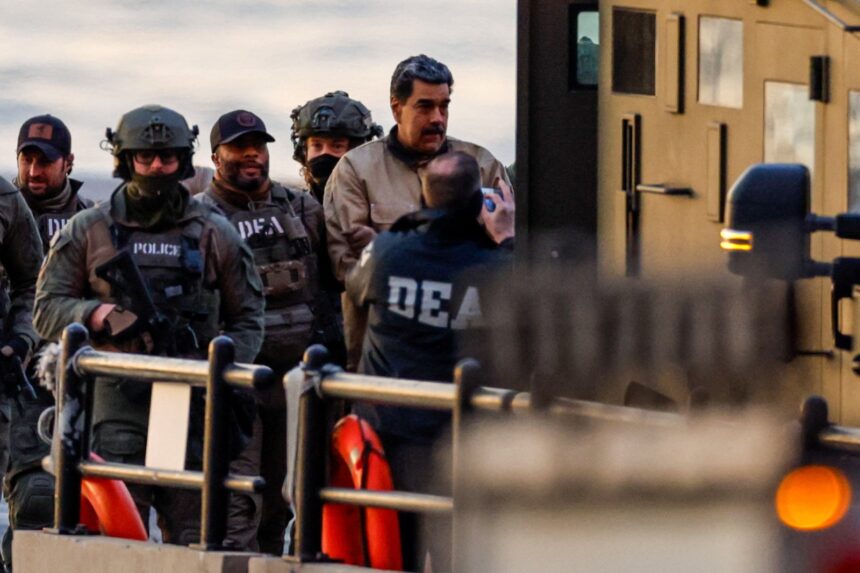
Venezuelan President Nicolás Maduro and his wife, Cilia Flores, appeared before a New York federal judge on Monday to face narco-terrorism and drug trafficking charges following a unilateral US military operation that prompted President Donald Trump to threaten further strikes if the remaining government fails to cooperate.
The Venezuelan leader and his wife arrived at the courthouse in an armoured truck, surrounded by US Drug Enforcement Administration (DEA) agents. Footage showed the vehicle entering the building ahead of the proceedings, where the pair appeared before 92-year-old Federal Judge Alvin Hellerstein, a Bill Clinton appointee confirmed in 1998. The charges against them include narco-terrorism, conspiracy, drug trafficking, and money laundering.
Speaking to the media while returning from his residence in Florida to Washington on Monday, President Trump escalated his rhetoric, threatening a second military strike if the remaining members of the Venezuelan government do not cooperate with US objectives.
Trump stated that his administration would “work with what remains of the Maduro regime to curb drug trafficking and restructure the oil sector,” rather than immediately pushing for elections to install a new government. He added that the United States would cooperate with Interim President Delcy Rodríguez, though he noted he had not spoken with her directly. “We are the ones running things,” Trump said.
As Maduro faces charges in New York involving “drugs, weapons, and terrorism,” Trump indicated that American oil companies would spend $bn to rebuild Venezuela’s crumbling energy infrastructure. He emphasised that the United States requires “full access” to the country, adding, “We need access to the oil and to other things in their country that allow us to rebuild it.”
Senior officials in the Maduro government remain in their positions and have described the arrest of Maduro and Flores as a kidnapping. The Venezuelan government has maintained for months that Trump intends to seize the country’s natural resources, specifically oil, citing previous statements by the US President regarding the entry of major American oil firms.
In a statement posted on social media following the arrest, Interim President Delcy Rodríguez adopted a more conciliatory tone, calling on the US government to work together on a cooperation agenda. Rodríguez said Venezuela “aspires to live without external threats.”
The US operation has sparked a wave of international concern and condemnation. On Monday, China’s foreign ministry called for the immediate release of Maduro. Ministry spokesperson Lin Jian told a press briefing that Beijing is “gravely concerned” by the arrest and is closely monitoring the security situation, noting that China has maintained “positive communication and cooperation” with the Venezuelan government.
The governments of Brazil, Chile, Colombia, Mexico, Uruguay, and Spain issued a joint statement on Sunday rejecting the “unilateral” military operation. The group described the action as a “highly dangerous precedent that threatens regional peace and security and puts the civilian population at risk.” They also expressed concern over “any attempt at governmental control or external seizure of natural or strategic resources in Venezuela.”
In Europe, calls for transparency have intensified. A German government spokesperson said on Monday that the United States must explain the legal basis for its actions to the international community. “The United States must explain to the international community on what basis the actions we have witnessed over the past few days should be judged, and this has not yet happened,” the spokesperson said.
British Prime Minister Keir Starmer also described the situation as “not clear” and called for an explanation from Washington. “What we need in Venezuela is a peaceful transition to democracy. That was our position before this weekend, and it remains our position,” Starmer told reporters. He added that international law remains the framework for judging the actions of all governments, noting that the situation is “complex” and involves ongoing developments.
French President Emmanuel Macron expressed a divided stance during a cabinet meeting on Monday. According to government spokesperson Maud Bregeon, Macron stated that France “does not support or approve of the method used” by the United States to arrest Maduro, citing the need to defend international law and the freedom of peoples.
However, Macron also referred to Maduro as a “dictator” and suggested his departure was “good news for Venezuelans.” The French President noted that France supports “popular sovereignty,” which he said was expressed during the 2024 presidential elections. Paris and much of the international community recognise opposition candidate Edmundo González Urrutia as the victor of that vote, and Macron asserted that the 2024 winner should play a “pivotal role” in any transition.


