

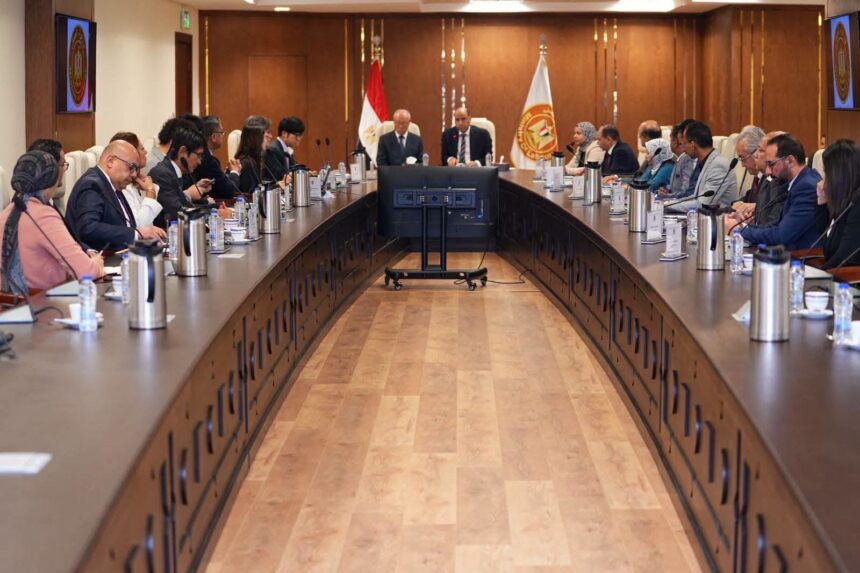
Egypt’s Ministry of Labor has launched an “Investor Facilitation Unit” to streamline regulatory procedures, with Minister Hassan Radad pledging on Sunday to resolve challenges regarding foreign work permits to encourage the expansion of Japanese businesses in the domestic market.
Radad announced the measure during a meeting at the ministry’s headquarters in the New Administrative Capital with representatives of Japanese companies operating in Egypt, attended by the Japanese Ambassador to Egypt, Fumio Iwai.
The gathering focused on enhancing bilateral cooperation in labour, investment, and vocational training. During the session, Radad listened to operational challenges raised by the Japanese representatives, primarily concerning procedures for foreign work permits and inquiries related to the application of the labour law and labour relations.
The minister affirmed the ministry’s commitment to studying and addressing these challenges in coordination with relevant authorities to remove obstacles, support the stability of corporate operations, and encourage further capital injections. Regarding foreign work permits, Radad confirmed the ministry’s dedication to expediting the review of applications and inquiries within the regulatory framework to ensure procedural efficiency.
Radad explained that the newly founded “Investor Facilitation Unit” is designed to enhance direct communication with business owners, simplify services under the ministry’s jurisdiction, and assist facilities in applying labour legislation. He added that the ministry is continuously developing its investor services to create an attractive investment climate and support private sector partnerships, in implementation of directives from President Abdel Fattah al-Sisi.
To support legislative compliance, the minister highlighted the importance of organising awareness seminars in cooperation with Japanese companies to introduce the provisions of Labour Law No. 14 of 2025. The sessions aim to clarify the legal rights, duties, and obligations of all parties in the employment relationship to enhance workplace stability, balance workers’ rights with employers’ interests, and sustain investment.
Radad also commended Japanese companies for their efforts in vocational training and skills development, noting that investing in human resources is a core pillar for raising production efficiency and industrial competitiveness. He expressed the ministry’s readiness to cooperate on developing tailored training programmes, leveraging Japanese expertise to prepare a skilled Egyptian workforce capable of meeting modern technological demands.
Sunday’s meeting follows earlier talks between the labour minister and the Japanese ambassador regarding new avenues for cooperation in occupational safety, health, and vocational training. Both sides concluded the session by emphasising the need for continued direct coordination to support Japanese corporate activities and joint training initiatives during the coming period.


