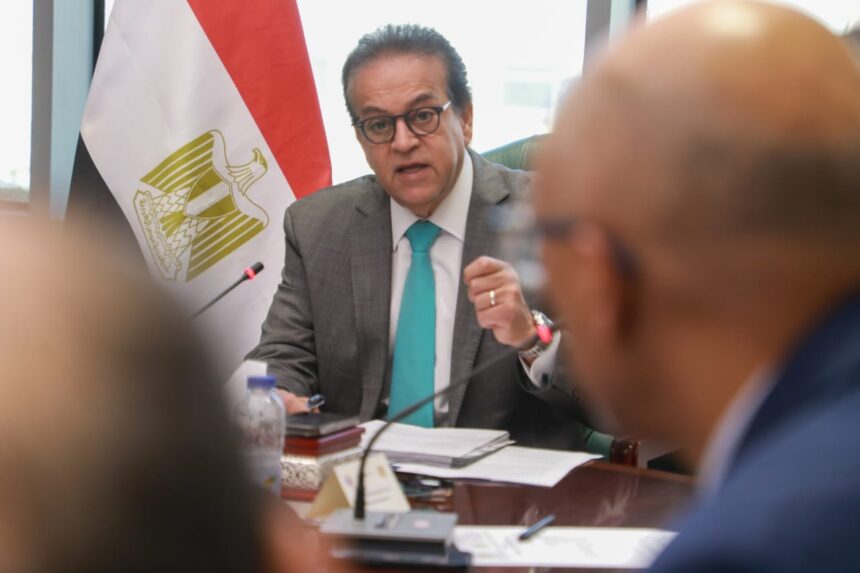
Egypt’s Minister of Health and Population, Khaled Abdel Ghaffar, chaired a meeting of the Board of the Emergency Medical, Genetic and Rare Diseases Fund on Monday to review the fund’s operations and discuss strategic initiatives aimed at strengthening healthcare services and expanding support for patients.
The meeting, held at the Ministry of Health’s headquarters in the New Administrative Capital, reviewed the fund’s recent activities and future plans, according to a ministry statement.
Abdel Ghaffar thanked board members for their efforts since the fund’s establishment, saying they had helped lay the foundation for its work. He also welcomed the newly appointed members, expressing hope for stronger coordination among stakeholders to achieve the fund’s objectives.
The board approved the minutes of its previous meeting and reviewed updates on a cooperation protocol with the Central Bank of Egypt to support the national initiative to eliminate surgical waiting lists, as well as a partnership with the Agricultural Bank of Egypt to finance corneal transplant procedures.
The ministry said the fund has supported around 17,000 corneal transplant operations since its establishment, including 1,000 procedures carried out under the protocol through March this year.
Board members also reviewed the fund’s contributions to the “Rare and Able” campaign, which supports patients with genetic and rare diseases, as well as its participation in activities marking World Rare Disease Day.
The meeting also discussed the fund’s financial position and reviewed its draft budget for the 2026/2027 fiscal year.
The board approved amendments to the fund’s bylaws in line with Law No. 5 of 2024, a move the ministry said would strengthen the fund’s governance and enhance its ability to support patients with emergency medical conditions and rare diseases.
Members also approved extending the mandate of the fund’s executive director on an interim basis until procedures for appointing a permanent executive director are completed.
The board stressed the importance of expanding partnerships with civil society organisations and non-governmental organisations to strengthen their role in supporting national efforts to address genetic and rare diseases and improve healthcare services for patients.