

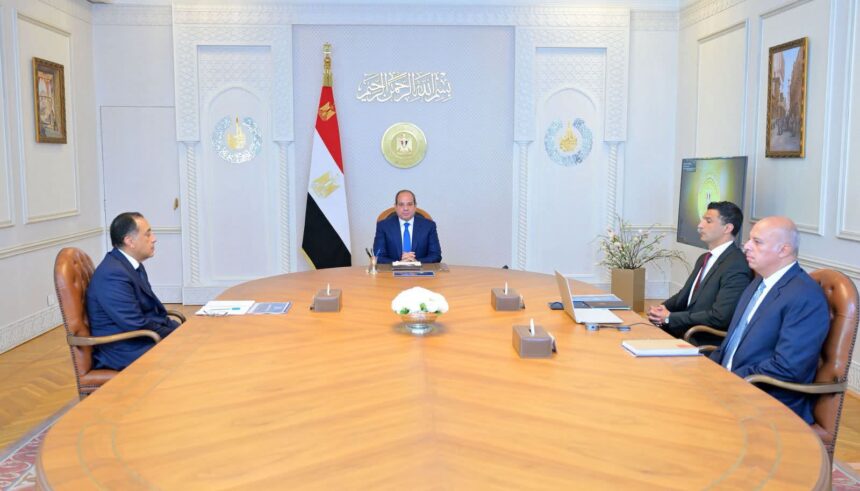
Egyptian President Abdel Fattah Al-Sisi on Monday reviewed the implementation of Egypt’s National Industrial Strategy 2026-2030, which aims to increase non-oil exports to $100bn and strengthen the country’s position as a regional manufacturing hub.
The strategy was discussed during a meeting with Prime Minister Mostafa Madbouly and Minister of Industry Khaled Hashem, according to a statement from the presidency.
Hashem said the strategy, developed in partnership with the private sector, comprises programmes focusing on industrial mapping, productive villages, the revival of distressed factories, legislative reforms, institutional development, supplier development, and support for small and medium-sized enterprises (SMEs).
The strategy identifies seven priority industries: ready-made garments, textiles, food processing, pharmaceuticals, automotive manufacturing, and the electrical, engineering, and electronics industries.
Al-Sisi directed that every component of the strategy be implemented according to a clear timetable, stressing the importance of integrating Egypt more deeply into global value chains to reinforce its position as a regional industrial and export hub.
The president also reviewed plans to expand domestic automotive manufacturing and localise vehicle technologies. Hashem described the automotive sector as one of the strategy’s highest priorities because of its potential to attract investment and facilitate technology transfer.
The minister said the government is implementing policies to transform Egypt into a regional automotive manufacturing centre through the National Automotive Industry Development Program, which is designed to attract leading global manufacturers.
Al-Sisi stressed the need to localise both vehicle production and component manufacturing, while expanding electric vehicle production in support of the country’s green economy objectives.
The meeting also reviewed the government’s roadmap for deepening and localising the steel industry, including measures to address challenges facing the sector. Al-Sisi emphasised the importance of expanding domestic production of industrial inputs for heavy industries to strengthen local supply chains, reduce imports, and increase value added within the Egyptian economy.
Hashem also presented updates on industrial zones and reforms aimed at streamlining procedures for establishing industrial projects. He said the government is expanding the use of renewable energy in manufacturing and implementing the “Industry Solar” initiative, which aims to install rooftop solar power systems at around 7,000 factories across Egypt.
The minister also outlined the Egyptian Initiative for African Industrial Integration, which aligns with the African Union’s Agenda 2063 and seeks to strengthen economic integration among African countries.
Al-Sisi emphasised the importance of expanding Egypt’s presence in African markets, strengthening strategic partnerships, and promoting regional industrial integration as a driver of intra-African trade and greater value addition to the continent’s resources.
The president concluded the meeting by calling for the full implementation of the strategy within the established timelines, wider adoption of digital technologies, greater private-sector participation in manufacturing, the swift removal of obstacles facing industrial investors, and increased investment in vocational training to support industrial development.
