

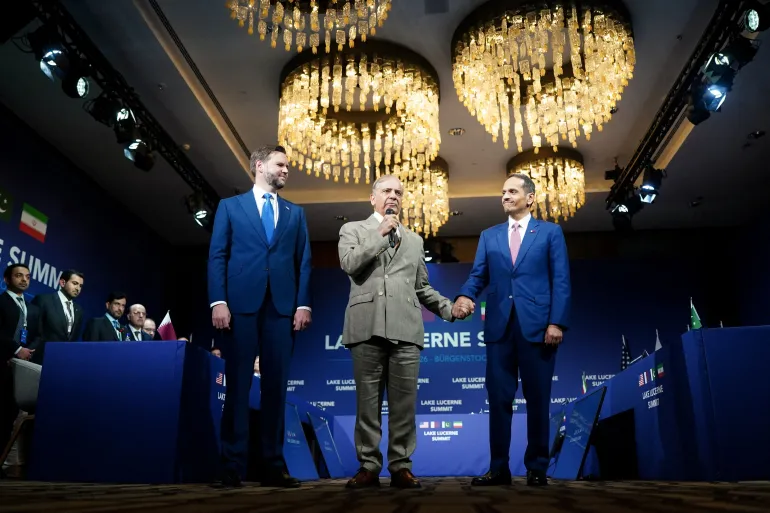
High-stakes talks between the United States and Iran in Switzerland were thrown into uncertainty on Sunday after US President Donald Trump threatened renewed military action against Tehran, prompting the Iranian delegation to suspend its participation and leave the negotiating venue, according to Iranian media reports.
The negotiations, held near Lake Lucerne with mediation from Pakistan and Qatar, began with separate meetings between the delegations and intermediaries. The US team met Pakistani officials, while the Iranian delegation, led by Parliament Speaker Mohammad Bagher Ghalibaf and Foreign Minister Abbas Araghchi, held talks with Qatari Prime Minister and Foreign Minister Sheikh Mohammed bin Abdulrahman Al Thani.
Iranian state television reported that the first round of four-party discussions lasted about 80 minutes before breaking for consultations. According to the report, the talks focused primarily on implementing Article 13 of the recently signed memorandum of understanding between Washington and Tehran, with particular emphasis on Lebanon. The nuclear issue was not discussed, contrary to reports carried by some foreign media outlets.
Iranian officials said the discussions centred on implementing provisions related to ending hostilities in Lebanon, releasing frozen Iranian assets, and establishing a proposed $300bn investment fund.
Speaking at the opening session, US Vice President J.D. Vance said the talks offered an opportunity to reshape regional relations. “The question is whether we can permanently change relations in the Middle East,” he said, adding that President Trump had tasked his team with pursuing diplomatic solutions to several regional disputes.
Qatari Prime Minister Sheikh Mohammed described the meeting as “just the beginning” of efforts to build a better future for the region, while Pakistani Prime Minister Shehbaz Sharif called the gathering a historic moment that could pave the way for broader international peace.
The atmosphere deteriorated, however, after Trump issued a warning on Truth Social demanding that Iran immediately stop its “well-paid proxies” in Lebanon from causing trouble.
“If they do not, we will strike Iran again, just as we did last week, but harder,” he wrote.
Iranian news agency Tasnim quoted a source close to the negotiating team as saying that the Iranian delegation left the venue in protest over Trump’s remarks, casting doubt over the future of the talks.
The dispute underscored the central role of Lebanon in the negotiations. Iranian Foreign Ministry spokesperson Esmaeil Baghaei said Tehran considers implementation of the memorandum’s provisions a top priority and stressed that final negotiations cannot begin until several key commitments are fulfilled, foremost among them ending military operations on all fronts, including Lebanon.
Baghaei said continued Israeli violations of the ceasefire would dominate the discussions, adding that Iran remained cautious about implementation based on previous experiences.
Israeli leaders showed little sign of changing course. Israel’s Prime Minister Benjamin Netanyahu said Israel would remain in its security zone in southern Lebanon “for as long as necessary” to protect northern communities and reiterated that he would never allow Iran to obtain nuclear weapons.
The Secretary-General of Hezbollah said the group would not accept a ceasefire that allows Israel unrestricted military freedom inside Lebanon.
“There will be no return to the situation before 2 March,” he said, warning that any Israeli violations would be met with a response.
Iranian President Masoud Pezeshkian also adopted a firm stance, insisting that Iran would not abandon its right to enrich uranium. He said the country’s military resilience and national unity had forced its adversaries to soften their positions, noting that issues once considered non-negotiable by Washington were no longer central demands.
Meanwhile, conflicting signals emerged over the status of the Strait of Hormuz. While previous statements suggested that maritime traffic could resume under the memorandum, Iran’s Fars News Agency quoted a military source as saying that the waterway remained closed and that the Islamic Revolutionary Guard Corps had not authorised the passage of vessels.


