

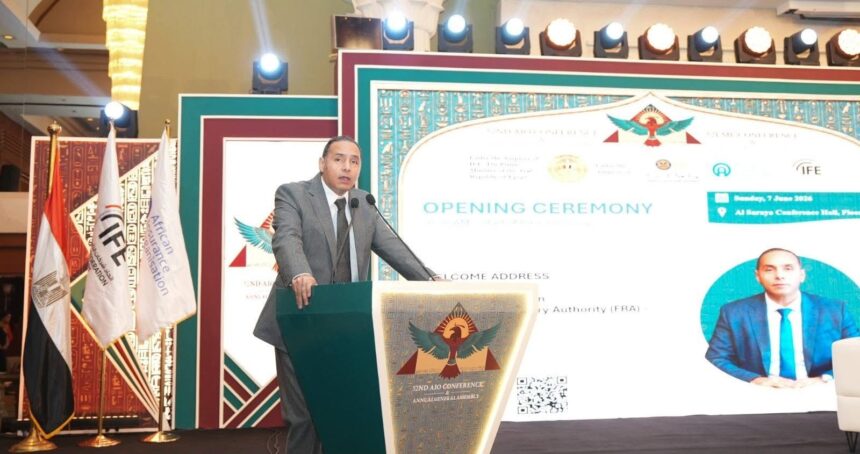
The Egyptian Financial Regulatory Authority (FRA) has approved two companies to issue insurance policies using financial technology and is processing applications from over 10 others, FRA Chairperson Islam Azzam announced on Sunday as part of a broader strategy to deepen the market.
Delivering the opening address at the 52nd African Insurance Organisation (AIO) Conference in Cairo, Azzam stated that the issuance of insurance documents via smart applications has “become a reality.” The FRA has established a flexible regulatory environment that mandates companies operating digitally to provide necessary technological infrastructure and implement the highest cybersecurity standards.
The two approved companies are authorised to issue policies via mobile applications, conduct electronic identity verification, fulfil “Know Your Customer” (e-KYC) procedures digitally, and register electronic contracts. Additionally, the FRA-Sandbox has hosted two projects utilising technology to improve the accuracy of risk and damage assessments and to expedite compensation procedures.
The conference, organised by the Insurance Federation of Egypt, was attended by Minister of Investment and Foreign Trade Mohamed Farid, who delivered a keynote speech on behalf of Prime Minister Mostafa Madbouly. Attendees included Minister of Planning and Economic Development Ahmed Rostom, Deputy Foreign Minister for African Affairs Mohamed Abu Bakr, AIO President Yared Mola, and Insurance Federation of Egypt Chairman and AIO Vice President Alaa El-Zoheiry, alongside various regulatory and industry executives.
Azzam noted that the push for digitisation and product diversification coincides with the second anniversary of Egypt’s Unified Insurance Law No. 155 of 2024. He described insurance as an essential tool for protecting Egyptian families, achieving economic empowerment, and supporting comprehensive economic growth.
The Egyptian insurance industry is undergoing a transition aimed at enhancing financial inclusion and expanding social protection through microinsurance and products targeting small and medium-sized enterprises, professionals, labourers, and agricultural workers. This aims to improve the ability of citizens and productive sectors to face various risks.
Despite the new legislative framework, Azzam highlighted that low insurance penetration remains a shared challenge across Africa, where rates do not exceed 3% in most countries, with the exception of South Africa at approximately 12%. He stated that awareness and product diversification are key to changing this reality, expressing ongoing support for the Insurance Federation’s initiatives to disseminate insurance culture.
To meet market demands, the FRA has issued approximately 80 executive decisions for the Unified Insurance Law over the past two years, aiming to build a regulatory framework compliant with international practices, governance, and risk management standards.
The authority has completed the regulation of core professions, including actuaries, consulting experts, and brokers, while continuing dialogue with the sector to build capacity through domestic and international training courses. In specialised activities, the FRA issued new regulatory standards for reinsurance and established the first registration criteria for Managing General Agents (MGAs).
Furthermore, the FRA finalised the regulatory and governance framework for specialised medical insurance and healthcare management companies. Six companies have received temporary licences to practise the activity, whilst four others have applied for final licences. In the microinsurance sector, the FRA approved the establishment of two new companies and is currently reviewing a third application to expand the beneficiary base.
Azzam stated the FRA has diversified distribution channels to include the postal service, banks, electronic stores, and telecommunications companies. Currently, 11 insurance firms market their products through the branches of 30 banks nationwide.
Financial solvency remains a primary focus. Azzam detailed that the FRA developed rules for calculating technical provisions and reserves, required a tenfold increase in capital, and mandated the implementation of the IFRS 17 international standard to unify accounting practices for contracts and enhance transparency.
To protect consumer rights, the authority has issued specialised controls for examining client complaints and providing effective mechanisms to ensure citizens receive their due services.
Azzam concluded his address by announcing that the FRA is currently studying a project to fully link the authority electronically with all non-banking financial sectors. The integrated digital system will facilitate advanced data analytics, streamline procedures, and raise the efficiency of regulatory services. He urged further integration and the exchange of successful experiences between African markets to support sustainable economic development and Egypt’s Vision 2030.


