

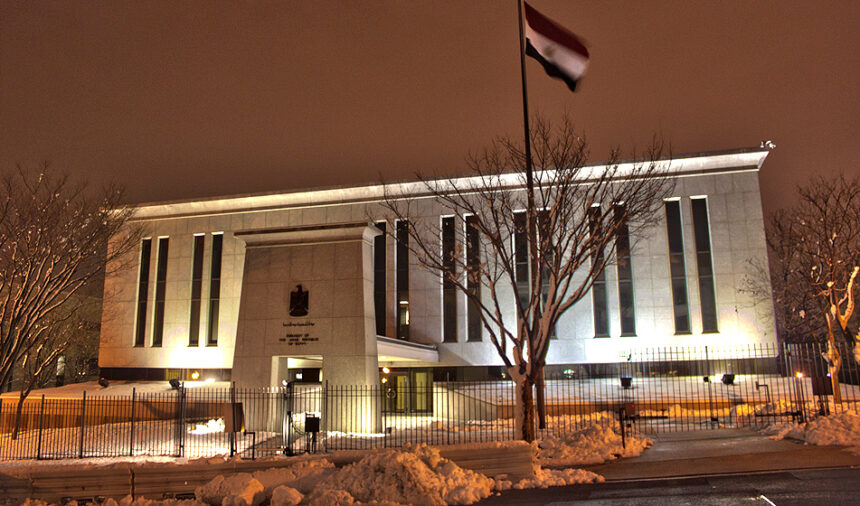
In the heart of Washington, where global policies are shaped, alliances forged, and strategic interests converge, Egypt faces a complex challenge: how to reassert itself as a central and indispensable partner to the United States in a region undergoing profound transformation.
This is no longer a theoretical question confined to academic debate. It has become an urgent policy issue, amid perceptions of declining Egyptian visibility within key US decision-making circles, alongside the rise of regional actors that have built more agile and diversified influence networks.
Against this backdrop, an intensive dialogue at Atlantic Council in Washington brought together its experts and a delegation of journalists accompanying Egypt’s “Doorknock Mission.” Discussions highlighted growing concern over the limited presence of the Egyptian file in the US Congress, despite Egypt being the largest Arab country, a major recipient of US military assistance, and host to the largest American embassy in the Middle East. Participants stressed that a country of Egypt’s geopolitical and economic weight cannot remain absent from strategic deliberations for long.
Influence Gaps and a “Lobbying Deficit”
Experts pointed to a widening gap between Egypt and other countries that have developed sophisticated influence mechanisms in Washington. Lobbying, they noted, extends far beyond traditional pressure groups; it encompasses a broad ecosystem of think tanks, media platforms, diaspora networks, and direct policymaker engagement.
“Influence varies across institutions,” participants noted, “with Egypt effective in some areas but less so in others.” The core issue is not a lack of influence per se, but the absence of a cohesive strategy to organise and deploy it. Unlike some regional peers, Egypt has yet to fully leverage a structured, diaspora-driven network capable of shaping congressional decision-making in a sustained way, despite active communities in Washington, Virginia, and Maryland.
Think tanks were identified as both an opportunity and an underutilised channel. Institutions such as the Atlantic Council play a critical role in shaping US policy discourse. Recent engagements by senior Egyptian officials were viewed as positive steps, but ones that require continuity within a broader, more systematic outreach strategy.
Shifting the Narrative: From Aid to Partnership
A key structural challenge in Egypt-US relations remains the dominance of a security-centric narrative, often at the expense of economic and developmental dimensions.
Experts argued that Egypt must reposition itself; from a recipient of assistance to a strategic economic partner. This shift would entail emphasising cooperation in energy, education, technology transfer, and renewable energy, where significant untapped potential exists.
They also highlighted the need for a more coherent engagement framework during official visits. Meetings in Washington often lack unified messaging, with disproportionate focus on defence and security, while other sectors receive limited attention.
Economic Pressures and Regional Spillovers
Regional instability continues to weigh heavily on Egypt’s economy, particularly through its impact on the Suez Canal. The war in Gaza, Red Sea disruptions, and tensions in the Bab el-Mandeb Strait have significantly curtailed shipping traffic.
Estimates cited during the discussion suggest the canal lost around $7bn in revenue last year. Prolonged instability along key maritime routes could further erode Egypt’s foreign currency inflows.
While alternatives such as the SUMED pipeline and LNG facilities were noted, they were described as insufficient to offset losses on this scale.
Relative Stability at a Fiscal Cost
Despite mounting pressures, Egypt’s relative stability in a volatile region remains a key asset. Compared to countries such as Sudan, Syria, and Lebanon, Egypt continues to demonstrate institutional resilience, supported by extensive social protection systems—including subsidies for food, fuel, and electricity—and large-scale programmes such as “Decent Life”.
However, this stability carries significant fiscal costs, raising questions about long-term sustainability.
Structural Reform and the Investment Climate
Participants underscored the importance of balancing fiscal consolidation—often linked to IMF programmes—with the need to sustain public investment and economic growth.
Strengthening the role of economic expertise in policymaking, improving project prioritisation, reducing debt vulnerabilities, and empowering the private sector were all cited as critical steps. Enhancing competition and improving the overall investment climate were also seen as essential to unlocking growth.
Regional Realignments and Emerging Opportunities
The discussion also touched on shifting regional dynamics, including evolving Gulf ties and the gradual rapprochement between Egypt and Türkiye. This development was described as strategically significant, with potential implications for regional engagement, particularly in Libya.
Experts also pointed to growing momentum around economic integration in the Middle East, where trade corridors and infrastructure development may increasingly precede political alignment.
Reframing Egypt’s Role in Washington
A recurring theme was the perception in Washington that Egypt “can do more.” Experts cautioned, however, that such views often overlook domestic constraints and regional pressures.
They emphasised the need for a more effective strategic narrative, one that highlights Egypt’s role in regional stability, counterterrorism, its geostrategic position, and its potential as an energy and logistics hub.
At the same time, strengthening the domestic investment environment remains essential to bolstering external credibility.
Toward a Strategic Reset
The discussion concluded that redefining Egypt’s role in Washington requires more than periodic diplomatic engagement. It calls for a comprehensive strategy built on four pillars: developing an effective influence network, broadening policy engagement beyond security, strengthening economic messaging, and improving the domestic investment climate.
Ultimately, Egypt’s most valuable asset remains its stability in an unstable region. The challenge now is to translate that stability into a coherent and compelling strategic narrative, one that restores Egypt’s position at the centre of decision-making in Washington as an indispensable regional partner.


