

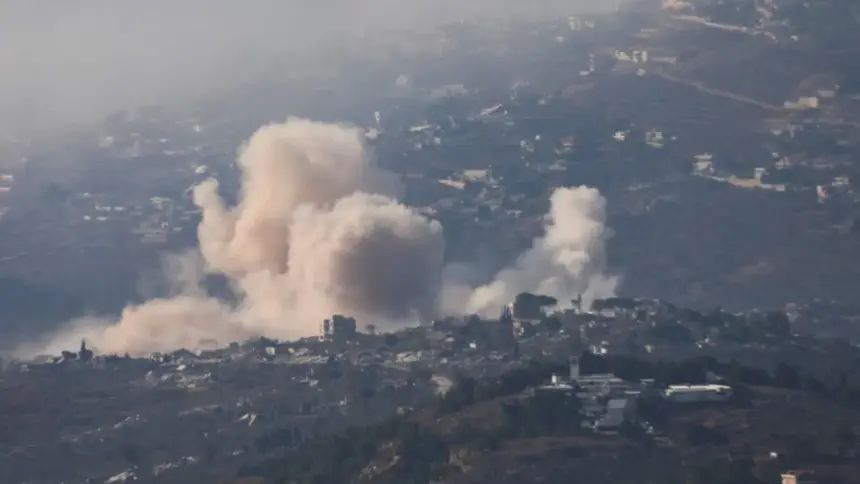
The Israeli military launched a series of airstrikes and artillery bombardments on southern Lebanon on Saturday, marking its first such operations since a 10-day ceasefire took effect, citing the need to enforce a “Yellow Line” that isolates 55 Lebanese villages.
In a concurrent blow to stability in the region, a French soldier serving with the United Nations Interim Force in Lebanon (UNIFIL) was killed and three others were wounded in a separate ambush by suspected Hezbollah militants in the southern town of Ghandouriyeh.
The Israeli military stated that its forces spotted Hezbollah elements south of the designated “Yellow Line” who had approached troops from the north in a manner that posed an “immediate threat.” The military said its air force and ground troops, supported by artillery fire, targeted the individuals across several areas in southern Lebanon to “remove the threat.”
According to the US network CNN, citing Israeli military officials, Israel intends to apply the “Yellow Line” model—a tactic previously utilised in the Gaza Strip—to southern Lebanon. The military has established a boundary within which it currently operates, and Lebanese residents will not be permitted to return to 55 villages located inside this zone.
The Israeli military asserted it is operating “according to political echelon directives” and is authorised to take necessary self-defence measures while safeguarding its deployed forces. It maintained that these actions are not restricted by the ceasefire agreement. Israeli Defence Minister Israel Katz stated on Friday that the military “will continue to control all areas it controls,” even as some Lebanese residents had begun returning to their homes in the south.
The fatal attack on the UNIFIL patrol occurred as peacekeepers were undertaking an ordnance clearance mission. UNIFIL reported that the patrol came under small arms fire from non-state actors suspected to be affiliated with Hezbollah. French Defence Minister Catherine Vautrin stated the soldier was caught in an ambush at “very close range.” Two of the wounded soldiers are in serious condition, and the Lebanese army noted that the patrol exchanged fire with the armed men.
Lebanese President Joseph Aoun offered his condolences to French President Emmanuel Macron, strongly condemning the targeting of the French force and praising the sacrifices of international troops. Aoun affirmed Lebanon’s commitment to protecting UNIFIL and announced he had directed competent agencies to conduct an immediate investigation, stressing that Lebanon “will not be lenient in pursuing those involved and bringing them to justice.”
Macron called the attack “unacceptable” and, in calls with Aoun and Lebanese Prime Minister Nawaf Salam, demanded the perpetrators be identified and prosecuted without delay. Salam confirmed he had issued strict instructions for an immediate investigation to hold the perpetrators accountable.
The military developments on the ground contrast sharply with statements from Washington, highlighting a growing gap between US and Israeli leadership. US President Donald Trump stated on his Truth Social platform that Israel is “banned” from continuing its bombardment of Lebanon.
According to the Israeli newspaper Haaretz, Trump’s post surprised the Israeli military and contradicts instructions issued to forces on the ground. Israeli military officials assert that withdrawing from the currently controlled area inside the Lebanese border is “not possible at this stage,” and troops remain authorised to continue destroying Hezbollah infrastructure during the ceasefire.
The initial 10-day ceasefire agreement between Israel and Lebanon came into effect on 16 April at 5:00 p.m. EST (midnight local time). The pause is intended to facilitate serious negotiations for a permanent agreement, with the possibility of extension if tangible progress is made.
Under the agreement, Israel retains the right to self-defence at any time against imminent or ongoing attacks without violating the ceasefire, while committing to refrain from offensive military operations inside Lebanon. The Lebanese government is obligated to take “concrete steps” to prevent Hezbollah and other irregular armed groups from launching attacks against Israel. All parties acknowledge that Lebanese security forces hold exclusive responsibility for defending the country’s sovereignty.
The US is tasked with facilitating further direct negotiations to address outstanding issues, including the demarcation of international land borders, to reach a comprehensive and lasting peace agreement.
Despite the diplomatic framework, earlier reports indicated the Israeli military seeks to establish a depopulated buffer zone inside Lebanese territory. Experts analysing satellite imagery and mapping data have highlighted extensive destruction surrounding approximately 11 villages near the Israeli border, including Ramyah, Ayta ash Shab, Blida, and Muhaibib, noting that existing geographic features are already being primed for the creation of this buffer zone.
