
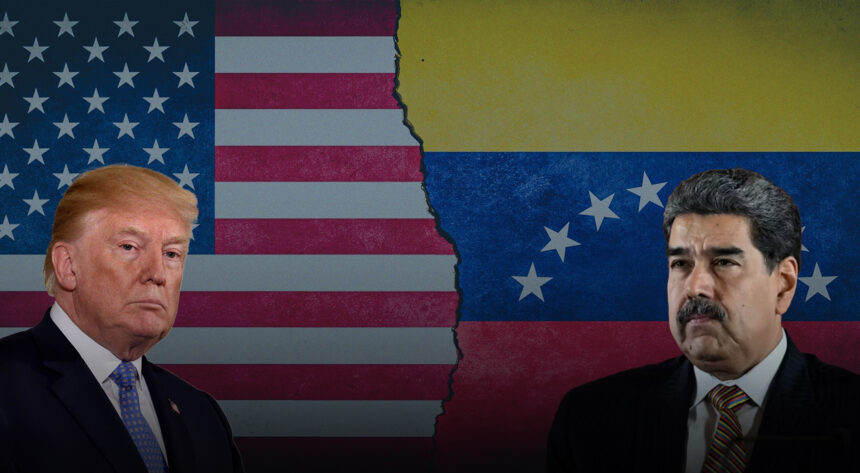
The decision by the U.S. administration, under President Donald Trump, to pursue legal measures against Venezuela’s president has once again reignited debate over the limits of power within the international system and the delicate line separating accountability from respect for state sovereignty. This debate unfolds at a global moment already marked by a rapid erosion of the rules that have governed international relations for decades. The move did not emerge in a vacuum; rather, it reflects a prolonged political and legal trajectory that points to deeper shifts in how international crises are managed.
Relations between Washington and Caracas have been chronically strained for years, driven by repeated U.S. accusations against the Venezuelan leadership of corruption, involvement in trafficking networks, and widespread human rights violations, in addition to a severe economic crisis that has forced millions of Venezuelans to flee the country. Over this period, the United States relied primarily on economic sanctions and diplomatic isolation as tools of pressure. These measures, however, failed to produce meaningful political change, prompting policymakers to search for more forceful alternatives.
What distinguishes the current phase is the shift from political and economic pressure to the use of cross-border legal mechanisms. This move carries implications that extend well beyond the Venezuelan case itself, opening broader questions about the legitimacy of such actions. Are we witnessing a natural evolution in international accountability mechanisms, or an expansion of legal power by major states outside established multilateral frameworks? The question is legitimate, but the answer remains complex.

International law, as it developed in the post–World War II order, rests on a fundamental principle: state sovereignty, with narrowly defined exceptions exercised through collective institutions rather than unilateral decisions. In recent years, however, this balance has become increasingly fragile, as major powers have turned to expansive interpretations of concepts such as extraterritorial jurisdiction and accountability for transnational crimes. As a result, the international legal system now faces a genuine test.
The core issue here is not the principle of accountability itself, but the manner in which it is applied. When international legal tools are enforced selectively, justice becomes vulnerable to doubt and is transformed from a shared system of rules into a field of political contestation. This dynamic reinforces a pattern of double standards that is difficult to ignore, whereby certain regimes are pursued while others are effectively exempted—not because of legal distinctions, but because of power calculations.
Nor can this development be understood in isolation from broader transformations in the structure of the global order. The world is no longer unipolar, nor governed by stable and widely accepted rules. Instead, it is witnessing a quiet struggle over the very definition of legitimacy: who has the authority to hold others accountable, and who decides when rules apply and when they may be bypassed. In such an environment, unilateral decisions become increasingly common, even when they are framed in legal or moral terms.
From the perspective of global leadership, this exposes a clear dilemma. Calls for a rules-based international order lose much of their credibility when they are not supported by consistent, collective practices that respect international institutions and constrain unilateral action. Otherwise, the result is a weakening of the very system that was meant to protect all states, not only those with political or military power.
At the same time, it would be unrealistic to ignore the fact that the absence of effective international accountability mechanisms often pushes states to act on their own, driven by the belief that existing institutions are no longer capable of fulfilling their intended role. This further complicates the picture, placing the international system between institutional paralysis on one side and the risks of unilateral overreach on the other—a dilemma for which there are no easy solutions.
For this reason, the post-Trump Venezuela debate should not be reduced to arguments over the U.S. president or the nature of the Venezuelan regime. Rather, it should be understood as part of a broader trajectory reflecting a deep crisis in global governance itself—a crisis rooted in the imbalance between power and law, and in the uncertainty surrounding the future of an international system increasingly unable to provide clear answers to its most pressing questions.
Ultimately, this is not a matter of endorsement or rejection, nor of siding with one actor over another. It is about confronting a question that has become increasingly difficult to avoid: how can the idea of international law be preserved in a world where political decisions move at accelerating speed, and where power at times precedes legitimacy? It is a question that remains open, and one whose answer has yet to be determined.
Dr. Marwa El-Shinawy – Academic and writer