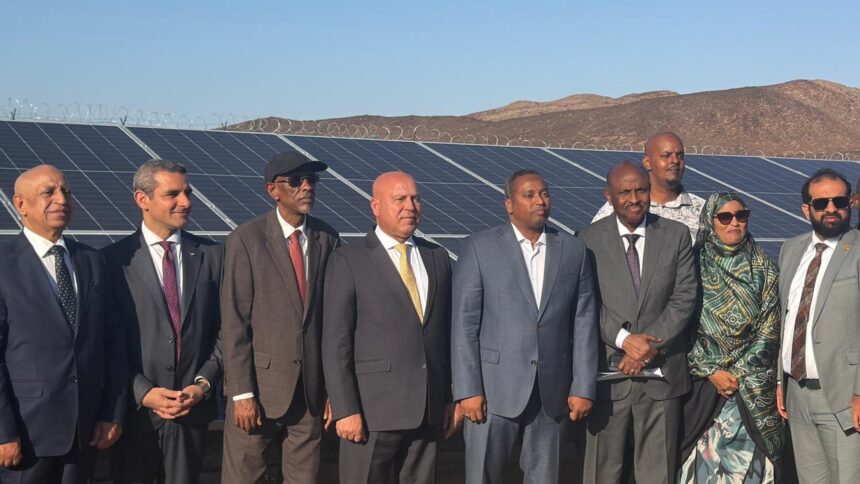
Egypt’s Deputy Prime Minister for Industrial Development and Minister of Industry and Transport, Kamel Al-Wazir, inaugurated a new solar power plant in Omar Jagaa village in Djibouti’s Arta region, marking a further step in strengthening bilateral cooperation between the two countries.
The inauguration ceremony was attended by Djibouti’s Minister of Energy and Natural Resources, Minister of Infrastructure, the Egyptian and Djiboutian ambassadors, local officials, and representatives of the Arab Organization for Industrialization (AOI) and the Egyptian Agency for Partnership for Development (EAPD).
During the event, Al-Wazir conveyed greetings and congratulations from President Abdel Fattah Al-Sisi and the Egyptian government to Djibouti’s leadership and people. He described the project as a tangible outcome of President Al-Sisi’s historic visit to Djibouti in April 2025, which laid the foundation for enhanced cooperation in energy, infrastructure, industrial development and the green economy.
“The solar power plant is more than a power generation project; it is a strategic pillar for improving quality of life, supporting local economic activities and promoting the use of renewable energy,” Al-Wazir said.
He stressed that the project reflects Egypt’s commitment to supporting African partners through the provision of technical expertise, capacity building and practical development solutions that deliver direct and measurable benefits to local communities.
Djibouti’s Minister of Energy and Natural Resources, Younis Ali Guedi, said the facility is the largest solar power plant completed in a rural area of the country. He described the project as a symbol of the deep-rooted friendship and strategic cooperation between Egypt and Djibouti, made possible by the support and leadership of both countries.
The project was implemented through the collaboration of several Egyptian entities. The Arab Organization for Industrialization carried out on-the-ground execution, while the Egyptian Agency for Partnership for Development provided primary funding and oversight as part of Egypt’s international development cooperation initiatives.
Technical support and advanced technologies, including remote monitoring systems, were supplied by Egyptian partners, including ARECO and Huawei Group. The plant has a maximum generation capacity of 300 kilowatts (kW) and is supported by an energy storage system with a capacity of 1.29 megawatt-hours (MWh), ensuring reliable and sustainable electricity supply for the local community.
The Omar Jagaa solar power plant forms part of a broader initiative to electrify remote rural areas in Djibouti and represents a key component of Egypt’s efforts to share renewable energy expertise with African partners.
Al-Wazir said the project paves the way for further cooperation in green energy, local industrial development and technology transfer between Egypt and Djibouti, contributing to sustainable job creation and the development of human capital.
“The inauguration of this plant is a clear demonstration of Egypt’s commitment to long-term, mutually beneficial partnerships across Africa,” he said, adding that the initiative aligns with the strategic visions of both countries for sustainable development and regional stability.
The project was first announced during its groundbreaking ceremony in June 2025, continuing the outcomes of President Al-Sisi’s April 2025 visit to Djibouti, which significantly strengthened bilateral cooperation in the energy and infrastructure sectors.