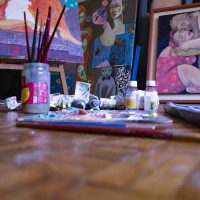


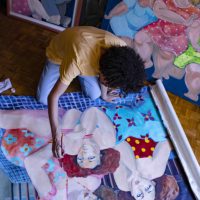


“Art is the only way to run away without leaving home,” Egyptian painter and puppeteer Abdelwahab Hawam recalled a favourite quote while he was finishing one of his paintings in preparation for his first upcoming solo exhibition in Lebanon next September.
Hawam, 30 years old, who was born in a small village in El Mahalla El Kubra, Gharbeya, tried very hard to maintain the spirit of the countryside, colours, and facial features of people who used to be his family members, colleagues, and neighbours, as well as the kinds of warm, close relationships between them there, according to his description.
Inside a tough, crowded, and even dull city, Cairo, he combined his skills of painting and puppeteering, the first professionally, and the other as an amateur. As a painter, he decided from his early age to break into a field which he believes is “full of corruption and favouritism,” much like other careers in Egypt.
“I knew from the first moment that I could not be anything but a painter, which I can do well, and it is the only thing that makes me happy, satisfied, and alive,” said Hawam.
After finishing high school in El Mahalla El Kubra, he moved to Cairo to study at the Faculty of Fine Arts of Helwan University, starting a path he wished to leave his mark within.
As a child, he used to keep colours and sketchbooks to paint whatever he wanted. Some people who crossed his path had supported him, others had tried to obstruct his progress, as they kept warning that he was committing a sin by painting and portraying people. “I was repeatedly told by teachers and acquaintances that painting is forbidden, but I never agreed with that. I don’t hurt anyone when I paint, I am just doing something I love,” noted Hawam.
However, at home, he has a mother who strongly supported her child’s talent. “My mother kept encouraging and pushing me to improve my skills, she is the person who helped me most in my life,” said Hawam.
After his graduation, he hardly found a chance to achieve his dream and become a painter. “I had to work as a decorator for a while, but I could not go on. I only wanted a quiet place and a paintbrush, but it did never go that easy.”
Following a period of being upset, he decided to leave the capital and return to his hometown. “I could not continue living in Cairo with a job I dislike and low salaries. So I went back to El Mahalla,” said Hawam, adding, “I needed to isolate myself and keep working on new paintings until I could return to Cairo as a real artist.”
Hawam overcame the days and months full of frustration in his room with his painting tools, until he found a chance to show a gallery owner some of his works, who decided to buy them. “They were instantly sold from his gallery; I felt that maybe it is time to get back and start again.”
Hawam returned to Cairo, renting a new house and continuing to work hard. “I said this is what I have to do: keep working even if it might take a long time to achieve what I want.”
However, being a professional painter has never been easy for him, as he sometimes found himself forced to meet clients’ demands or galleries’ requests. “Once a gallery owner asked me to stop painting dull and sad paintings because clients started complaining as they wish to get ‘cheerful’ ones,” said Hawam.
He added, “at first, I felt I don’t have to do this; I paint what I feel and what reflects me and my experience in life, but I had to accept to ease the selling of my paintings.”
Hawam further added, “unfortunately, in Egypt, galleries are preserved for well-known painters or [people with] good networking or connections so I wanted to take my chance even if it meant taking a step back.”
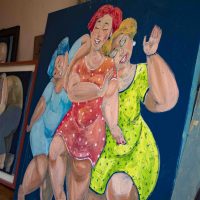
However, those “cheerful” or “full of life” paintings became, over time, acceptable to Hawam. “I paint fat ladies laughing, chatting, and spending their daily lives in scenes which are familiar to every house in Egypt,” noted Hawam. However, he explained, “portraying fat ladies does not mean that I want to change beauty standards or help women accept their bodies, as they should always do.”
“I paint them because I accept all people with different shapes of bodies, without any discrimination,” said Hawam.
He further said that painting curly haired people from rural areas revealed the environment where he grew up. “Of course I am influenced by people in the countryside, men and women. There was a heart-warming social life that I really miss in Cairo.”
“But regarding women in my paintings,” he said, “I love curly hair and elegant, simple clothing, as the most inspiring one was the Egyptian actress Soad Hosny, especially her role in Shafika and Metwali (1979).”
Amid daily stresses and sadness, Hawam tries to find brightness. “I always search for beauty and optimism inside things and people,” he said.
Hawam added, “I always keep looking for things or people to share positive energy with, avoiding stress or pressures such as in politics or sports. I know that artists should be aware of their political situations, reflecting and documenting voices of people and events, but, I prefer to avoid getting involved at all, searching instead for things that give me positive and optimistic impetus.”
Hawam took part in many collective exhibitions, but never had his own one yet.
“There are galleries that exhibit the works of a few painters they know, refusing to include other painters; this was so disappointing,” he said, adding, “in Egypt, if you want to be a famous painter, you have to paint what clients want.”
He noted that some clients randomly select the paintings, as they just care for colours or styles. “There is a trend these days that people love to acquire paintings that only match their home furniture colours and styles,” said Hawam, adding that they do not appreciate the art.
He added, “I believe that people should choose a painting that means anything to them, on personal or emotional levels, like one that reminds them of people they love, they lost, or their future or past, it has to mean something.”
“I really do not mind giving my paintings to someone who cannot afford paying its price as long as it means anything to them,” Hawam further said.
While painting took long years from Hawam, puppeteering was just a hobby, until it helped him to spread his paintings through social media, and even in obtaining work offers.
“I was surprised by the huge reactions I got on a video featuring my puppet, Aziza, dancing nearly a year and a half ago,” said Hawam, adding that he never studied anything related to puppeteering or the mechanisms of moving puppets or manufacturing them.
Hawam continued posting videos featuring Aziza, dancing to folkloric or modern music. Videos widely circulated inside and outside Egypt, giving him a new audience for his paintings. “I was not happy at the beginning because people cared for Aziza more than my paintings, but after a while, I become grateful to her,” he said.
Aziza was the lucky card for Hawam, who is warming up for his first solo exhibition in Lebanon. “My paintings were exhibited before in collective exhibitions, but this time, it is different. It is my first sole one. I am so excited and worried.”
Hawam was mostly influenced by the Egyptian artist Ragheb Ayad. “I started by simulating his paintings when I was a child,” he said, adding, “I also like Gazbia Sirry, George Bahgoury, Inji Aflatoun, Vincent van Gogh, Egon Schiele, Marc Chagall, and others.”
He could work on a painting for hours without feeling exhausted. “It does not matter if you exert efforts on something you love, I hope everyone seeks potential in things that makes them satisfied and happy. Choose careers in which they could be successful, despite standards of high grades or top universities,” he said, adding, “all of us have something to offer to society, and deserve a chance,” Hawam concluded.