

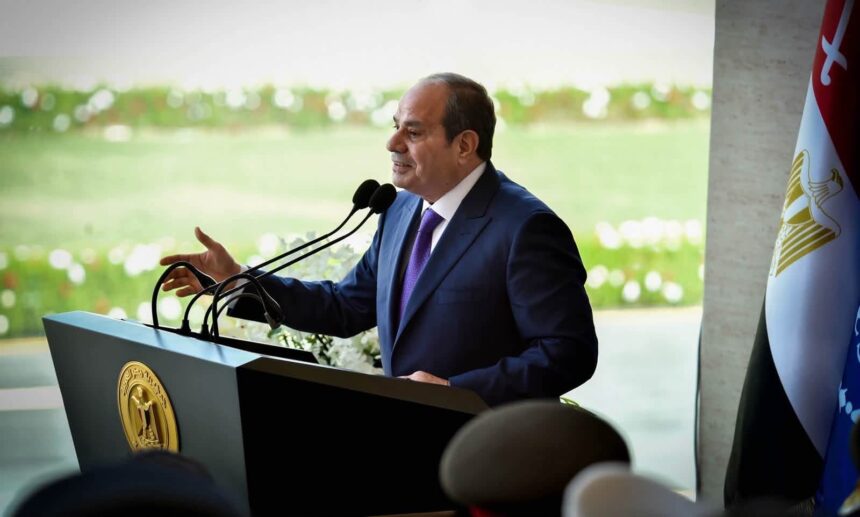
In a rare moment in our modern history, we find ourselves confronted with a presidential statement that touches the core of our political future: a commitment to constitutional presidential term limits and a refusal to amend the constitution to extend one’s stay in power. This statement, whether met with optimism or caution, represents a turning point that could prove to be the most significant in recent decades, not only because it opens the door to public debate, but because it strikes at the very roots of the power structure itself.
For me, as an Egyptian citizen who believes that the constitution is the supreme social contract and that the peaceful transfer of power is the cornerstone of any stable democracy, this statement is more than mere words. It is a declaration of the potential end of the era of the “eternal president” and the possible beginning of the era of the “institutional president”.
Our history is replete with examples in which a ruler’s ascent to power was not merely a transition into office but the beginning of the formation of vast networks of interests and influence. These networks, which permeate state institutions and the worlds of finance, business and media, find in the ruler’s continued tenure a guarantee of their own continuity and gains. Over time, these networks become akin to a state within a state, fiercely defending their interests and viewing any change as a threat to their existence.
Herein lies the transformative power of adhering to the constitution. The mere realisation by these networks that the current political era is approaching its inevitable end will force them to recalculate. Alliances that appeared solid may unravel, and loyalties that once seemed absolute may be reassessed. This silent manoeuvring behind closed doors, where files are reopened and positions re-evaluated, constitutes the real challenge.
This transition, if it occurs, would represent a historic precedent: a transfer of power governed not by crises, revolutions or death, but by a predetermined and peaceful constitutional mandate. This is the true test of our state’s ability to separate the continuity of institutions from the continuity of individuals, and the supreme national interest from the interests of those who profit from preserving the status quo.
Domestically, establishing this democratic legacy would send a reassuring message to citizens that their will, as embodied in the constitution, is respected. This would strengthen confidence in state institutions and promote genuine development based on merit and accountability rather than patronage and loyalty.
Internationally, Egypt’s image as a state of institutions that respects its constitution and remains committed to a democratic path would be significantly enhanced. This political stability, built upon solid constitutional foundations, would earn Egypt broader international respect and attract long-term investment seeking a stable political environment that does not depend on the continued presence of a single individual.
The true hope lies in the Egyptian state becoming the only constant and the ruler returning to his natural role as a public servant, arriving on time and leaving on time, while leaving behind a legacy of strong institutions and respect for the rule of law. This is the genuine stability we seek: a stability that does not falter with the departure of a ruler, but grows stronger through respect for the will of the people.
Dr Mohamed El-Seidy, a pilot, businessman, and a member of the CPYP
