

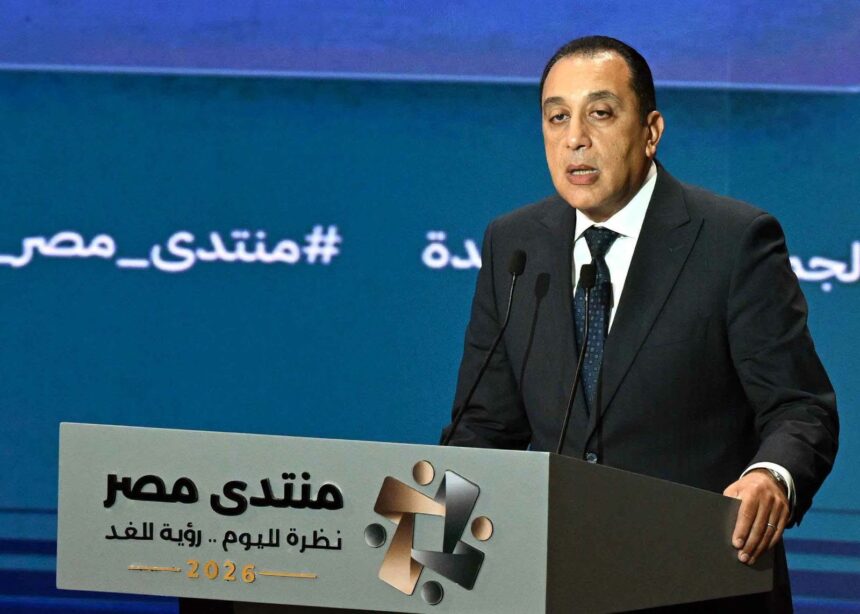
Egypt’s Prime Minister Mostafa Madbouly said Egypt Forum 2026 aims to establish shared national priorities and develop actionable solutions with clearly defined responsibilities and measurable outcomes, as the government seeks to address citizens’ concerns and set its agenda through 2030.
Speaking at the opening session of the forum, held under the theme “A Look at Today, a Vision for Tomorrow” in the presence of President Abdel Fattah Al-Sisi, Madbouly said the event was designed to facilitate constructive dialogue among the government, civil society, experts, political figures, opposition representatives and citizens.
“The government will not speak alone while citizens listen; the opposite is what should happen,” Madbouly said, stressing that the forum would provide an opportunity for citizens to raise questions and for government officials to respond openly.
He noted that the forum would review Egypt’s development efforts over the past 12 years, assess achievements and shortcomings, and address public concerns over government policies and national projects.
Madbouly added that discussions would also examine the challenges that had prompted changes in some government priorities, with the aim of objectively evaluating past decisions and identifying priorities for the coming years.
More than 16,000 proposals submitted
The prime minister said preparations for the forum included public opinion surveys, consultation sessions and discussions involving universities, research centres and civil society representatives.
During the 15 days following the president’s call to organise the forum, surveys were conducted among citizens, young people, investors and private-sector representatives to identify their main concerns and assess their satisfaction with public services.
More than 450 citizens participated in listening sessions at the National Training Academy, submitting around 150 ideas and proposals. Meanwhile, more than 4,000 academics, researchers and experts took part in 30 preparatory sessions held across 28 Egyptian universities.
The government also organised approximately 13 preparatory sessions involving 16 think tanks at the Cabinet’s Information and Decision Support Center.
Madbouly said the forum’s website had recorded 17 million views and more than 61,000 registered participants, who submitted over 16,000 ideas and proposals. Around 50% of registered participants were aged between 18 and 35, including more than 5,000 students, some of whom were school pupils.
The consultations identified more than 42 public questions for discussion during the forum, covering issues including the New Administrative Capital, infrastructure spending priorities, the future of Egypt’s economy after its programme with the International Monetary Fund (IMF), external and regional challenges, and public debt management.
Madbouly said the government would respond to citizens’ questions transparently and without withholding information, while presenting the results of its policies and explaining the reasoning behind major decisions.
Education, inflation and healthcare top public concerns
According to the prime minister, five issues emerged as the leading priorities for approximately 70% of respondents: education, prices and inflation control, improving healthcare services, wages and pensions, and maintaining security and stability.
Other concerns included culture and media, strengthening national identity, employment, youth and sports, and information and communications technology.
Madbouly said the findings would help shape the forum’s agenda and ensure that discussions reflected citizens’ needs, particularly those of younger generations.
The forum’s programme is organised around several main themes, beginning with human development. The first day focuses on education, youth and creativity, culture, and social values, with discussions examining how to improve educational outcomes and expand opportunities for learning, participation and innovation.
The second day addresses integrated development and quality of life, including urban development, healthcare and digital government services. Discussions will examine how to maximise the benefits of national projects and improve the accessibility and efficiency of public services through digital transformation.
A further theme focuses on social protection and community security, including economic and social pressures on households, social protection programmes, and food and water security.
Economic agenda focuses on investment
Economic issues will feature prominently in the forum, with sessions dedicated to investment, industry, sustainable employment and the government’s proposed national economic transformation programme for the period following the IMF programme.
The agenda will also cover ways to increase foreign currency resources, manage public debt and address energy-related challenges.
Madbouly explained that the central objective was to move from economic stability towards more productive and competitive growth led by investment and the private sector, with benefits extending to employment, incomes and living standards.
Friday’s sessions will provide citizens with an opportunity to discuss issues of public concern directly, including prices, the settlement of building violations, urban greening, regulation of the real estate market, issues affecting Egyptians abroad and the problem of stray dogs.
Government targets measurable action through 2030
Madbouly stressed that the forum’s success would not be measured solely by the publication of recommendations, but by the development of a practical programme with clear responsibilities, implementation timelines and performance indicators.
The government aims to establish a national action programme covering the next four years through 2030, with each relevant authority responsible for implementing its assigned measures and monitoring progress against defined targets.
He indicated that the broader objective was to improve living conditions while taking into account Egypt’s economic circumstances and the challenges facing the country.
The prime minister also acknowledged the burden borne by Egyptian citizens during years of economic and structural reforms, describing them as central to the country’s development journey.
Concluding his remarks, Madbouly said national progress required sustained collective effort rather than promises of rapid success, emphasising the importance of commitment and cooperation in achieving long-term development goals.
