

When cold, dry Shamal winds sweep across the Arabian Gulf in winter, their effects are quickly felt through falling temperatures, rising dust and rough seas. Beneath the surface, however, these winds trigger complex changes that can transform the entire water column within days.
A recent study has found that strong winter Shamal winds can drive cold surface water downward, intensifying vertical mixing from the sea surface to the seabed. Yet, in a seemingly contradictory effect, the same process can weaken turbulence near the seafloor by reducing the differences in water velocity that normally sustain it.
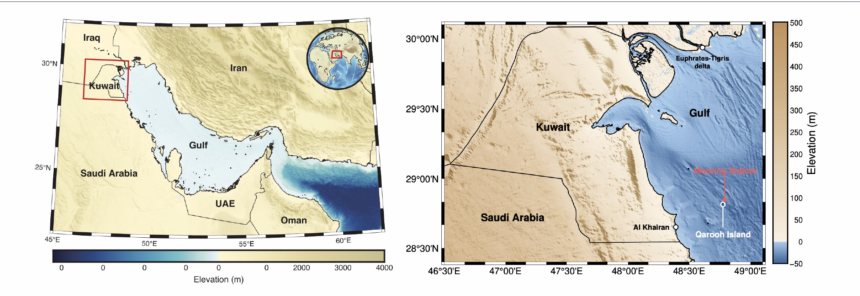
Published in Frontiers in Marine Science, the study combined field measurements collected near Kuwait’s Qarooh Island with computer simulations of water movement. It examined two strong winter Shamal events in February and March 2013 to investigate how the winds affect water-column dynamics and turbulence.
Tariq Al-Rashid, assistant professor in the Department of Marine Science at Kuwait University’s College of Science and lead author of the study, says the key finding is that Shamal winds can affect far more than conditions at the Gulf’s surface, reshaping the movement and mixing of water throughout its depth.
Cold, dry air accelerates heat loss from the sea, cooling surface waters and increasing their density. The denser water then sinks, triggering vertical mixing that, in shallow areas, can extend through the entire water column to the seabed.
During the stronger event in March, the researchers recorded wind speeds of 15.12 metres per second, or approximately 54 kilometres per hour, while relative humidity fell to 33% and sea surface temperatures dropped by around 2°C. Net heat loss from the sea surface reached approximately 511 watts per square metre.
Evaporation accounted for the largest share of this heat loss. Strong, dry winds carry water vapour away from the surface, transferring substantial amounts of heat from the sea to the atmosphere. As the upper water layer cools and becomes denser, it sinks and mixes with the water below.
Why Did Seabed Turbulence Weaken Despite Stronger Winds?
One of the study’s most striking findings was that turbulence driven by tidal currents near the seabed weakened during the strongest Shamal conditions, even though stronger winds might ordinarily be expected to increase turbulence throughout the water column.
Al-Rashid explains that the apparent contradiction reflects the interaction of two distinct mixing mechanisms: one generated near the seabed and the other driven by cooling and mixing at the surface.
Under relatively calm conditions, tidal currents move water back and forth, while friction with the seabed slows the water closest to the bottom compared with the layers above. These differences in velocity create what scientists call vertical shear, which generates persistent turbulence near the seafloor.
During strong Shamal events, however, surface cooling triggers extensive vertical mixing, making temperatures and current velocities more uniform throughout the water column. This reduces the velocity differences that previously sustained turbulence near the seabed.
Al-Rashid describes the process as the introduction of a powerful mixing mechanism from above. Although this mechanism makes the water column more uniform overall, it simultaneously weakens the conditions responsible for generating the usual turbulence near the bottom.
As a result, the sea can become more thoroughly mixed from surface to seabed even as turbulence associated specifically with tidal shear decreases in the lower layers.
The findings illustrate how different physical processes can operate simultaneously, producing effects that may appear contradictory when considered in isolation.
Why Does This Matter for Kuwait and the Arabian Gulf?
The process is particularly relevant to the Arabian Gulf because of its shallow waters. With an average depth of approximately 35 metres, the Gulf is shallow enough for changes originating at the surface to influence conditions near the seabed more readily than in deeper seas and oceans.
Al-Rashid explains that strong vertical mixing can redistribute heat, dissolved oxygen, nutrients and suspended particles throughout the water column.
It may also carry nutrients accumulated near the seabed into sunlit surface waters, where phytoplankton can use them. This could, in turn, affect marine productivity and the wider food web.
The researchers recorded changes in dissolved oxygen consistent with the combined effects of cooling, enhanced gas exchange between the sea and atmosphere, and vertical mixing. They also observed indications of changes in suspended material near the seabed.
According to Al-Rashid, understanding these processes could help researchers investigate the movement of sediments and the pollutants associated with them, with potential implications for fisheries, coastal development and desalination plants in Kuwait and other Gulf countries.
However, he stresses the need to distinguish between the physical processes demonstrated by the study and their potential wider consequences.
The researchers did not directly measure changes in fish populations, nutrient or pollutant concentrations, or desalination plant performance. Instead, they investigated the physical mechanisms that could influence these areas and provide a basis for further research.
Nor can the findings be generalised to the entire Arabian Gulf without additional evidence. The measurements were collected at a single location near Qarooh Island, while water depth, currents, salinity and coastal geography vary considerably across the region.
The study also faced limitations in its salinity measurements. Biological growth, or biofouling, on some sensors affected data quality, prompting the researchers to assume that salinity remained vertically uniform. This assumption was based on early reliable measurements and previous studies. Although considered reasonable under the observed conditions, it introduced additional uncertainty into estimates of water-column stability.
Another limitation was the use of a one-dimensional model focused on vertical water movement, which could not fully represent horizontal transport. Some model outputs were also calibrated against actual measurements, meaning that comparisons between simulations and observations did not constitute a completely independent validation.
Nevertheless, the models reproduced the overall pattern of changes, although they underestimated some brief, sharp peaks in turbulence.
Al-Rashid says future research should include additional locations and seasons and incorporate three-dimensional models to establish how widely these mechanisms operate across the Arabian Gulf. Such work could help clarify how winter Shamal events influence the region’s marine environment and improve understanding of the physical processes that underpin its coastal and marine systems.


