

A new Egyptian study suggests that waste cooking oil, often discarded as a household or restaurant waste product, could be converted into a useful fuel for diesel engines when carefully blended with conventional diesel.
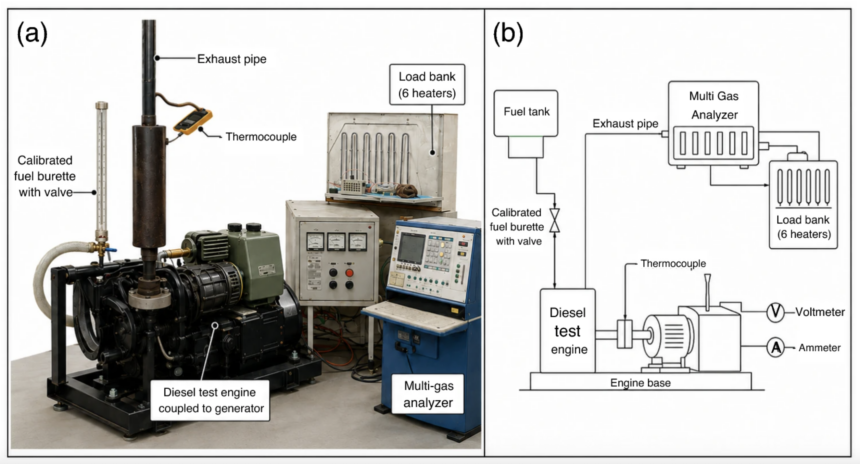
The study tested biodiesel produced from used cooking oil collected from restaurants and households in Egypt. After filtering the oil, removing moisture and converting it into biodiesel, the researchers blended it with diesel at different concentrations: 10%, 20%, 30%, 40% and 50%. They then tested the blends in an unmodified single-cylinder diesel engine connected to an electric generator, operating at a fixed speed of 1,500 rpm and under loads ranging from 1 to 5 kilowatts.
According to Islam Amer of the Mechanical Engineering Department at Suez Canal University, the study’s lead author, the value of the research lies in turning a waste-management problem into an energy opportunity. Waste cooking oil can block sewers and contaminate soil and water when disposed of improperly. Converting it into biodiesel provides a circular approach by reducing waste while producing a liquid fuel that can be used in diesel engines.
The key question was not simply whether biodiesel made from waste cooking oil could power the engine, but which blend offered the best balance between engine performance and emissions.
The answer was B20 — a blend containing 20% biodiesel and 80% diesel. Across the tested load range, conventional diesel had an average brake-specific fuel consumption of 310 grams per kilowatt-hour, while B20 recorded 320 grams. In other words, the engine consumed only slightly more fuel with B20 than with conventional diesel.
At the same time, B20 reduced several exhaust pollutants. Compared with diesel, it reduced average carbon monoxide emissions by 17.5%, unburned hydrocarbon emissions by 13% and carbon dioxide concentration by 12.2%. At full load, B20 reduced carbon monoxide by 20%, hydrocarbons by 9.1% and carbon dioxide by 10%.
These benefits came with a trade-off: nitrogen oxide emissions increased when biodiesel was added. For B20, average nitrogen oxide emissions rose by 11.5%, while exhaust-gas temperature increased by 5.8%. At full load, however, B20 limited the increase in nitrogen oxide emissions to 8.9%, substantially lower than the 22.2% increase recorded for B50.
Higher biodiesel blends, particularly B40 and B50, achieved larger reductions in carbon monoxide, hydrocarbons and carbon dioxide. However, they also resulted in greater penalties, including higher fuel consumption, lower thermal efficiency, higher exhaust-gas temperatures and increased nitrogen oxide emissions. This made them less attractive when the engine’s overall performance was considered.
B10, by contrast, preserved engine efficiency better than B20. The study found that if maintaining thermal efficiency close to that of conventional diesel is the main priority, B10 may be preferable. However, when seven criteria were given equal weight — fuel consumption, efficiency, exhaust temperature, carbon monoxide, hydrocarbons, carbon dioxide and nitrogen oxides — B20 ranked first, followed by B10.
The explanation is relatively straightforward. Biodiesel contains oxygen within its chemical structure, which can promote more complete combustion and reduce some emissions associated with incomplete combustion. However, it also has a lower heating value than diesel, meaning that more fuel is required to produce the same power output. As the biodiesel proportion increases, this fuel-consumption penalty becomes more pronounced.
The study has important limitations. The tests were conducted on a single small engine under controlled laboratory conditions, so the findings cannot automatically be applied to all diesel engines or vehicles.
The researchers also did not conduct long-duration durability tests to determine how the fuel might affect engine wear or deposits over time. They did not directly measure particulate emissions, cylinder pressure, ignition delay or heat-release behaviour. In addition, some biodiesel quality indicators, particularly total and free glycerol, exceeded selected fuel-standard limits, indicating that further purification would be required to achieve full specification compliance.


