

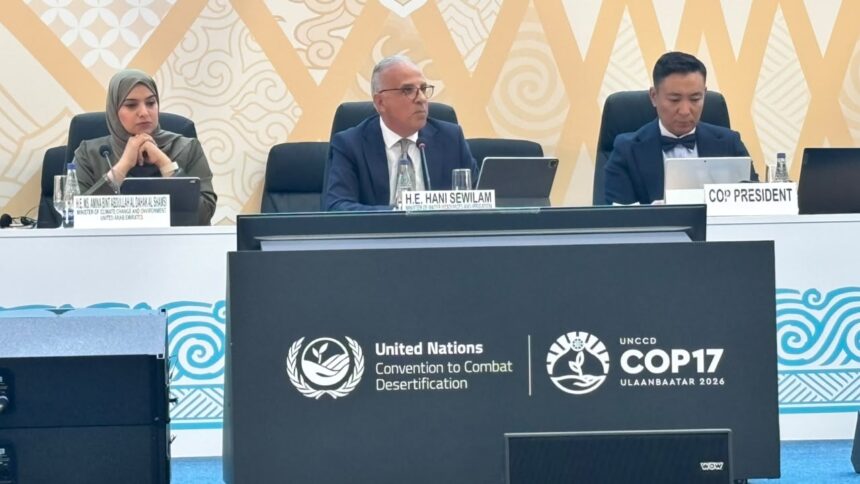
Egypt has called for a legally binding international protocol on drought, warning that land degradation, desertification and drought are no longer solely environmental challenges but direct threats to water and food security, livelihoods and socioeconomic stability.
Water Resources and Irrigation Minister Hani Sewilam made the call during the ministerial segment of the 17th Conference of the Parties to the United Nations Convention to Combat Desertification (UNCCD COP17) in Ulaanbaatar, Mongolia.
Sewilam said drought poses a particularly serious threat to countries facing acute water scarcity such as Egypt, where available water resources fall below the absolute water scarcity threshold and desert areas account for more than 95% of the country.
He called for a shift from crisis response towards prevention and preparedness, including stronger early-warning systems and integrated management of water and land resources.
Egypt is seeking tangible progress towards a legally binding drought protocol that would provide a clearer basis for collective international action and help vulnerable countries strengthen their capacity to prepare for and respond to drought, Sewilam said.
The minister also called for greater financing, clearer institutional mechanisms and innovative financial instruments to support countries and communities most affected by drought and land degradation, particularly developing and African countries.
He stressed the importance of restoring degraded land and rangelands, arguing that such investment could simultaneously strengthen food security, protect biodiversity and preserve the livelihoods of millions of people.
Sewilam also called for transboundary water resources to be governed in accordance with international law and the principles of mutual benefit and avoiding harm. He warned that unilateral measures could undermine the interests of riparian countries and exacerbate the effects of drought and desertification in shared river basins.
During a separate lecture at COP17, Sewilam presented Egypt’s efforts to modernise water management under its “Water System 2.0” framework.
The programme includes greater use of satellite imagery and drones for monitoring, rehabilitation of water infrastructure, agricultural drainage-water reuse, nature-based solutions for coastal protection and digital technologies for water management.
Sewilam highlighted the digital twin of the Ismailia Canal as an example of the country’s shift towards digitally managed water infrastructure, using data and modelling to monitor conditions, improve operations and support decision-making.
On the sidelines of COP17, Sewilam also met French Ambassador for Climate and Environment Barbara Pompili to discuss water investment and financing initiatives, capacity building and joint projects with France.
Their talks covered cooperation with the French Development Agency, including Egypt’s Fourth National Drainage Programme, a project to automate the operation of the Delta Barrages and a strategic plan to rehabilitate pumping stations.
Sewilam said innovative financing and public-private partnerships should play a greater role in turning international water commitments into implementable projects.
Egypt is due to host UNCCD COP18 in Sharm El-Sheikh in 2028, with Sewilam saying Cairo will work with international partners to build on the outcomes of the Mongolia conference.


