Media cooperation between China and Africa is no longer confined to the exchange of news and television programs, media delegations, or broadcasting experience. The 7th China Africa Media Cooperation Forum, held in Beijing in August 2026, demonstrated a broader direction encompassing technology, artificial intelligence, audio-visual archives, content production, professional training, economic development, and people to people exchange. The shift is about redefining how media can preserve historical memory, strengthen cultural ties, and contribute to future development.
At the centre is the DREAM Project, focused on restoring historical audio-visual materials within the China Africa Cooperation Initiative on Innovation in Radio, Television, and Audio-visual Content. Its importance goes beyond repairing old images or converting film reels into digital files. It raises a deeper question: who has the technological capacity to rescue Africa’s visual memory and make it accessible to future generations?
The initiative emerged from the 2024 Forum on China Africa Cooperation Summit in Beijing, where Chinese President Xi Jinping announced cooperation on innovation in radio, television, and audio-visual content and designated 2026 as the Year of China Africa People to People Exchanges. By 2025, it had begun translating these commitments into practical projects involving digitization, restoration, training, and institutional capacity building.
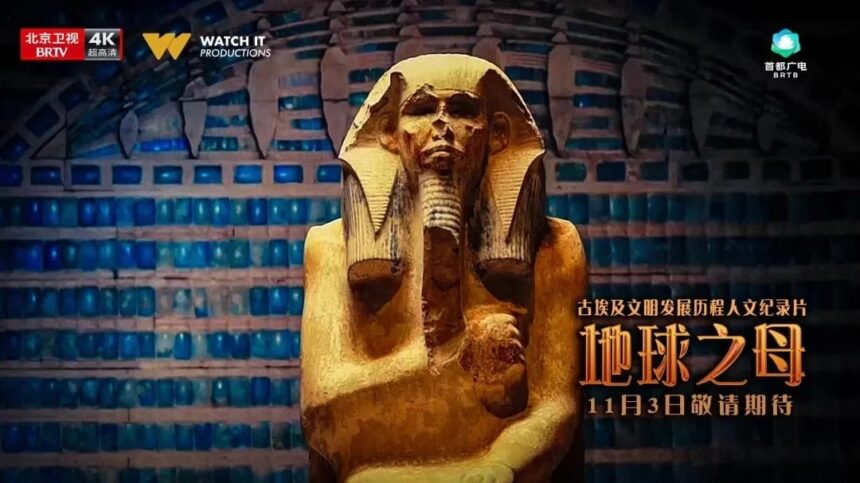
Egypt provides a clear example. In April 2025, the Academy of Broadcasting Science of China’s National Radio and Television Administration signed a memorandum of understanding with United Media Services to cooperate on restoring historical audio-visual materials in 4K. The Egyptian documentary series Mother Earth (Om El Dounia), comprising 25 episodes and 875 minutes, was selected for restoration. A sample of the restored 4K version was presented in Cairo in May 2025 during the “Audio-visual China – Beijing Love Night” event.
The significance extends beyond image quality. Mother Earth is closely connected to Egyptian history and civilization, making digital restoration a tool for protecting cultural memory. China also emphasizes capacity building through training and technical assistance.
The model has expanded beyond Egypt. In May 2026, China’s Ministry of Foreign Affairs announced the delivery to Benin of 300 minutes of digitized, restored, and enhanced historical audio-visual material, together with restoration equipment. Chinese engineers were also expected to train Beninese counterparts and work on an additional 500 minutes of video.
The 7th China Africa Media Cooperation Forum provided the context for this transformation. Held in Beijing from 19 to 21 August 2026, it brought together representatives from China and 45 African countries, with approximately 400 participants, including 33 African officials at ministerial level. The Forum was held under the theme “Sharing New Development Opportunities and Creating a New Future for Audio-visual Media.”

Its agenda extended beyond conventional journalism to content innovation, people to people exchange, technological cooperation, industrial integration, audio-visual media and economic development, and artificial intelligence. The emergence of AI as a distinct area of discussion is significant: the debate is moving from how China and Africa exchange content to how they will produce, restore, distribute, and govern content in the age of AI.
The Forum announced 80 results of China Africa cooperation in radio, television, and audio-visual media and adopted a Joint Declaration calling for stronger news cooperation, joint content production, reciprocal translation and broadcasting, youth exchanges, new formats such as short form drama, and cooperation on AI applications and governance. DREAM can therefore be understood as part of a shift from content exchange toward technological and institutional cooperation.
Yet the project raises difficult questions. Who owns the digital version after restoration? What becomes the authoritative version when historical material is damaged? How much of a reconstructed image or sound has been recovered from the original, and how much has been generated or estimated by AI? Are original materials preserved alongside enhanced versions? Who controls the metadata and intellectual property governing future access?
Restoration can affect how history is seen. As AI becomes more capable of reconstructing missing information, transparency becomes essential: original materials should be preserved, restoration processes documented, modifications disclosed, and intellectual property rights clearly defined. Most importantly, African institutions should retain authority over their national archives.
For Egypt, this presents an opportunity. If the experience with Mother Earth develops further, DREAM could support a broader program for rescuing older Egyptian and African cinematic, television, and documentary archives, alongside cooperation in digital archival science, training, rights management, and AI assisted restoration. The relationship should be reciprocal: China brings technological expertise, while Egypt and Africa bring vast archives and decades of experience in filmmaking and broadcasting.
The more mature model combines technology, expertise, and content on both sides to build a shared framework for protecting cultural memory, grounded in partnership, local ownership, and technological transparency.
The deeper significance of the 7th Forum is that China Africa media cooperation is evolving from dialogue toward integration across content, technology, training, and markets. DREAM captures this transformation by bringing archives once kept in storage into a new ecosystem of digital restoration and cultural exchange.
Restoring an old film in 4K may appear to be a modest technical exercise. In reality, it raises questions about memory, identity, ownership, AI, and cultural sovereignty. Its striking paradox is that technology associated with the future is being used to rescue the past.
Ultimately, the success of the DREAM Project should not be measured only by the number of reels restored, machines delivered, or professionals trained. The decisive question is whether Africa emerges from this cooperation with greater capacity to preserve its own memory. If the answer is yes, DREAM could become one of the most consequential forms of China Africa cooperation in the long term—not simply preserving images of the past, but helping ensure that the past remains accessible.
The next phase of China Africa media cooperation will therefore concern not only who produces and broadcasts the story, but who possesses the technology to preserve it and the capacity to transmit it to future generations. That is the real transformation: from media cooperation to cooperation on the infrastructure of memory.
Dr. Marwa El Shinawy, Academic and Writer