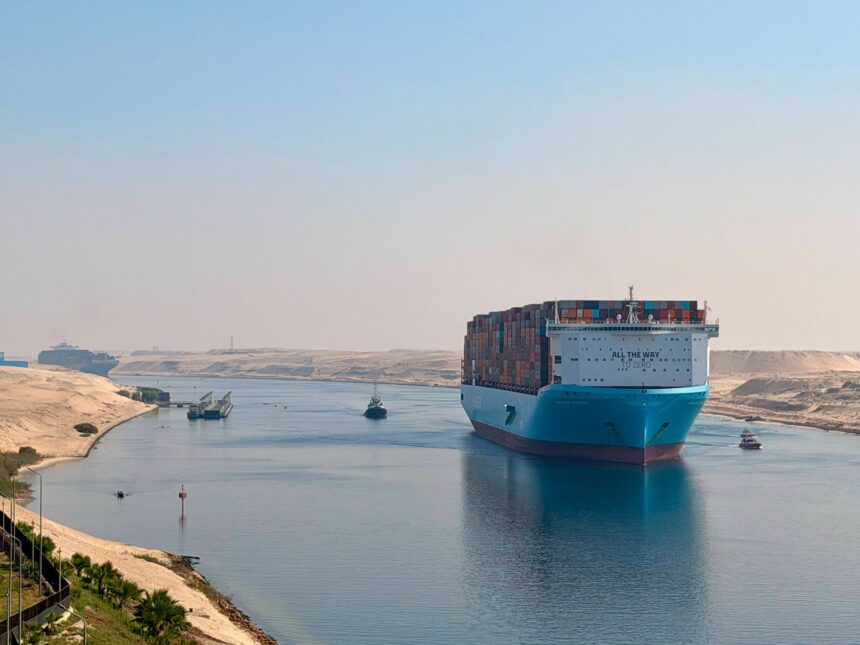
The Suez Canal has successfully restored several shipping services operating on the trade route between Europe and Asia, recording a noticeable increase in daily transit rates by Maersk container vessels, Canal Authority Chairperson Osama Rabie stated on Saturday.
Rabie’s comments coincided with the inaugural transit of the BANGKOK MAERSK, a 190,000-tonne container ship that crossed via the northbound convoy on a voyage from Italy to Singapore. The vessel operates within Maersk’s AE7 service, which directly connects major ports in Asia with North Europe and the Mediterranean.
The returning services reflect the strategic importance of the canal as a primary hub linking East and West, Rabie said. He noted the increased daily transit rates of Maersk ships were evident on Saturday, as the BANGKOK MAERSK was preceded in the northbound convoy by another company vessel, the 200,000-tonne MATHILDE MAERSK.
Measuring 350 metres in length and 56 metres in width, the BANGKOK MAERSK can carry up to 17,200 twenty-foot equivalent units (TEU). It is equipped with a dual-fuel engine capable of operating on green methanol to reduce harmful carbon emissions. Following Suez Canal Authority protocol for vessels making their first crossing, Rabie delegated Senior Chief Pilot Hesham Helmy and Chief Pilot Galal Shabaka to board the ship, welcome the crew, and present a commemorative gift to the captain.
Ship Captain Pata Radu stated that choosing to transit the Suez Canal instead of navigating around Africa saves approximately 14 days of travel time, which positively impacts time and cost while serving clients’ interests. Radu commended the authority’s efforts in developing the navigational channel, praising the New Suez Canal project for increasing efficiency and the recent southern sector development for enhancing the navigational safety of giant vessels. He also highlighted the cooperation and efficiency of the canal pilots in facilitating a safe transit.
Overall navigation traffic in the canal on Saturday saw the transit of 57 ships, carrying a total net capacity of 2.8 million tonnes.