

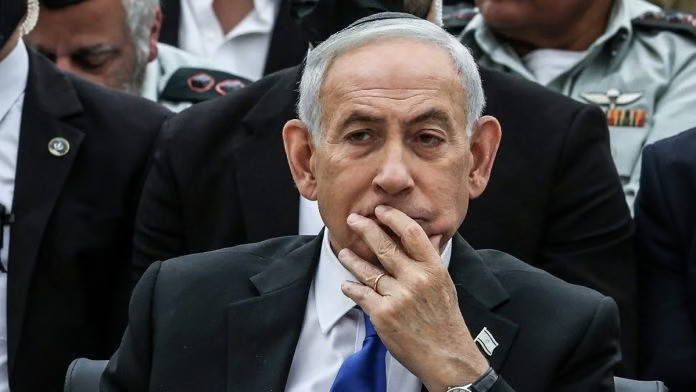
Declining political consensus in the United States regarding support for Israel is creating mounting pressure on Israeli Prime Minister Benjamin Netanyahu and raising deep concerns among Israeli officials about the long-term sustainability of the alliance.
Critics argue that Netanyahu’s intense focus on cementing ties with US President Donald Trump may have come at the expense of securing the enduring, bipartisan nature of US-Israeli relations. A joint poll conducted last month by the Washington Post and Ipsos revealed that a majority of Americans, including approximately three-quarters of Democratic voters, support reducing or ending US military assistance to Israel.
According to the Washington Post, this shifting sentiment has cast a shadow over prominent Democratic primaries this year, including in New York, Colorado, and Michigan. The trend was notably highlighted during this week’s Democratic primary for a US Senate seat in Michigan, where Abdul El-Sayed, a staunch critic of military aid to Israel, ran against Haley Stevens, who received over $30 million in financial backing from the American Israel Public Affairs Committee (AIPAC) and affiliated groups. For official election results and vote counts from this primary contest, suggest checking the Michigan Secretary of State.
While the division over Israel is less severe among Republican voters, internal splits are widening. Netanyahu, who met with Trump last month, continues to project confidence, assuring Israelis that his personal relationship with the US president remains “very good.” However, as Netanyahu prepares for general elections in Israel this October, his political opponents are seeking to recalibrate relations with Washington.
During the Herzliya security conference last month, Israeli opposition leader and former Prime Minister Yair Lapid stated that “foreign relations have never been in such a decline.” He noted that Israel’s growing isolation remains manageable because “there is a realisation around the world that Israel’s problem is not the state itself, but rather the government.” Netanyahu’s office declined to comment on the remarks.
Although US-Israeli military cooperation reached unprecedented levels during the Iran war, the June ceasefire agreement brokered by Trump with Tehran was poorly received in some Israeli circles. While Netanyahu sought to downplay disagreements over the deal, his political allies and domestic media outlets blamed the White House for perceived shortcomings in managing the conflict. The ceasefire agreement has since collapsed.
As US public opinion continues to shift, some Israeli officials are advocating for fundamental changes to the country’s reliance on Washington. “Israel must also diversify its foreign policy partnerships,” stated Israeli Ambassador Michael Oren. “There is no alternative to the United States, and we will not forge an alliance with Russia or China, but we should not remain as dependent on Washington as we are accustomed to.”
The Washington Post noted that this shift aligns with growing scepticism toward Israel among younger Americans. Jesse Weinberg, a researcher specialising in US-Middle East relations at the Institute for National Security Studies in Israel, observed that the Michigan primary “reflects a broader trend of the younger generation adopting explicitly anti-Israel positions.”
Weinberg added that for many young voters, the war on Gaza has become a defining political moment that will leave a lasting impact on their perspectives. In both the United States and Israel, many view the potential formation of a new Israeli government as a critical opportunity to repair relations with Washington.
