

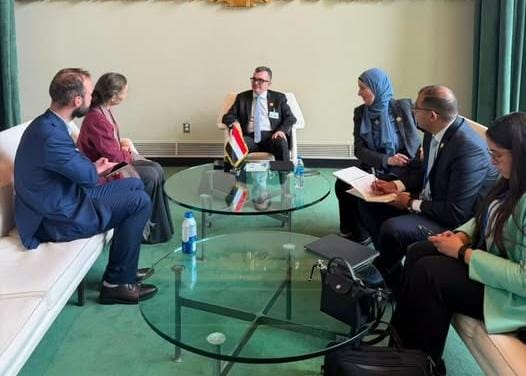
Minister of Planning and Economic Development Ahmed Rostom met with Sabina Alkire, Director of the Oxford Poverty and Human Development Initiative (OPHI), to discuss expanding cooperation on the development and measurement of multidimensional poverty indicators and adopting the latest international methodologies in the field.
The meeting took place on the sidelines of the 2026 High-level Political Forum on Sustainable Development (HLPF) at the United Nations headquarters in New York.
The Egyptian delegation included Wael El Dahshan, Counsellor at Egypt’s Permanent Mission to the United Nations; Mona Essam, Assistant Minister of Planning for Sustainable Development Affairs; and Nada Yacoub, Assistant Director of the Sustainable Development Unit.
During the meeting, Rostom expressed the Egyptian government’s appreciation for its longstanding partnership with OPHI, praising the initiative’s technical support in advancing multidimensional poverty measurement methodologies.
He also voiced the ministry’s aspiration to expand cooperation through intensive capacity-building programmes and greater exchange of international best practices to ensure the sustainability and regular updating of Egypt’s National Multidimensional Poverty Index, based on accurate national databases, including population censuses and social registries.
Rostom stressed that the Egyptian state, under the leadership of President Abdel Fattah Al-Sisi and with the close follow-up of Prime Minister Mostafa Madbouly, places improving citizens’ living standards at the centre of its development agenda by increasing investments in human development and social sectors.
He added that the presidential Decent Life initiative is one of Egypt’s most significant national development projects, citing its unprecedented coverage of rural communities through expanded access to essential public services and improvements in human development indicators.
For her part, Alkire praised Egypt’s efforts to develop its National Multidimensional Poverty Index, describing it as an important tool for measuring poverty more comprehensively and supporting the design of more effective and better-targeted development policies.
She also expressed her appreciation for the Central Agency for Public Mobilisation and Statistics (CAPMAS), commending the professionalism and expertise of Egyptian statisticians in producing high-quality indicators that support evidence-based policymaking.
Alkire further praised Egypt’s experience in implementing the Decent Life initiative, describing it as a successful international model for addressing the multiple dimensions of poverty and improving the quality of life in the country’s most disadvantaged communities.
She noted that directing policies and programmes towards populations experiencing multidimensional poverty contributes directly to improving the efficiency of public spending and maximising development impact.
Alkire also highlighted forthcoming updates to the Global Multidimensional Poverty Index, which will include subnational indicators for several countries, including Egypt.
Both sides reaffirmed their commitment to continuing cooperation to strengthen evidence-based policymaking, improve multidimensional poverty measurement and enhance the efficiency of targeting the most vulnerable groups.